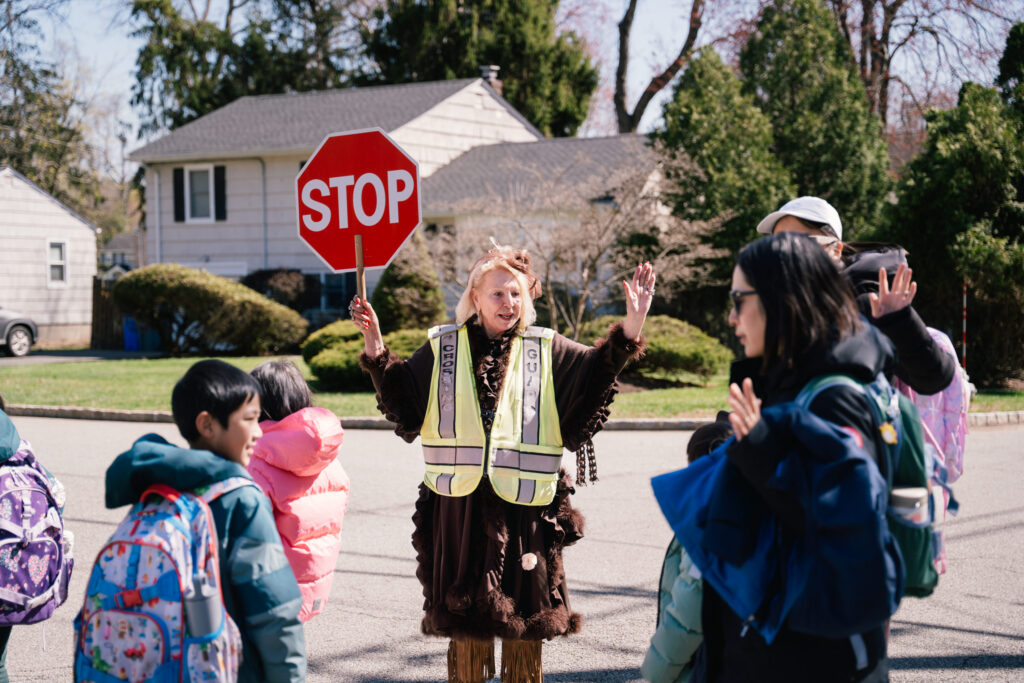
Paulette Dorflaufer loves to dress up.
Her job as a crossing guard starts at 7:15 a.m., but every morning she wakes early to assemble her elegant outfit and apply a coat of lipstick. In winter, she wears fur boots and full-length fur coats; in spring and fall, shawls or capes — all topped with a bright-yellow reflective vest. She always finishes the look with an ornamental hat, which she calls her “chapeau.”
“I’m French,” Dorflaufer told The Washington Post, explaining her glamorous style. “I always say, you never know when you’ll be invited to a party.”
Dorflaufer has been a local celebrity in Livingston, New Jersey, for decades because of her wardrobe and unfailingly sunny disposition, but recently she has started to gain wider acclaim.
Her fur coats, she said, have a deep significance from her childhood in a French orphanage. She was born to a Jewish family in Nazi-occupied France during the World War II.
“When I was adopted, the orphanage gave me a white rabbit-fur coat and a white rabbit-fur muff, and I guess I never forgot it,” Dorflaufer said.
Her recent viral fame started in late February, when New Jersey resident Oliver McAteer was driving and spotted Dorflaufer standing on a snowy street corner in a long fur coat and lilac decorative headpiece.
He took a video and posted it, writing: “Who is this New Jersey crossing guard diva??” The caption read: “Fur  Fascinator High viz Powerful Confident Fabulous We must know her story.”
The internet did its work. Tens of thousands of people watched the video in the first 24 hours, and Livingston locals identified Dorflaufer in the comments.
“Everyone knows her,” said her granddaughter Rachel Frieman, who calls Dorflaufer “Mema.” “Growing up, it was like, ‘Oh, the crossing guard, that’s my grandmother.’”
When Frieman was young, she knew bits and pieces of her grandmother’s story. But when she was old enough to type, Dorflaufer asked for her help writing it down.
Dorflaufer was born in 1943 during the Holocaust, the youngest of 10 children. As a baby she needed a minor surgery, so her mother took her to a hospital in Marseille, near where the family lived. Her parents and many of her siblings were taken to concentration camps, but in the hospital, Dorflaufer survived and ended up in an orphanage in Paris. She was adopted by an American family in New Jersey when she was 4.
“I did not know my story,” she said, adding that her new family was Jewish and wanted to adopt after their young daughter was killed when she was hit by a truck while sledding.
Dorflaufer said she had a happy childhood, and by the early 1970s was married with children of her own. She decided to look into her past and contacted the French Embassy, inquiring if any of her family was still alive. The embassy found someone who shared her original last name — Korssia — and Dorflaufer asked a French acquaintance to call the number, since she had forgotten her native language. One of her cousins answered the phone.
“She calls up, and the man couldn’t believe it,” Dorflaufer recalled. “He said, ‘Tell Paulette we’ve been looking and searching for her all these years.’”
Dorflaufer learned she had a brother and two sisters who were still alive, and she immediately planned a trip to France. Her sisters met her at the airport with their families.
With the help of her siblings, the French Embassy and the American Red Cross, Dorflaufer pieced together her family’s story. She and her siblings became close and visited each other over the years. They have since died, but she is still in touch with their children. Her grandchildren and her siblings’ grandchildren have visited each other, traveling between France and the United States.
Dorflaufer now has three children and seven grandchildren, and is expecting her first great-grandchild in August. She’s had many jobs in her life — she worked as a teacher’s aide, a fashion model, at a bank and as a cosmetician in a mall in New Jersey. She went back to school to become a dental hygienist. But 25 years ago, she was looking for part-time work and got a job as a crossing guard outside of the elementary school where her granddaughter was a student.
“What I love is meeting the children,” Dorflaufer said. “Meeting the parents, people with their dogs and their babies. It’s wonderful. I love it. And I don’t mind the cold. I call it my happy corner because I get sunshine, I get exercise, I meet people.”
Sometimes students will come back years later to visit her when they’re grown up or in college.
Frieman said her grandmother has always been a people person.
“She has this zest for life,” Frieman said. “She really is a positive light. And so I do see why people gravitate towards her, why she makes their day, because she’s just happy.”
Frieman knew her grandmother was beloved in Livingston, but when McAteer posted his video of her, she learned how many lives she’s touched.
One commenter said: “She has (without ever knowing) helped my kids ease their school drop off nerves. on the way to school, before getting to her corner, we play a game where we guess what color ensemble she will be wearing. it brings us so much joy and motivation to start the day! she is always there through every season to bring the fashion, safety and smiles to our community! THANK YOU ms. paulette for being YOU and all you do to brighten the world.”
Another said: “Every morning, as we make our way to drop the kids off at school, we pass by her. It has become such a small but meaningful part of our routine. She is like a muse — effortlessly inspiring, quietly radiant.”
As much joy as Dorflaufer has brought others, she said she’s gotten it back many times over. In fact, looking back on her life, she said after her harrowing beginning, she’s found much to be thankful for.
“I’m happy. I met my family, they came here, they met my mom,” Dorflaufer said. “It’s a wonderful ending that I got to meet them.”
The post ‘Crossing guard diva’ with remarkable past is a social media star in her 80s appeared first on Washington Post.