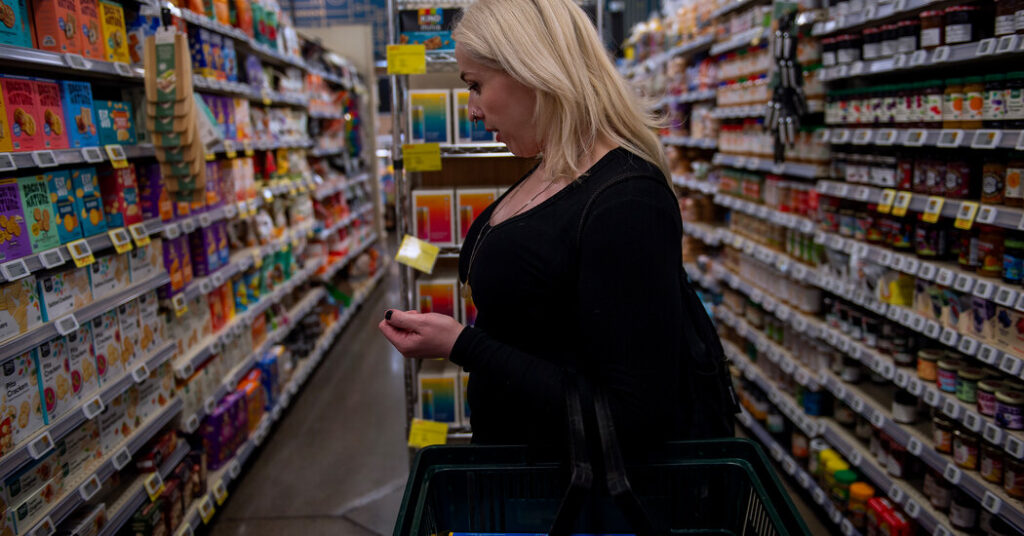
Angie Howard lives in a walkable neighborhood in Portland, Ore., and works from home, so she has not had to shell out for higher gas prices since the war in the Middle East began. Still, Ms. Howard, who lives alone, said she had noticed costs jumping all around her anyway.
“You go into the grocery store, you buy the things you normally would, and then all of a sudden it’s $20 or $30 more there, and you start to see additional fuel charges,” she said. “And at the end of the week, where you would normally have two nickels to rub together, now they’re not there.”
Ms. Howard has lived comfortably enough on her salary working in client services for a legal technology company that manages class action claims, she said. But over the past month, she has been paying more attention to sales, eating more at home rather than going out and thinking twice about buying a ticket to Hawaii that costs more than twice what it did when she last went in 2021.
“That’s going to be the first thing that goes,” Ms. Howard said.
Decisions by people like Ms. Howard will have an enormous bearing on the health of the U.S. economy in the coming year, as oil prices are expected to stay high even after the White House’s tenuous truce with Iran and as markets remain volatile.
The enduring strength of consumer spending, which powers two-thirds of America’s economic output, has been the main reason that the United States has evaded a recession through successive drubbings over five years: roaring inflation, a rapid run-up in interest rates and a barrage of tariffs.
But the war in the Middle East may prove one blow too many for even those hardy American consumers, who have also seen their balance sheets eroded by slowing wage increases, rising costs and a pullback in government safety net benefits. The personal savings rate is the lowest it has been since 2008, outside pandemic-era swings.
“It wouldn’t take much for real disposable income to turn negative and for this to result in a recessionary outcome,” said Joe Seydl, a markets economist at J.P. Morgan Private Bank.
There are two main channels through which that drag would act on the economy. One is the higher energy prices that act as a tax on consumers, giving them less to spend on other priorities, like Ms. Howard’s trip to Hawaii.
The other is what economists call “wealth effects,” or the free-spending mentality among higher-income earners fostered by the ballooning value of investment portfolios and retirement accounts in recent years. If that kicks into reverse, the pullback could be drastic.
“They used to teach that the stock market is not the economy,” Mr. Seydl said. “But I actually think we’ve evolved into a more wealth-driven economy, because the feedback mechanism through stock wealth, to consumer spending, to overall G.D.P. growth is much stronger today than it was decades ago.”
The United States has grown less dependent on oil since the energy crises of the 1970s, both because the industrial mix has shifted from energy-intensive manufacturing to services and because cars and appliances have gotten more efficient. However, people can still be very exposed to high gas prices, and those with low incomes have the least cushion to absorb them.
Take Dakota Wylde, who lost his job as a contractor last year in sweeping federal layoffs at the National Renewable Energy Laboratory in a Denver suburb. He then went to graduate school for urban planning but had not managed to find a job other than a work study and has been living on modest savings. The jump in gas prices makes it harder to save on other expenses, like groceries. Even a trip to Costco in the 2013 Toyota RAV4 that Mr. Wylde shares with his wife costs a few dollars more.
“Do the savings at Costco justify the price of driving out there?” Mr. Wylde wonders. “Or should I pay more at one of the grocery stores within walking distance?”
If he can’t find work and prices keep increasing, Mr. Wylde may take out a student loan to live on. He has already jettisoned most nonessential spending, like streaming subscriptions, and there aren’t many other places to cut back.
“When we get to that point, we have to start thinking about the hard stuff,” Mr. Wylde said. “Like do we need to have a third meal a day?”
So far, those kinds of difficult choices have not been obvious in economic data. Retail sales for February, the latest available, continued their upward trend. Higher-frequency credit card transactions from Bank of America show that while gasoline spending jumped 20 percent from a year ago, other categories did not sag noticeably.
That resilience has a few sources. Consumers have benefited from tax refunds that are larger than normal because of legislation passed last year. And those with investment accounts are still riding high; the S&P 500 is up 24 percent over the past year even after the first-quarter slump. In a long-running survey of consumer sentiment by the University of Michigan, people with the most wealth in stocks have remained relatively chipper, while those with little or no investments have soured on the state of the economy.
Shruti Mishra, a U.S. economist at Bank of America, has two thresholds in mind. One is $120 for a barrel of oil, and the other is a 20 percent drop in major stock indexes. Both would need to be sustained for weeks or months to meaningfully dent consumer spending, she said.
“The fact that you had the stimulus coming in, the fact that consumer spending was higher income led, which is more insulated from an oil price shock, I think all of that is keeping you afloat right now,” Ms. Mishra said.
Besides, stock markets are not the only wealth generator that has risen in recent years. Home prices have escalated more than 50 percent nationwide over the past five years. For people who refinanced into rock-bottom interest rates, sitting on valuable assets with modest monthly costs conveys a feeling of financial security that supports extra spending.
Tim Wolf is the type of consumer keeping the American economy buoyant. He has worked as a courier in downtown Minneapolis for 23 years and drives 50 miles, round trip, to and from his job every day, but with a Toyota Prius, the extra gas costs have been minimal.
Also helpful: His townhouse in the suburbs has appreciated to $370,000 from $260,000 when he bought it in 2017. Even a hit to his 401(k) — which sank to $560,000 from about $640,000 over the past few months — hasn’t derailed his plans to travel around the world with his fiancée when he retires in a few years.
“I guess I’ll be OK as long as it doesn’t drop to zero,” Mr. Wolf said. “It’s just a matter of enjoying life when we get the opportunity. Hopefully we’ll be in a situation where we can do that and not have to worry about world events.”
That kind of attitude is why most economists have only slightly marked down their projections for growth this year. At the giant asset manager Vanguard, for example, economists expect gross domestic product to grow 2.3 percent in 2026, down from 2.5 percent before the war.
Still, the war isn’t over, and another step up in energy prices could introduce a third risk for consumers if companies call off expansions or let go workers in large numbers, pushing the unemployment rate upward.
“I think we’re not quite at that point, and we haven’t been seeing any evidence of that really materially happening,” said Josh Hirt, an economist at Vanguard’s investment strategy group. “But that would be the one to really think about if things were to escalate again from here.”
Lydia DePillis reports on the American economy for The Times. She has been a journalist since 2009, and can be reached at [email protected].
The post Consumer Spending, Engine of the U.S. Economy, Is Under Strain appeared first on New York Times.