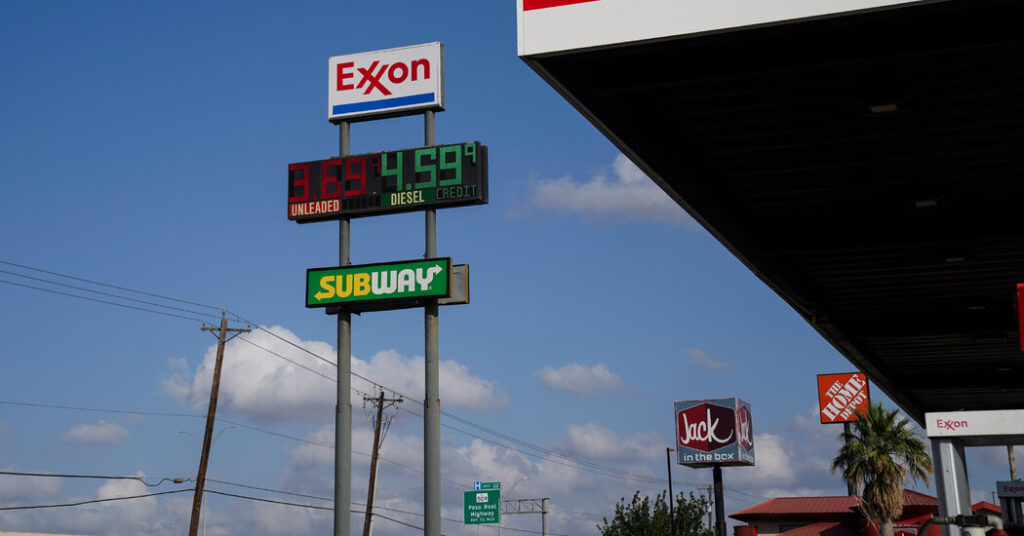
The price of regular gasoline in the United States jumped 25 percent between February and March, the highest monthly percentage increase on record, according to data from the Energy Information Administration. The surge highlighted how quickly the U.S.-Israeli war with Iran, now in its sixth week, has echoed through daily life across the world.
The average cost of a gallon of regular gasoline was $3.64 in March, up from $2.91 in February. That percentage increase was higher than when prices topped $5 a gallon after Russia invaded Ukraine in 2022, and was the biggest monthly percentage increase since the E.I.A. began tracking the data in 1990.
“We forecast retail gasoline prices to peak at a monthly average of close to $4.30 per gallon” in April, the administration said this week in an outlook note. It also forecast an average cost of $3.70 for the year.
Gasoline prices follow the cost of crude oil, which has risen nearly 50 percent since the start of the war. But there is usually at least a slight delay before what people are paying at the pump noticeably rises. Now, unlike during the Ukraine war, there is a more tangible threat to oil supplies.
After a fragile cease-fire agreement between the United States and Iran this week, it’s unclear how easily ships will be able to pass through the Strait of Hormuz, a vital passageway south of Iran through which 20 percent of the world’s oil supply travels.
“What we’re seeing today is unusual,” said Phillip Braun, a finance professor at Northwestern University. “The degree of risk that oil companies perceive today is much higher than from before.”
And higher gasoline costs could be chipping away at American wallets alongside more pronounced economic headwinds.
Sustained higher oil and gas prices bring a greater risk of inflation. What also separates the conflict in the Middle East from the oil shocks of the 1970s, after which the United States went into recessions, has to do with the actions of the Federal Reserve, Mr. Braun said.
“Today, the Fed is being much more conservative — it’s not accommodating what the oil prices are doing,” Mr. Braun said. “They’re keeping interest rates up. That means there might be a bigger negative impact that we see today in the economy than we did in the 1970s.”
Emmett Lindner is a business reporter for The Times.
The post A Record Jump in U.S. Gasoline Prices Is Squeezing Consumers appeared first on New York Times.