Fertility in the United States has been declining since the Great Recession, and reached a new low last year, according to federal data released Thursday, causing some to fear a baby bust.
But it’s not clear that will happen. Instead, there could be a lull, demographers say — a period of very low fertility that could eventually rebound.
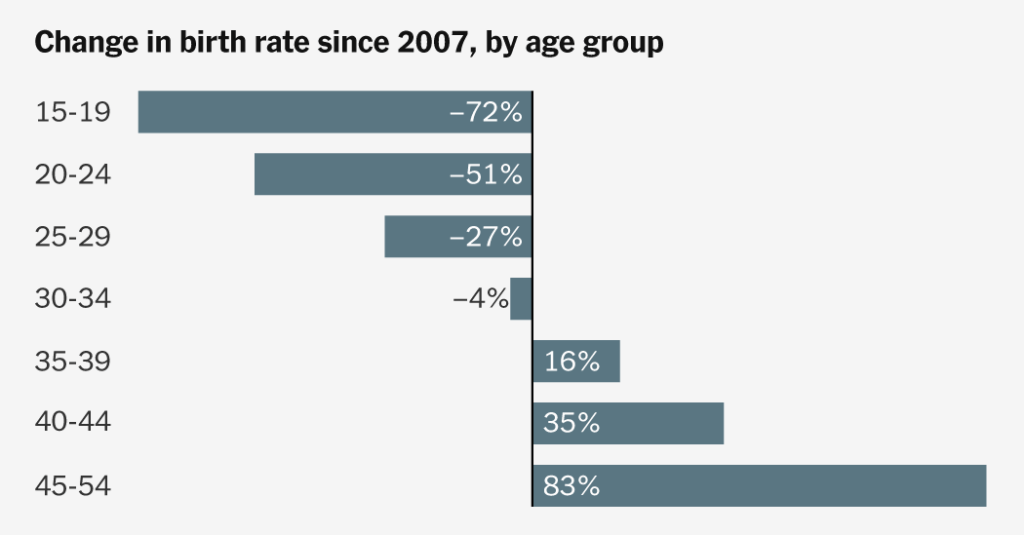
That’s because of a drastic shift among American women who are now of childbearing age: They are waiting longer to have babies. They’ve become much less likely to have them in their teens or 20s — and much more likely to in their 30s or 40s.
Demographers have a name for this kind of lull in fertility: a “postponement transition.” It happened in the 1990s in Europe, then rebounded somewhat as the younger women who delayed pregnancy eventually had children. It also happened in the United States in the 1970s, as more women pursued college and careers after the women’s movement. These women didn’t end up having fewer children; they just had them later.
“It’s totally real that births are declining,” said Philip Cohen, a sociology professor at the University of Maryland. “It’s just not completely clear how much that will turn into overall population decline in the long run. The total number will come back up if people who are now 25 just wait until they’re 40.”
At first, mostly college-educated women living in cities were delaying childbirth. More recently, though, it’s become true across demographic groups.
For women with high school degrees or less in their 20s, the birthrate has declined 36 percent since 2007 — and for those with a high school education or less who are 35 and older, it has increased 58 percent, found Martha Bailey, an economist at the University of California, Los Angeles.
In 2024, the most recent year for which there is this data, 49 percent of women who were 30 had given birth to at least one child. By comparison, 63 percent of women who were 30 just a decade ago had had a child, and 69 percent of those who were 30 two decades ago, according to an analysis of federal data by Professor Cohen.
Yet today’s 45-year-olds, who are nearing the end of their childbearing years, are more likely to be mothers than women who were that age two decades ago. As of 2024, 88 percent of 45-year-old women were mothers, up from 84 percent in 2004.
It wasn’t a surprise that fertility began falling in the Great Recession of 2007-9, because that’s common during financial crises. But demographers didn’t necessarily expect it to keep going. Since 2007, the number of births per 1,000 women ages 15 to 44 has declined 24 percent.
In some ways, the delay in pregnancy is a sign of women’s autonomy. They’re investing more time in their educations and careers. There are more accessible fertility treatments. Unintended pregnancies have fallen, as women have easier access to reliable and affordable birth control.
It’s also an indicator of anxiety about the future and finances.
Young people are increasingly waiting to have children until they feel established in adulthood — with steady careers, a long-term partner and a house. As family life has become less affordable and the economy more uncertain, those milestones have become harder to achieve. Birthrates are falling more for unmarried women and those with less education and lower incomes.
Postponing pregnancy, Professor Cohen said, “is good when it reflects a greater degree of security, stability, but not if they’re lonely or because America has made it so hard.”
One of the biggest drivers of the delay in childbearing is widely considered to be a success story: the decline of teen pregnancy, which had been unusually high in the United States. It reached its recent peak in 1991, at 61.8 births per 1,000 girls and women ages 15 to 19, before rapidly declining to 11.7 per 1,000 in 2025. The change is attributed to more effective contraception, education about pregnancy prevention and less sex among teenagers.
Since the Great Recession, teenage pregnancy has fallen 72 percent, accounting for nearly a third of recent fertility declines, according to an analysis by Alison Gemmill, an associate professor of epidemiology at the University of California, Los Angeles.
In Southern states, where teen pregnancy was highest, the drop accounts for even more of the recent declines, she found: more than half in Kentucky, and nearly 50 percent in Alabama, Louisiana and Mississippi.
The question is whether the young women who aren’t having children now will eventually have them.
If they follow the pattern of today’s 45-year-olds, the vast majority of them will. And surveys indicate that most of them want to.
Still, demographers say it’s unlikely that fertility will fully catch up to the level of earlier decades.
Women who plan to have children at older ages may not be able to, or may have fewer children than they planned, because it becomes harder to get pregnant. Even though most of today’s 45-year-old women are mothers, the number of babies they’ve had on average has fallen slightly.
Especially among women with less education, some may never feel economically stable enough to have children, said Karen Benjamin Guzzo, a professor of sociology at the University of North Carolina at Chapel Hill.
“I worry we get to a point where there are the fertility haves and have-nots,” she said.
Claire Cain Miller is a Times reporter covering gender, families and education.
The post Women in Their 20s May Not Be Having Babies, but by 45 Most Probably Will appeared first on New York Times.