Lebanon said on Thursday, a day after an intense wave of Israeli airstrikes, that more than 200 people had been killed in the bombardment. The attacks, targeting the Iran-backed militia Hezbollah, put heavy pressure on the fragile U.S.-Israeli truce with Tehran.
The strikes on Wednesday added to a grim death toll in Lebanon, where more than 1,500 people have been killed and more than a million displaced since the war against Iran began, according to the Lebanese authorities.
At least two civilians have been killed in Israel by Hezbollah attacks, and about 10 Israeli soldiers have died, according to Israeli officials.
Why is Israel bombing Lebanon?
Shortly after Israel and the United States began the war with Iran on Feb. 28, Hezbollah, in solidarity with Tehran, fired rockets across Lebanon’s southern border into Israel. That prompted the current offensive against Hezbollah, with which Israel has clashed for decades.
Since then, Israel has invaded much of southern Lebanon and signaled that it plans to occupy the area. For weeks, Israeli officials have publicly rebuffed overtures from Lebanon’s government to hold direct talks about a cease-fire.
On Wednesday, Israel claimed that Hezbollah, whose longtime stronghold is on the southern outskirts of Beirut, had repositioned to other parts of the city. That raised the possibility of more strikes in areas that Israel has not yet targeted.
Is Lebanon part of the cease-fire or not?
That is a point of contention.
Prime Minister Shehbaz Sharif of Pakistan, whose country brokered the truce with Iran, said that the agreement covered the fighting in Lebanon. Iran’s foreign minister, Abbas Araghchi, agrees. But Israel’s prime minister, Benjamin Netanyahu, says otherwise.
“I insisted that the temporary cease-fire with Iran not include Hezbollah, and we continue to pound it forcefully,” Mr. Netanyahu said in a television address on Wednesday.
Karoline Leavitt, the White House press secretary, also said that Lebanon was not part of the deal.
Britain and France have condemned Israel’s intensifying strikes and said that Lebanon should be included in the truce. Failing to do so “will destabilize the whole region,” said Yvette Cooper, the British foreign secretary. She described Israel’s attacks as “deeply damaging.”
Jean-Noël Barrot, the French foreign minister, told France Inter radio, “Iran must stop terrorizing Israel through Hezbollah.” But he added that Lebanon should not be the “scapegoat” of an Israeli government that is “frustrated because a cease-fire has been reached between the United States and Iran.”
Vast numbers of Lebanese people remain displaced, unsure whether they can return home.
What happened on Wednesday?
Lebanon’s health minister said the death toll from the strikes had risen to 203, with more than 1,000 others wounded. That made it the deadliest day for the country since the war began.
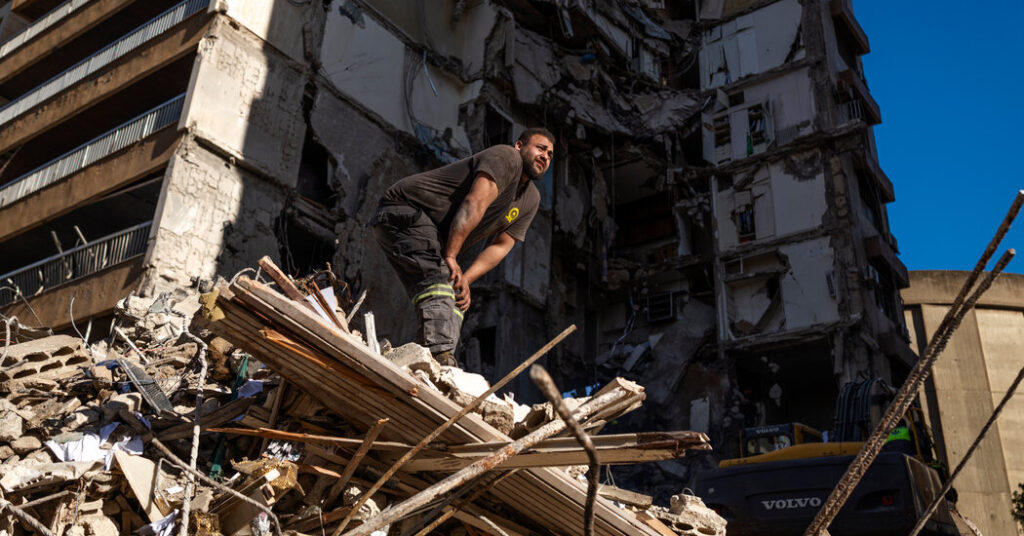
Israeli forces said they carried out more than 100 airstrikes in just 10 minutes. Sirens whirred across Beirut, and thick smoke rose over the city’s skyline. Apartment buildings were reduced to rubble, and rescue teams clambered to reach people trapped in the ruins.
The Israeli military said it had killed the personal secretary to Hezbollah’s leader, Naim Qassem. The secretary, Ali Yusuf Harshi, “played a central role in managing and securing” Mr. Qassem’s office, the military said.
How have Iran and Hezbollah responded?
Hezbollah condemned the strikes, saying that it had a “natural and legal right to resist the occupation and respond to its aggression.” On Thursday morning, it fired more rockets toward Israel.
The Islamic Revolutionary Guards Corps of Iran, in a statement carried by Iranian state media, threatened military retaliation if Israel’s attacks on Lebanon were not “immediately halted.”
Aurelien Breeden, Christina Goldbaum, Euan Ward, Hwaida Saad and Stephen Castle contributed reporting.
Lynsey Chutel is a Times reporter based in London who covers breaking news in Africa, the Middle East and Europe.
The post What to Know About Israel’s Strikes on Lebanon appeared first on New York Times.