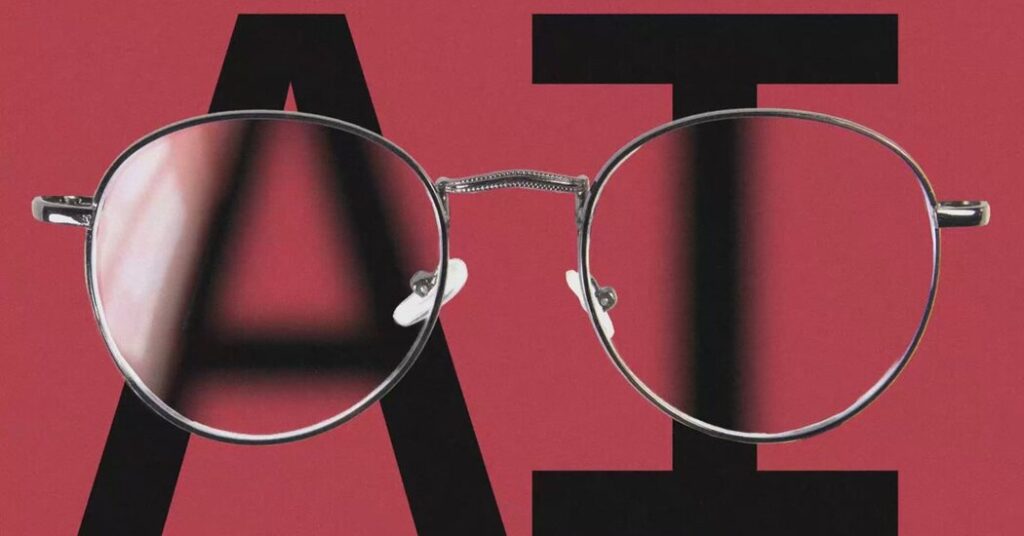
I never thought A.I. would get me thinking of D.E.I.
I’ve reached a depressing turning point as a college professor. With A.I. now entrenched in academic life, when a student submits a wonderful essay, I will never again be sure that it was purely a work of the student’s initiative, intelligence and talent.
Some essays will be. But there will be no way to really tell. Technology could allow me to determine only what was likely. And would an essay count as original if the student used A.I. to begin the paper but then built upon those prompts?
Let’s face it: From now on we will have to revise our sense of what is original and authentic. There is no way to adjudicate where to draw the line, and few professors will be up for submitting every essay they receive to this kind of evaluation.
It’s a drag. And there is something else gloomy about A.I. making it unnecessary to write an essay from the ground up. A.I. will put more people under the sort of suspicion that D.E.I. does.
A.I. will put artistic and intellectual achievement under a cloud of doubt, a sense that the creator did not do it all on their own, and possibly could not have. And this is the burden that D.E.I. policies often saddle its intended beneficiaries with.
Call it diversity, equity and inclusion or affirmative action or racial preferences, it is rooted in a quest to give people an opportunity to compete more easily against straight white people, especially men.
Adjusting standards for admission or hiring in view of a group’s past handicap is a unique moral advance.
But it should be applied for as limited a time as possible because of the side effects. Under a policy that allows certain people to be judged even partly on who they are rather than what they bring to the table, people of color are often suspected of being “D.E.I. hires,” brought on with lesser qualifications than their white equivalent would be permitted to have.
Sometimes, the charge is false. From what I see, and from what people with law degrees whose opinions I trust tell me, the Supreme Court justice Ketanji Brown Jackson is clearly qualified for her position.
But the interviews Karine Jean-Pierre gave during her book tour last year gave credence to the idea that when President Joe Biden made her White House press secretary her race, gender and sexual orientation were more important criteria than her ability to convey policy, positions and ideas clearly.
The arts, academia, the media and political appointments are rife with equivalents to both Jackson and Jean-Pierre. D.E.I.’s good intentions come with the cost of a kind of benevolent overstep, which will inevitably leave onlookers skeptical of Black competence in general, as a mere five minutes on X can illustrate. Black college students often complain that their white and Asian peers assume they were admitted on the basis of affirmative action.
And despite the Trumpian quest to eliminate D.E.I., my guess is that its basic imperatives, to even the playing field for people who aren’t white or male, are too ingrained in blue America’s DNA to fall completely by the wayside.
Being an accomplished Black person often means that knowing how good you are is something generated internally. (Yes, even for me.) And now, because of A.I., the gimlet eye that under D.E.I. has been applied to people who aren’t straight white guys will now expand its gaze to vastly more people and accomplishments. That’s depressing.
We are in a new world. A.I., for all the miracles it offers, will leave us wondering whether we should grade much of what people create on a curve. So much will seem potentially less impressive. Amazement and wonder will be a little further out of reach than before.
First world problem? Probably. But it’s still a downer.
And — one thing that would give me a boost is if someone could inform me how to obtain a can of a certain flavor of the sparkling water brand Bubly. My daughters and I have collected cans of every flavor since Bubly’s debut and have them placed in a charming display. However, one flavor, merry berry bublé, was apparently released only in Canada (and only as a limited edition around Christmas of 2021). Does anyone out there know how we could complete our Bubly collection with a can of merry berry bublé?
The post What A.I. and D.E.I. Have in Common appeared first on New York Times.