The Venezuelan National Assembly on Thursday approved a new law meant to modernize the country’s decrepit mining industry and lure private companies to excavate Venezuela’s untapped riches of gold and critical minerals.
The sweeping changes, in a Socialist-led country that had long exerted state control over its mines, are the latest example of the Venezuelan government’s compliance with the Trump administration since the United States captured the country’s leader, Nicolás Maduro, in January.
The Venezuelan Legislature, controlled by Mr. Maduro’s ruling Socialist Party, passed the new law one month after the U.S. interior minister, Doug Burgum, brought dozens of American mining executives to meet with the country’s acting president, Delcy Rodríguez. Both officials vowed to open Venezuela’s coveted deposits to American investment.
The proposal passed by a unanimous vote. The measure next goes to Ms. Rodríguez for final approval.
Venezuela sits on a mineral fortune that remains largely untapped. The country is believed to have one of the largest gold reserves in the world. It is also thought to hold a wealth of rare earths and vast reserves of bauxite, iron, coal, copper, nickel and coltan, a black ore used in the manufacturing of such items as smartphones and satellites.
Venezuelan and American officials welcomed the new legislation, saying it would help diversify the economy’s reliance on oil and improve conditions for foreign companies to invest. It is similar to a law passed in late January to overhaul the oil sector.
Ms. Ródriguez told about 50 investors who visited the capital, Caracas, last month that the new oil and mining laws were meant to ensure investors “had guarantees, had judicial security, had political security, stability and tranquillity so your investments could grow widely.”
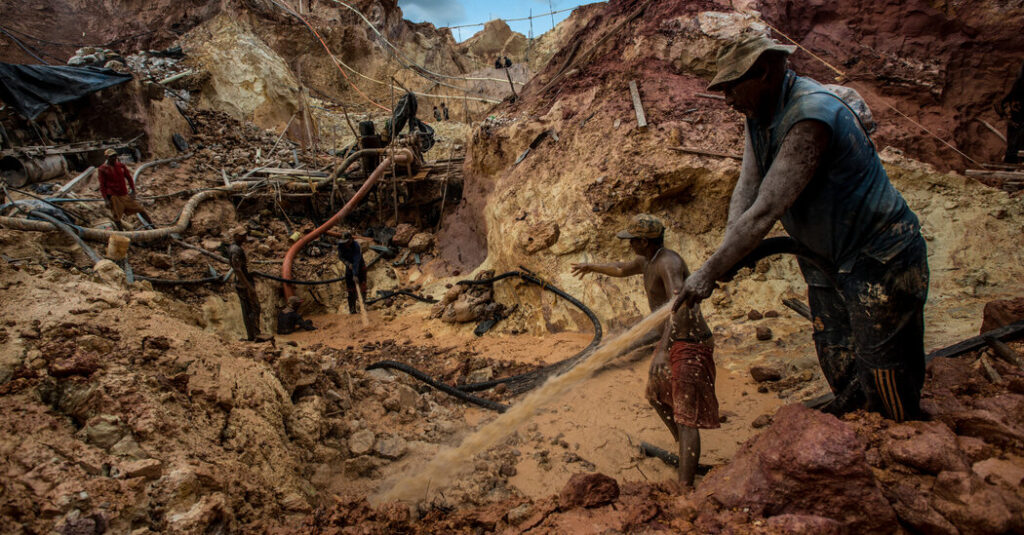
But the ambitions to attract investors are bound to clash with the perilous reality in Venezuela’s mining regions. Entrenched gangs, guerrilla groups and corrupt military officials control many mining operations. The stranglehold is often maintained with the forced labor of Indigenous people and kickbacks to Venezuelan officials, according to experts.
Illegal mining flourished under Mr. Maduro in the southeastern state of Bolívar and in large areas of the Amazon rainforest, where mining is prohibited but has boomed illegally, leading to deforestation and contamination. Most of Venezuela’s deposits are in an expansive jungle territory known as the Orinoco Mining Arc, an area larger than Cuba, making it hard to police.
So far, Venezuelan officials have not detailed how they plan to secure mineral-rich regions where armed groups — most notably the National Liberation Army, Colombia’s largest remaining guerrilla group — effectively act as a shadow government.
“Caracas is not the de facto authority in these mining regions,” said Bram Ebus, a consultant who has spent years researching illegal mining in Venezuela for Amazon Underworld, an investigative journalism project. “So they can write up a nice mining legislation, but when you go to these mining districts, there’s other armed authorities you need to deal with.”
Despite the challenges, the new law is meant to formalize Venezuela’s mining industry, which some market researchers project could generate at least $8 billion in annual revenue by 2036.
For one, the law appears intended to provide companies that obtain mining licenses, which can last up to 30 years, with remedies and safeguards against the Venezuelan government’s unilateral seizure of their assets.
Mining conglomerates are still scarred from a wave of nationalizations under Venezuela’s former Socialist president, Hugo Chávez, who took control of the country’s gold industry in 2011. Mr. Chavez expropriated the assets of American and Canadian companies operating in Venezuelan gold mines, leading to continuing legal fights over billions of dollars that the companies say they are owed.
The new law will allow investors to resolve contract disputes with the Venezuelan government through mediation and arbitration, rather than solely through Venezuela’s courts. But some experts cautioned that the language around arbitration was vague, leaving it unclear if disputes could be settled in international venues.
The law will also create four new oversight entities, including a specialized unit within Venezuela’s National Guard to police mining areas.
The statute overturns previous mining laws that banned such arbitration, required all gold sales to be made to Venezuela’s central bank rather than directly to international markets, and required private companies to partner with state entities.
Mónica Martíz, the leader of Venezuela’s largest civil organization of mining engineers, said that mining engineers were dismayed that Venezuelan lawmakers had crafted the legislation without their input.
She also expressed some concerns about the law, such as the requirement that some private companies partnering with the state give the Venezuelan government a majority stake in the venture. But she said that, overall the law was a step in the right direction toward rescuing Venezuela’s mining sector from collapse.
“The mining industry is ready to follow the law,” she said. “We want good mining, responsible mining, mining with all the best technological mining practices.”
A group of 15 nonprofit organizations in Venezuela warned that the law presented “a grave threat” for the environment and could exacerbate continuing deforestation in Venezuela and lead to the continued human rights abuses of Indigenous mining workers.
The Venezuelan government is still poised to retain some control over its deposits.
The country will be allowed to claim control over certain minerals that it deems “strategic” for national defense or the economy. It also gives Venezuela’s national bank a preferential right to buy gold produced in the country and still allows state-owned enterprises to mine minerals.
In 2019, during Mr. Trump’s first term, the United States imposed sanctions on Venezuela’s mining industry, which the Treasury Department described as a “lucrative financial scheme” used by Mr. Maduro to enrich himself and bypass U.S. oil sanctions. The United States froze the assets of Venezuela’s state-owned mining company, known as Minerven, and barred U.S. banks and citizens from engaging financially with the company.
But on March 6, after Mr. Burgum’s visit to Venezuela, the Treasury Department issued a license to allow U.S. entities to engage with Minerven, as the United States seeks to grow its control over Venezuela’s natural resources. Mr. Trump has made obtaining access to minerals a major plank of his foreign policy.
Experts said that the mining companies most likely to first invest in Venezuela may be those that had a presence in the country before they were kicked out.
Gold Reserve, a gold mining company listed on the Canadian stock exchange, has been embroiled in an 18-year legal fight with Venezuela after Mr. Chavez in 2008 revoked its permits to mine large gold and copper deposits and took control of the company’s mining project without compensation.
The company applauded Mr. Maduro’s capture in a news release in January. Gold Reserve’s executives also accompanied Mr. Burgum during his visit last month and welcomed the new mining changes, with the company saying last month that it had submitted its input on the law as it was drafted.
The company did not respond to a request for comment about its plans in Venezuela.
“The United States can’t force mining companies to go to Venezuela, it has to convince them, persuade them, create the capacity and support system,” said Diego Area, the president and chief executive officer of Global Americans, a nonpartisan think tank focused on U.S.-Latin America relations.
Mr. Area, who is Venezuelan, said putting the law in place would be “complex” but he struck an optimistic chord, saying it was “chaos finally beginning to have order.”
Isayen Herrera contributed reporting from Venezuela.
Luis Ferré-Sadurní is a reporter for The Times based in Bogotá, Colombia
The post Venezuela Approves New Law to Open Mining to Foreign Investors appeared first on New York Times.