The ousted president of the Universities of Wisconsin, one of the Midwest’s largest public higher education systems, has waged a “misleading” campaign about the circumstances surrounding his firing this week, the board’s top regent told lawmakers on Thursday.
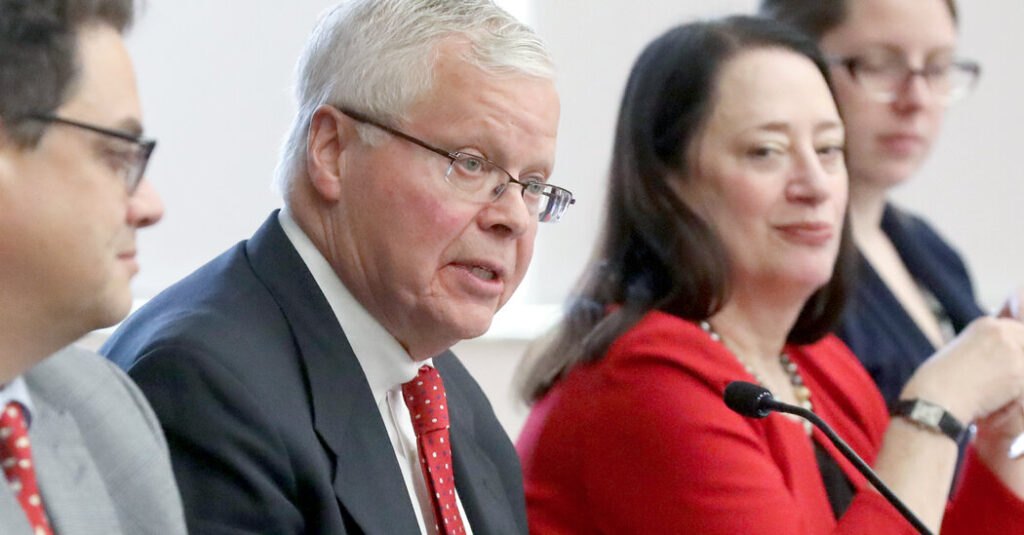
The former president, Jay O. Rothman, had repeatedly accused the Board of Regents of failing to explain why it wanted him to leave his post, which he had held since 2022. But in testimony before a State Senate committee on Thursday, the board’s president, Amy B. Bogost, said Mr. Rothman had weaponized well-established limits on what regents could say.
“President Rothman knows exactly what he is doing: He is a sophisticated professional who understands that personnel matters are confidential,” Ms. Bogost said, adding that Mr. Rothman had “chosen to use our constraint as a shield.”
Although Ms. Bogost acknowledged that Mr. Rothman had done some aspects of his job well, she said that regents had “substantial” reason to seek his exit after his performance review. After Mr. Rothman rebuffed proposals for his resignation by the end of the year, the board voted on Tuesday evening to fire him.
“That decision was not made lightly. It was not political. It was not retaliatory,” said Ms. Bogost, who noted that “boards of regents do not reach 17-to-0 decisions on a whim.”
Ms. Bogost indicated she would be willing to say more if Mr. Rothman waived his confidentiality rights.
Mr. Rothman, a former chairman of the Foley & Lardner law firm, did not respond to requests for comment on Thursday. He told The Associated Press on Wednesday that he had been “blindsided” by the effort to dismiss him, but signaled that he was unlikely to bring a lawsuit challenging his firing.
Mr. Rothman was considered an at-will employee of the Wisconsin system, which includes 13 universities and has more than 164,000 students.
Senior Republicans in Wisconsin have sharply questioned whether the board, which is controlled by appointees of Gov. Tony Evers, a Democrat, had partisan motives for removing Mr. Rothman.
State Senator Rob Hutton, a Republican, adopted a more conciliatory tone on Thursday but defended Mr. Rothman, saying that while the university system “desperately needs to be more ambitious and reform-minded, President Rothman worked to move the system forward.”
“Removing him with no explanation sends a troubling signal to taxpayers, students and employers and even donors about where the institution is heading,” Mr. Hutton added.
But one regent, Timothy F. Nixon, suggested to the committee that he had found Mr. Rothman unable to pursue change quickly in an era of seismic shifts in higher education.
“It is his nature to be very deliberate,” Mr. Nixon said during the hearing, which lasted more than two hours. “We don’t have time to be very deliberate in the year 2026.”
Mr. Nixon, paraphrasing Abraham Lincoln, also cast doubt on Mr. Rothman’s contention that he had not known about the board’s misgivings, saying his claim had “all of the substance of the shadow of a starving pigeon.”
Ms. Bogost said Mr. Rothman had threatened to resign “many times” during his tenure, which overlapped with a time of divided state government in Wisconsin.
Mr. Rothman and Republican lawmakers struck a deal in 2023 that cleared the way for pay raises and other spending in exchange for a freeze on diversity, equity and inclusion positions. The agreement frustrated some regents, as well as Democrats like Mr. Evers.
Mr. Rothman had also come under criticism from some faculty members for new general education requirements, which were prompted by a state law, and for the closures of branch campuses.
Mr. Evers has distanced himself from the board’s decision, which some Republicans have suggested should imperil the pending nominations of 10 regents, including Ms. Bogost and Mr. Nixon.
Mr. Evers said in a statement on Thursday that it was up to the regents to decide the university system’s president, and he warned Republicans against moving to block their confirmations.
“Republican lawmakers should resist their temptation to turn this into a political conversation, because it isn’t one,” Mr. Evers said. “The U.W. Board of Regents is not supposed to be an extension of any politician or political party.”
The acrimony is unspooling as regents prepare for a leadership transition at the system’s flagship university, in Madison. Chancellor Jennifer L. Mnookin is scheduled to leave at the end of the academic year to become Columbia University’s president.
Alan Blinder is a national correspondent for The Times, covering education.
The post Top Regent Defends Firing of Wisconsin University Leader appeared first on New York Times.