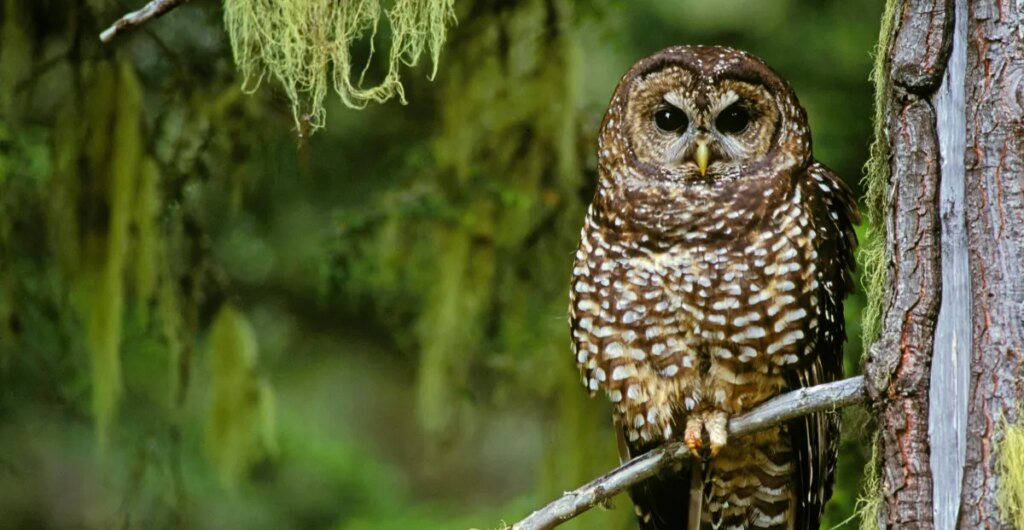
The value of forest ecosystems is hard to overstate. Blanketing roughly a third of the US, they supply clean water and air, absorb planet-warming carbon dioxide, and provide homes for imperiled wildlife and a tranquil place for Americans to hunt and fish.
It’s for this reason that environmental advocates widely opposed a plan announced by the Trump administration last spring. In an early March executive action, he ordered his administration to ramp up logging in our public forests, including those managed by the US Forest Service and the Bureau of Land Management. Failing to “fully exploit” forests for timber, Trump said, weakens our economic security, degrades fish and wildlife habitat, and sets the stage for wildfire disasters.
A month later, Secretary of Agriculture Brooke Rollins, who also oversees the US Forest Service (USFS), declared an unexpected emergency across more than half of the agency’s forests, citing the risk of wildfire, disease, and other threats. The emergency declaration allows USFS to log those lands with far fewer restrictions.
These moves drew unsurprising reactions from environmental groups.
“The Trump administration is brazenly sacrificing our forests and the species that depend on them,” Robert Dewey, former VP of government relations at Defenders of Wildlife, a nonprofit conservation group, said last spring after the Trump announcement. “There is no legitimate reason or emergency to justify rubberstamping logging projects.”
Defenders of Wildlife and other organizations called the emergency declaration a gift to the timber industry.
It is indeed hard to see a good intention for our nation’s forests through Trump’s track record. At face value, his administration’s logging push seems like multiple environmental disasters waiting to happen.
Yet there are two important points these concerns tend to overlook, starting out with this: Logging isn’t always the environmental boogeyman it’s made out to be.
Logging is often less harmful than you think
Logging is one of those things that seems universally and irrefutably awful for the environment. It brings to mind nightmarish images of giant machinery flattening pristine forests filled with helpless critters, à la movies like FernGully and Avatar. And in some parts of the world — and historically in the US — those images are not far off the mark.
But the reality today is more complicated.
The first thing to know is that many of our public forests are already not in a truly “natural” state. Decades of misguided fire suppression and a period of widespread logging in the wake of World War II produced forests today that are dense with trees of similar age, which makes them prone to intense wildfires and attacks from pests.
While it may sound counterintuitive, selective logging or thinning — i.e., removing some but not all of the trees — can actually make these forests healthier. In thinned-out forests, trees face less competition for water and sunlight, boosting their tolerance to drought and beetles, and fires aren’t as destructive, according to Mark Ashton, a professor of silviculture and forest ecology at Yale University. No one in this country knows this better than Indigenous Americans. Tribes were practicing thinning thousands of years ago using controlled burns, which prevent the buildup of fuel.
Absent a history of industrial logging and fire suppression, forests can thin themselves out on their own; when one tree grows big, for example, its canopy can shade out and kill those around it.
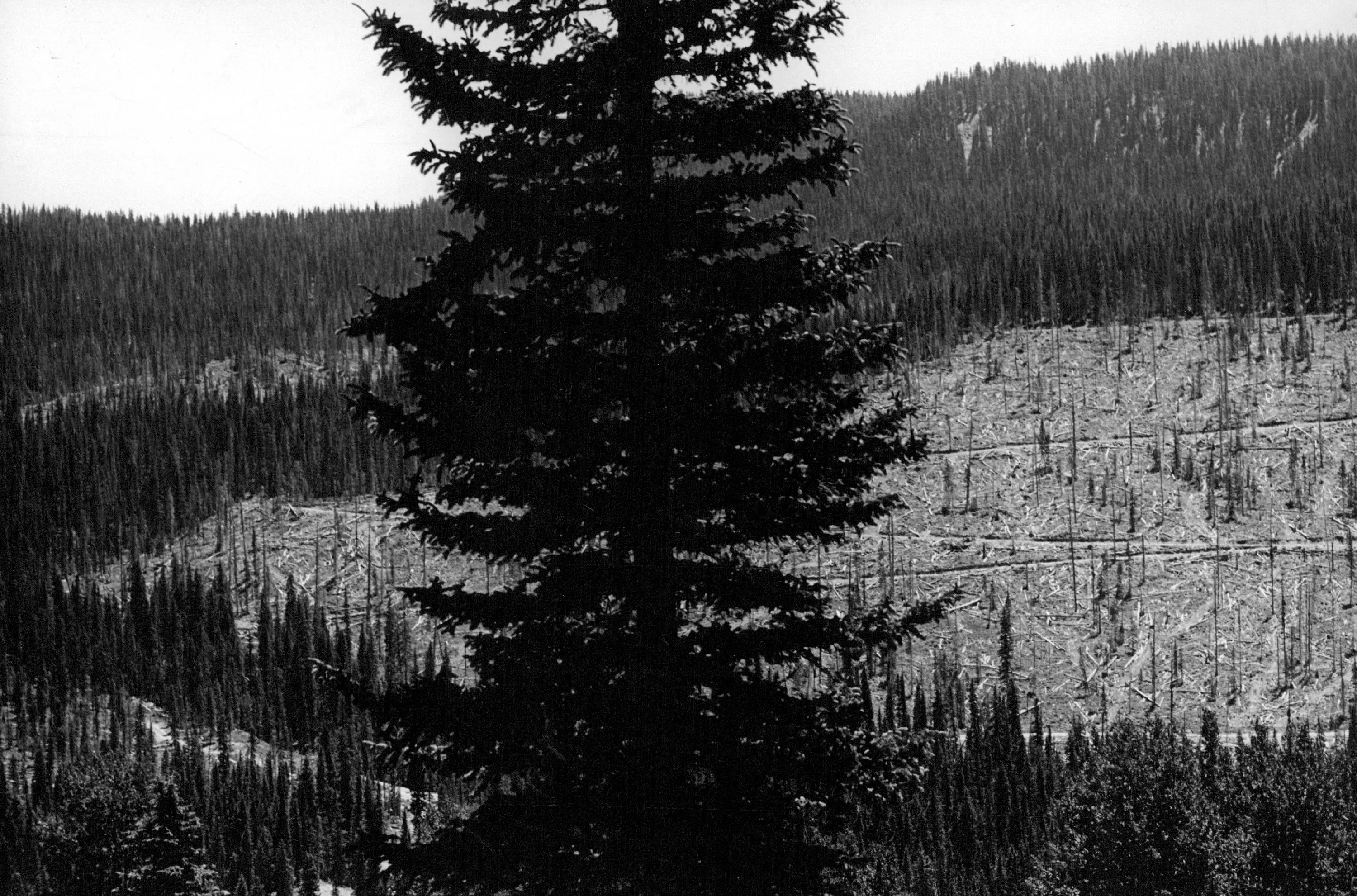
This raises another important point: Logging, and sometimes even clear-cutting, can mimic natural disturbances that shape forest ecosystems. Many Western forests, such as those dominated by lodgepole pine, evolved with fires that wipe out large tracts of trees. The cones of some of those trees only release seeds during a fire. In the right ecosystem, clear-cutting — followed by burning — can mimic this process, while also producing usable timber.
“It’s gotten a bad rap, but, I mean, basically you’re emulating a natural process,” Todd Morgan, a forest industry researcher at the University of Montana, said of strategic clear-cuts.
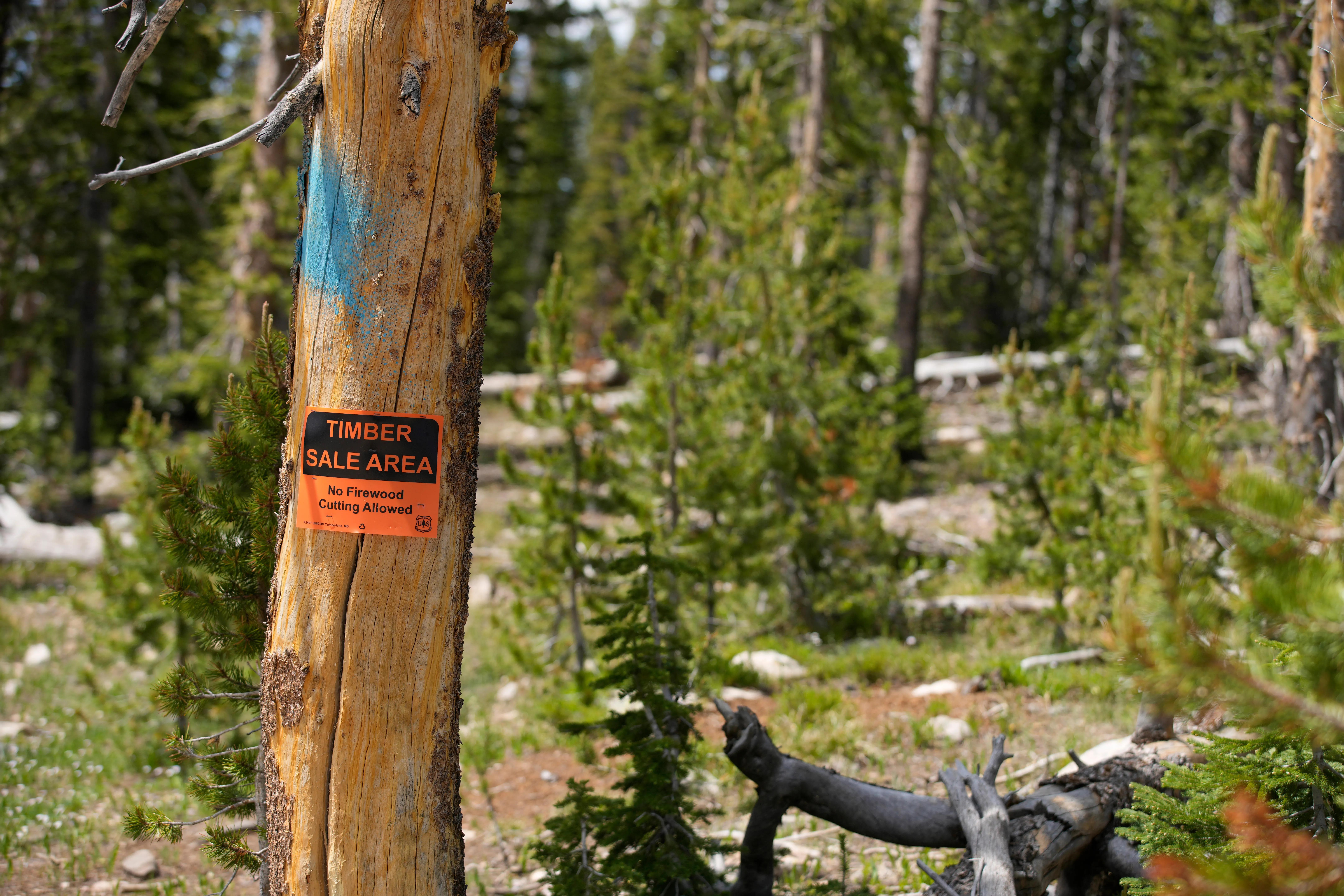
A sign indicates a timber sale area in the Uinta-Wasatch-Cache National Forest outside Kamas, Utah.
|
George Frey/Bloomberg via Getty Images
Of course, slashing trees in one area doesn’t mean a fire won’t just burn them in another. And as fossil fuels heat up the planet and rainfall patterns change, loads of forests are going up in smoke with or without logging. In the age of climate change, clear-cutting is only adding to the existing loss of wildlife habitat — amid an extinction crisis.
Still, logging, when done thoughtfully, isn’t always an environmental disaster. This is to say nothing of the valuable product it also produces: timber. Wood is a renewable material, unlike some of the alternative construction materials, like plastic, most of which still comes from oil and gas. Turning trees into lumber also keeps the planet-warming carbon they store locked up for longer than if they were burned.
The economic reality behind Trump’s timber push
Regardless of potential impacts of logging, Trump’s plan to expand timber production on public lands may run into challenges anyway. And the main reasons for that are not as much environmental as they are economic.
A big one is the lack of logging infrastructure near public forests. After World War II — when home-building was booming — the US intensively logged its national forests, the bulk of which are in the American West. Toward the end of the century, however, environmental regulations and a conservation ethic took hold, shifting most logging onto private lands that have fewer environmental protections.
That’s still the reality today: Around 90 percent of all timber currently comes from private forests, including tree plantations, which are concentrated in the southeastern US. As a result, there simply aren’t a lot of operational sawmills near public forests anymore, said Brent Sohngen, an environmental economist at Ohio State University. Many of those forests, meanwhile, are remote and hard to access. “There’s just not going to be an easy route for getting those logs out of the woods into a mill at a cheap price,” Sohngen said.
Yes, companies could always build new mills in anticipation of more logging, but such projects are expensive and only tenable if it’s clear that public lands will remain open to substantial exploitation for years to come. That’s in no way guaranteed, Sohngen said. Policies change from one administration to the next, not to mention from one month to the next in the Trump administration.
“I don’t think there’s enough certainty that [demand] will be there long-term that you will see an increase in infrastructure,” said Chris Wade, a research economist at RTI International, a research organization.
Another obstacle is environmental regulation — laws like the Endangered Species Act and the National Environmental Policy Act that pushed the industry into private lands in the first place. “Whenever someone proposes a timber harvest [in public lands], it’s going to get litigated,” Sohngen says. It’s for similar reasons that opening up Alaska wilderness and ocean to oil drilling has drawn few takers.
But perhaps the largest impediment to logging public lands is due, in part, to knock-on effects from Trump administration actions themselves — and that is that there’s simply not much demand for timber right now.
One reason is that the US housing market is stagnant due to high interest rates, and that market is a key driver of lumber demand. (Those high rates are, in turn, linked to inflation, which is expected to increase more due to the Trump administration’s war on Iran and its upward pressure on oil prices.) Some countries like China are also importing fewer logs from the US, due in part to retaliatory tariffs, further chilling demand, Wade said.
What’s also worth noting is that, should timber demand rise again, private forests can easily ramp up production, Sohngen said. Logging in federal lands, meanwhile, will likely have to be subsidized by taxpayers. In other words, there seems to be little economic incentive or payoff to actually cut more trees on public lands.
The very, very big caveat
Even with these obstacles in place, public lands will likely see a bump in timber harvesting under Trump. Again, there’s a way to log that wood responsibly, but doing so requires smart, experienced people, extensive planning, and resources — things the Trump administration has been clear-cutting with impunity.
Last year, the US Forest Service lost at least 5,800 of its some 35,000 employees (as of late 2024). That includes more than 20 percent of its scientists with PhDs, according to an analysis by Science News. Late last month, meanwhile, the Trump administration announced sweeping changes at the agency — among them, moving its headquarters from Washington, DC, to Utah and closing 57 of its 77 research facilities.
Share your feedback
Do you have a story tip or feedback on our reporting? Reach out to [email protected].
“Here’s my worry: Where are all the foresters in the forest service?” Ashton told me last fall, before the recent reorganization. “The whole institution has been gutted. That’s ominous. If you want to manage these forests sustainably, you have to have the knowledge and technical professionalism to do it right.”
Trying to manage forests without staff and research facilities is like “trying to fly a plane without a pilot,” said Martin Dovciak, a forest ecologist at the State University of New York.
At the same time, the administration is also trying to rescind what’s known as the Roadless Rule, which protects vast stretches of wilderness and old-growth forests from logging — those that haven’t been logged in the recent past and often don’t need active management. “It would be really crazy to do timber harvesting there,” Sohngen said. “There would be places there that [logging] would be disastrous for the environment.” And it’s not clear that logging old-growth trees even makes economic sense, foresters told me.
What’s more is that the Trump administration has been attempting to skirt safeguards that ensure logging on public lands minimizes environmental harm. The administration may once again, for example, convene the so-called God Squad — a panel with the power to overrule the federal Endangered Species Act — to sidestep protections for the nation’s most threatened species, should they interfere with logging plans (as it recently did to avoid protections for very endangered whales that happen to share territory with oil extraction in the Gulf of Mexico). “I think it’s on the table,” Wade, of RTI International, said of calling on the God Squad to avoid protections for species in peril.
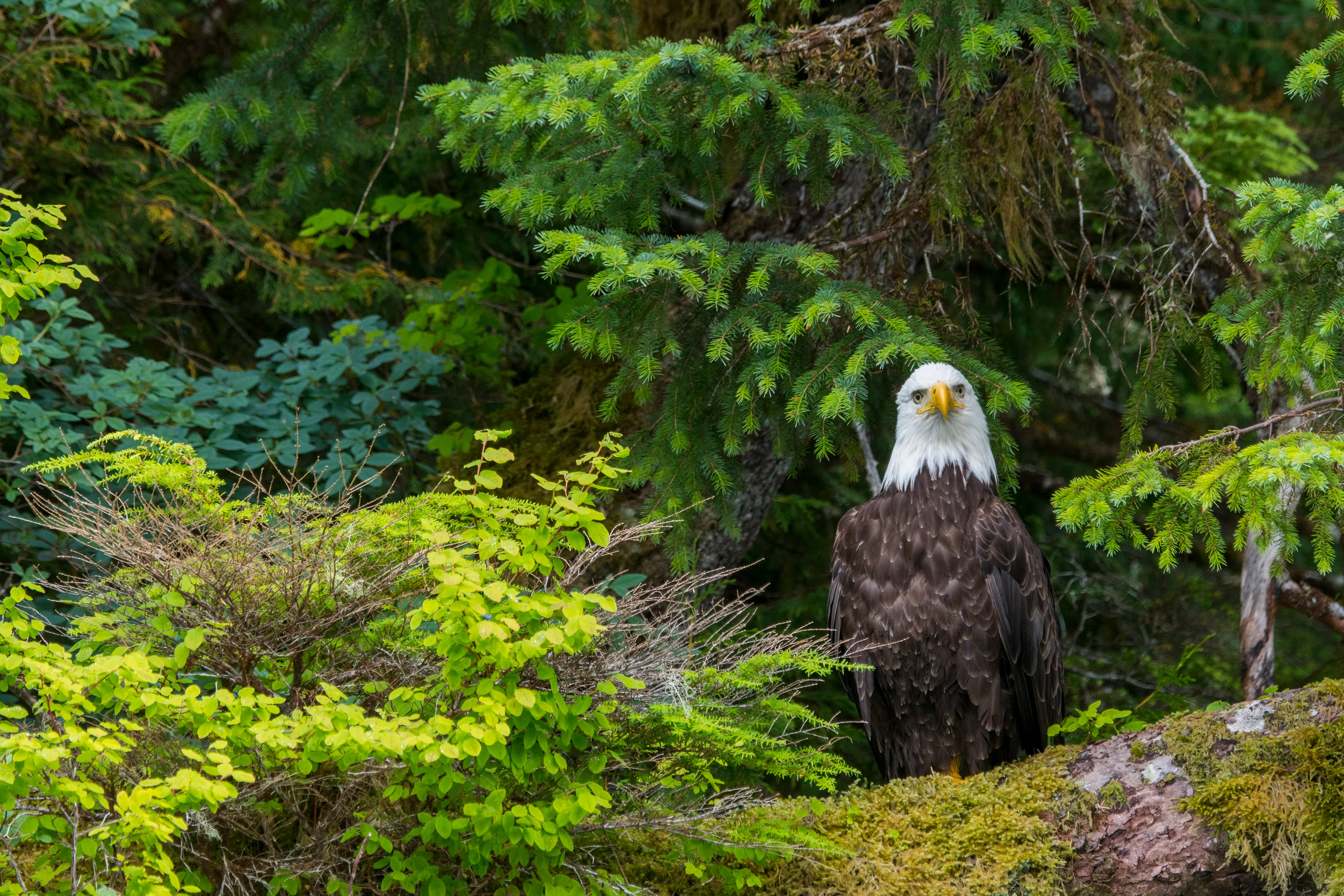
A bald eagle perches on a tree in Alaska’s Tongass National Forest, which covers one of the last remaining stretches of temperate rainforest in the world.
|
Wolfgang Kaehler/LightRocket via Getty Images
In response to an email detailing our reporting, a spokesperson for the Forest Service reiterated that active forest management (which includes logging) helps reduce the growing threats of wildfire, insects, disease, and drought. The agency did not address claims that Trump administration policies, and the loss of expertise, would make it hard to manage forests sustainably and in a way that is economically feasible.
A spokesperson for the Interior Department, which oversees the Bureau of Land Management, similarly told Vox that wildfires and other disturbances have razed vast amounts of forest in the West. “Under President Trump’s leadership, the Department of the Interior is committed to providing opportunities for the timber industry to boost supply chain stability and support local economies, clear dead and dying timber, protect lives and property, and defend communities from the devastation of wildfire,” the spokesperson said.
The White House deferred to the Interior Department when asked for comment.
This is all to say: While logging can be conducted to minimize harm and even benefit forest ecosystems, the Trump administration has shown no sign of making the environment a priority, experts told me.
“I do not doubt that there are still going to be good people left in the agency who are going to try to do the best they can under the circumstances,” Dovciak said. “But the circumstances are getting worse. I really worry about that.”
The post The surprising truth about logging appeared first on Vox.