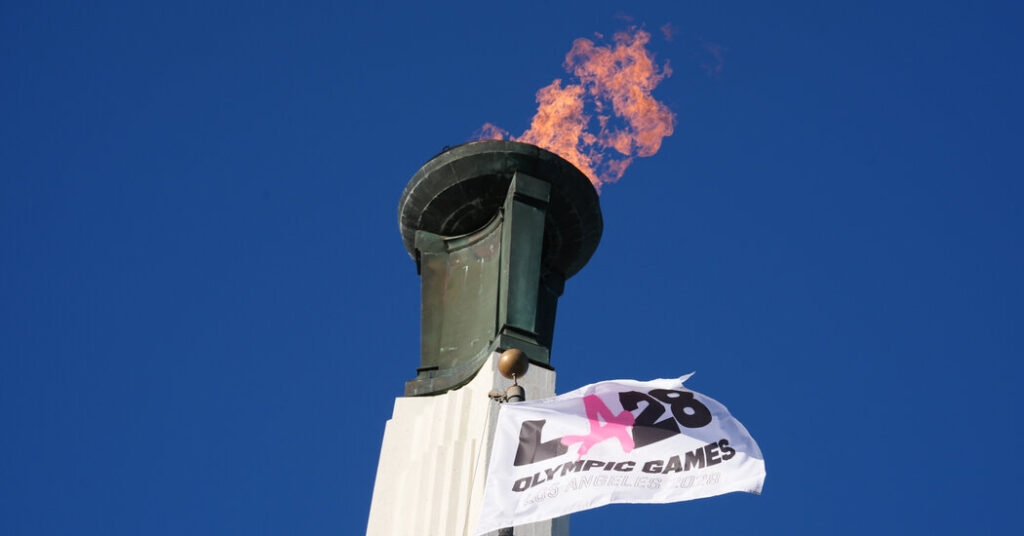
The 2028 Olympics are still more than two years away. But residents of Southern California, where nearly all of the events will take place, say organizers have already introduced them to a new sport: snagging tickets.
They have spent hours meticulously preparing for their big moment. They have felt the thrill of surprise victory. (Tickets to wrestling quarterfinals for $28? Score!) They have ridden the highs of effective teamwork. (“Should we all buy tickets to the mixed swimming preliminaries so we can car-pool to Inglewood?”)
And they have been stung by disappointment upon finding that many of their most coveted events were far out of their price range. Some fans reported seeing tickets for the opening ceremony for over $5,000.
“I was a psycho about it,” Michelle Hillier said, with a laugh.
The ticket sale provided a first glimpse of an American Olympics in an era when getting into popular sports and entertainment events means enduring an expensive gantlet rife with bots and hidden fees. Many who qualified for the locals’ presale said they hoped that the Olympics would be a refreshing change. Residents of certain counties in California and Oklahoma, which will host canoe slalom and softball, were eligible after winning a lottery.
Ms. Hillier, a content creator who lives on the west side of Los Angeles, said she felt lucky to have a buying window on the first day possible, April 2. Seeing the 100-meter dash had been her husband’s “lifelong dream.”
When her purchase window arrived, Ms. Hillier, 46, hunkered down with a pen, paper and her computer. She had researched the event codes for the tickets she preferred; each person could buy up to 12 tickets to any Olympic event, plus an additional 12 tickets to soccer matches.
But she and her husband couldn’t justify the several hundred dollars per ticket they would have had to spend to get into the storied Los Angeles Memorial Coliseum for the 100 final. So they settled for $100 tickets to sit in a nosebleed section for a preliminary round.
Although Los Angeles Olympic organizers emphasized that a million tickets would be available for $28, sticker shock seemed to be the dominant emotion for prospective buyers over the holiday weekend, as those who had won the lottery contemplated whether and how much of their allotment to buy.
“I was not mentally prepared to spend $2,000,” said Nicholas Liddell, 31, who lives in West Hollywood.
Ultimately, he spent closer to $1,700 on 12 tickets.
Mr. Liddell, who works in strategy at Disney, bought four tickets each to mixed-gender events: a tennis doubles quarterfinal, for $75 each, plus an $18 service fee per ticket; a swimming final, for $150 each, with a $36 per-ticket fee; and a track final, for $120 each, with a $29 per-ticket fee.
After attending the Milan-Cortina Winter Games this year, he felt that the Olympics were special enough to warrant some spending. Still, Mr. Liddell said he wished that 2028 organizers had been more transparent about the availability of cheaper tickets, especially for locals.
Los Angeles Olympic officials said that only a portion of tickets were released for the presale, in part because they were able to open it only to a portion of the five million people worldwide who had registered for the ticket lottery in January. They also said that they currently didn’t know exactly how many tickets would be available at each venue.
Organizers emphasized that they were balancing a range of sometimes competing priorities. The lottery system was meant to prioritize fairness and access, but they also have to make money from ticket sales.
Organizers announced on Thursday that the 2028 Games had “significantly exceeded” the first week of sales of any previous Olympics and that, for the first time, all of those tickets had gone to locals. They did not release more specific sales data.
While some of the tickets had eye-popping price tags, organizers said that in Los Angeles, one of the world’s biggest and richest sports markets, they could have charged more.
“I think at a high level, our goal was to ensure that there was something for everyone,” said Allison Katz-Mayfield, a senior vice president overseeing ticketing with the organizing committee. “There’s no research that would indicate that we should price any tickets at $28.”
She noted that 75 percent of the tickets available were priced at less than $400, and that almost half were priced at less than $200. Official resale platforms will roll out next year, although organizers would not say whether there would be rules limiting how much people could make by reselling. Organizers announced on Thursday that global ticket sales were officially open.
The 2028 Games have big financial hurdles to clear. Organizers have said that they have to at least break even, or taxpayers will have to cover budget shortfalls.
The Games are expected to cost $7.1 billion for everything from bus drivers to volunteer meals. Organizers have said they expect to cover about $2.5 billion of that with sponsorships, and hundreds of millions of dollars from other sources. But about $2.5 billion is budgeted to come from ticket and hospitality sales.
In 1984, the last time the city hosted the Olympics, they generated roughly $233 million in operating profit — about $731 million in today’s dollars, said Shirin Mollah, an economist who studies sports at Loyola Marymount University in Los Angeles.
“That’s always something we go back to, because it was one of the rare modern Olympics to turn a significant operating profit,” she said.
The city still bears reminders of that success: Public parks and pools have staff uniforms and signs that celebrate the contributions of the LA84 Foundation. The Paris Olympics in 2024 also made money.
As an Angeleno herself, Ms. Mollah said, she was excited to use the locals’ ticket presale as a case study for her students.
She said that most expensive tickets to the Paris Olympics had been less expensive than the prices so far in Los Angeles, but the European sports market is different from that of Los Angeles.
Selling tickets two years in advance, Ms. Mollah said, is a way of signaling to sponsors that “the Games are real and people want to be there.”
She added, “The Games have only just begun.”
Jill Cowan is a Times reporter based in Los Angeles, covering the forces shaping life in Southern California and throughout the state.
The post The First Race of the L.A. Olympics: Buying Tickets appeared first on New York Times.