You’re reading Fanfare With Will Leitch, a newsletter on the cultural moments capturing America’s attention. Click here to get the full edition in your inbox, including bonus musings on trends and recommendations for the weekend.
I met Steven Soderbergh once. It has to have been 20 years ago now. He was where I would have least expected him, which makes sense. I got caught in a torrid rainstorm near Times Square, and I ducked into a random, nearly empty Irish pub to wait out the downpour. And there, by himself, playing darts at 3 p.m. on a Tuesday, was the Oscar-winning film director. A huge fan, I couldn’t resist saying hello and telling him that I loved his films so much I’d even read the terrific, but mostly ignored, book called “Getting Away With It” that he’d co-written years earlier.
He looked at me, genuinely puzzled. “I am glad you have found the one other person who has read that book,” he said. He then went back to playing darts by himself.
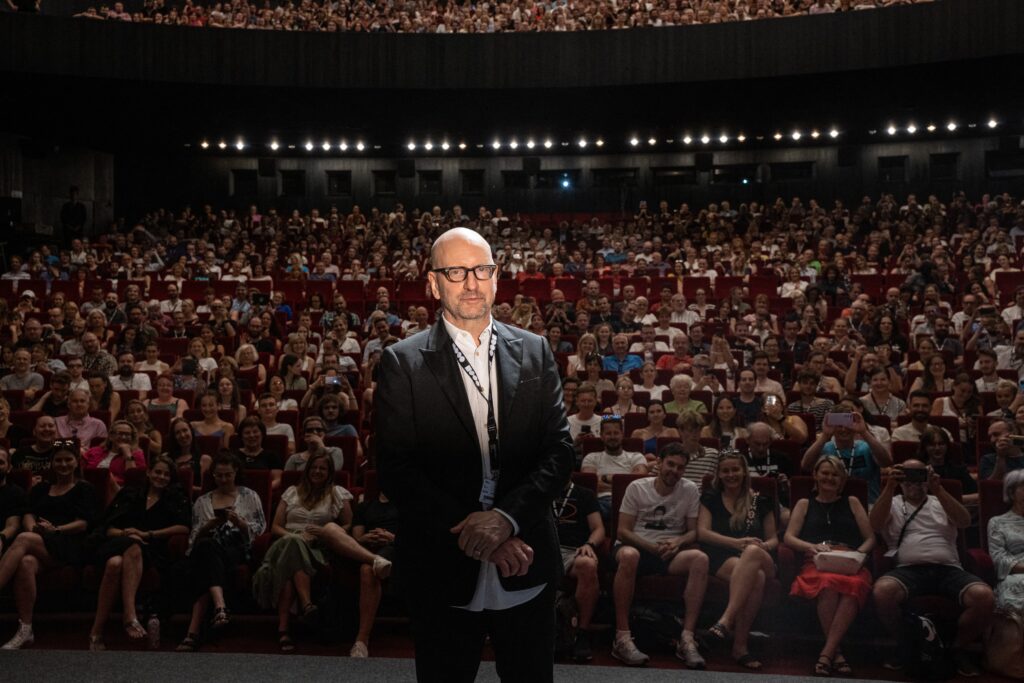
Soderbergh’s 37th feature-length film, “The Christophers,” hits theaters this weekend. Of the American directors who grew out of the independent film boom of the ’90s, Soderbergh has unquestionably had the most quixotic career. While contemporaries like Quentin Tarantino, Wes Anderson and Paul Thomas Anderson have built auteurist, boy-genius personas — to the point that “Saturday Night Live” has done parodies of all three — Soderbergh has forever gone his own way, darting from dramas to thrillers to gonzo comedies to heist capers to studio epics to microbudget indies shot on his iPhone. Some of these have been wildly successful — the “Ocean’s Eleven” movies, his two Oscar-winning films that came out in the same year, “Traffic” and “Erin Brockovich,” his bio-thriller “Contagion,” which of course found a second life during the covid pandemic — and some of them were so quickly forgotten that you couldn’t watch them now if you wanted to. The only place I can find 1991’s “Kafka” is bootlegged on YouTube.
These films are wildly different in style, content, budget and scope, but they are also immediately recognizable, within seconds of watching them, as Soderbergh’s: He has become his own genre. And he has done it by sticking to the principles of his first film, the Sundance hit “Sex, Lies, and Videotape,” which he wrote on a legal pad during a cross-country drive: Fierce independence, at all times — even when it’s self-defeating. Maybe especially when it’s self-defeating. Soderbergh is often his own cinematographer and editor — it helps keep the budgets down and allows him to do his own thing even more — but he’s self-effacing about it: If you see the names Peter Andrews or Mary Anne Bernard in the credits, that’s actually Soderbergh. (The names are slight variations on his parents’.)
What tends to bond Soderbergh’s films together is the enthusiasm in their creation. The guy loves making movies, and it shines through in every frame. “I’m mystified by directors who say, ‘I can’t find anything I want to do.’ I look around and I want to do everything. There are stories everywhere,” Soderbergh has said. “It’s the best job in the world … I jump out of bed, ready to go. It’s pretty great.” That’s how you end up making 37 feature films by age 63 — that’s more than Wes Anderson, Tarantino and the newly Oscar-minted PTA combined — despite, famously, announcing that you’re retiring from filmmaking. That 2013 “retirement,” which no one who had ever seen a Soderbergh film thought would come anywhere close to being permanent, lasted four years: Since returning in 2017 with the riotously entertaining “Logan Lucky,” he has made 11 films, in addition to working on numerous television shows.
To be able to remain as independent as he has, in an age in which the movie industry has changed dramatically, has required adaptability: Soderbergh was one of the first filmmakers to embrace digital media. He has had no qualms about working with Netflix despite how much it has disrupted the theatrical distribution model. He has made multiple movies on an iPhone. But all those films, always, have been done pretty much exactly how Soderbergh wanted to make them, and this insistence on independence has been rewarded with extreme loyalty by some of Hollywood’s biggest names: Who else but Soderbergh could get Meryl Streep to make a movie and get paid, as she put it, “25 cents” for it?
All that has ever mattered to him was making movies his own way. Soderbergh could have been Steven Spielberg; he could have been Tarantino; who knows, he could have been Orson Welles. But the goal was never to have that sort of great-man epic sweep. The goal was simply to make his own films, the way he wanted to make them. In this way, Soderbergh, more than any of his more decorated colleagues, is the ultimate Gen X, 1990s filmmaker: someone who resisted the spotlight, who avoided playing the more mainstream game, who focused instead on quietly doing his own work exactly how he wanted to do it.
Steven Soderbergh is not the most famous filmmaker of his generation, nor the most financially successful. But I think he’s the one who’s the truest to himself … and, thus, to these eyes, the most self-actualized. I might be the only person who would recognize (and accost) him in a Times Square Irish bar on a rainy day. But the trade-off — to make his own movies, forever, and constantly — looks more than worth it. And sorry, Steven, but: The book really is great. Someday I’ll find someone other than you to talk about it with.
The post The director who could have been Spielberg chose something better appeared first on Washington Post.