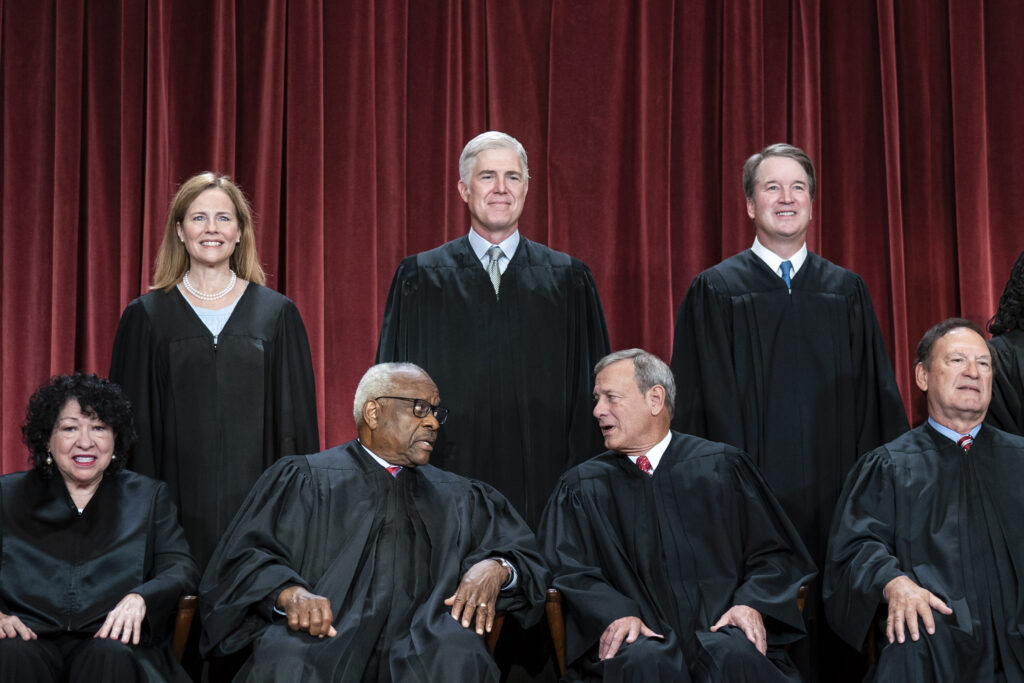
The sharply conservative Supreme Court that President Donald Trump’s three appointees remade is the first since at least the 1950s to reject civil rights claims in a majority of cases involving women and minorities, according to a detailed analysis conducted for The Washington Post.
The shift brings to an end a streak of successive courts expanding such protections that began with the dawn of the civil rights era. But the historic nature of the current court is also evident in other key areas of the law over the five terms since the third of Trump’s appointees joined the bench.
The analysis shows that in addition to civil rights, the court powered by Trump’s picks — Justices Neil M. Gorsuch, Brett M. Kavanaugh and Amy Coney Barrett — has pushed to the right of any modern court on religious rights and voting issues.
The court has also entered a new era of extreme partisanship. None over the past seven decades has been as starkly polarized.
“There is no center now,” said political science professor Lee Epstein, who performed the analysis with her Washington University colleague Andrew D. Martin and Michael J. Nelson of Penn State.
A yawning gulf has opened between the left and right flanks of the court, Epstein said.
“The polarization in American society seeps into the Senate. It seeps into the presidency. It is naturally going to seep into the courts. It would be surprising to see another John Paul Stevens,” Epstein said, referring to the late justice noted for his moderation. “Partisan identity and ideology have become so intertwined.”
The analysis examined 270 decisions handed down by the Supreme Court between 2020 and 2024 — the first five terms of the six-justice conservative majority — and drew on the Supreme Court Database, a compendium of cases the professors maintain.
The professors compared that data to the body of rulings under Chief Justice John G. Roberts Jr. before 2020, as well as rulings handed down under the six other chief justices dating back to the New Deal era. The analysis did not include rulings from the current term or orders in cases on the court’s emergency docket.
Overall, the Supreme Court has consistently leaned to the right for 50 years. That pattern has persisted despite the country being closely divided politically and the White House and Congress regularly changing hands between Democrats and Republicans. Republican presidents have had more opportunities to name justices than Democratic presidents have had.
The current court has expanded upon the pattern.
One of the most notable findings of the data analysis was the court’s shift on civil rights, Epstein and Nelson said. Since the three Trump appointees joined the court, the share of cases won by the side advocating an expansion of civil rights fell to 44 percent.
In all the other time periods going back to the early 1950s, the Supreme Court issued rulings in favor of expanding civil rights in a majority of such cases. The high-water mark for rulings in favor of civil rights was 74 percent during the court of Earl Warren in the 1950s and 1960s.
The Warren court is remembered as one of the most liberal in history, banning school segregation in the landmark Brown v. Board of Education and expanding voting rights and the rights of criminal defendants.
In recent terms, a number of the civil rights cases before the court have involved protections for gay and transgender people, and in most cases, the court has ruled against them. Last year, the justices upheld a Tennessee ban on gender transition treatment for minors and allowed religious parents to remove their children from school lessons using LGBTQ+ books. In 2023, the justices said a website designer’s First Amendment rights allowed her to refuse to create sites for same-sex weddings.
This term, the justices appear poised to go further. In March, the court ruled against a Colorado law banning “conversion therapy” for gay and transgender minors, casting doubt on similar laws in nearly 30 states. During arguments in January, the majority also seemed inclined to allow states to ban transgender people from girls’ and women’s sports.
But the justices have also pared back civil rights in other areas, most notably in striking down affirmative action in college admissions.
Trump was the first president since Ronald Reagan to select three justices, giving him an outsize role in shaping the court. Barrett took her seat in October 2020. Trump appointed Gorsuch in 2017 and Kavanaugh in 2018.
The Barrett and Kavanaugh appointments shifted the ideology of the court because they replaced Ruth Bader Ginsburg, a liberal, and Anthony M. Kennedy, a less consistent conservative, respectively. Gorsuch replaced another conservative, Antonin Scalia.
Since Barrett joined the court, the justices have issued conservative rulings in 54 percent of cases, a level equaled only by the court led by Chief Justice Warren E. Burger from 1969 until the mid-1980s.
Trump’s overwhelming series of victories on the emergency docket this term — roughly 75 percent since he took office — have intensified the debate over whether the justices are acting in a partisan manner. Democrats and liberal justices have said the orders in those cases display political bias toward the president.
The temporary rulings have allowed Trump to ban transgender soldiers from the military, strip deportation protections from migrants, fire the heads of independent agencies and gut the Education Department while legal challenges play out.
Liberal Justice Ketanji Brown Jackson lamented those orders in a blistering dissent in August after the court gave the administration a green light to slash hundreds of millions of dollars in grants for health research related to equity and diversity.
“This is Calvinball jurisprudence with a twist,” Jackson wrote, referring to a game played in the comic strip “Calvin and Hobbes.” “Calvinball has only one rule: There are no fixed rules. We seem to have two: that one, and this administration always wins.”
The court, however, has pushed back on the president in some significant recent rulings, striking down most of his sweeping tariffs and blocking his deployment of National Guard troops to Chicago.
One of the most striking findings of the data analysis is the degree to which the court has allowed religion to push into public life. Over the past five terms, the justices have voted in favor of parties asserting religious rights 98 percent of the time, far outstripping any other court in roughly 75 years.
The justices ruled a football coach’s First Amendment rights allowed him to pray on a high school field after a game, permitted government money to support religious education and decided that Philadelphia could not block funds from a Catholic social service organization that refused to certify same-sex couples as foster parents.
By contrast, the conservative majority has been far less willing to remove barriers to voting and uphold campaign finance restrictions, voting for them in only 7 percent of cases — the lowest rate since at least the 1950s. The court’s liberals voted for them in 87 percent of cases.
The court in the Trump era has weakened the landmark Voting Rights Act, which prohibits racial discrimination. It appears likely the court will deliver a blow this term to the law’s last major pillar, Section 2, which directs states to draw districts to protect the voting power of minorities.
The analysis also shows a court of ideological extremes, with increasingly dug-in factions of liberals and conservatives.
The gap between the share of votes on the liberal side cast by Democratic- and Republican-appointed justices has widened to 48 percentage points. That’s up from a 35-point gap during the rest of the tenure of Roberts, who was appointed by George W. Bush in 2005. And it’s six times the spread during the era of Warren, which featured moderately liberal justices of both parties and had the smallest partisan divide.
The justices have remained largely ideologically consistent over the past five terms with the exception of Barrett and Jackson. Barrett has grown somewhat more liberal over the past four terms, while Jackson has edged slightly further to the left, the analysis shows. Some conservatives have criticized Barrett for voting with liberals in some cases, but she maintains a distinctly conservative record overall.
Nelson, the Penn State professor who was a co-author of the analysis and studies public support for the courts, said the partisan tilt of recent decisions and the divides among the justices probably have helped drive the court’s decline in public approval over the past five years.
In the latest Gallup poll from September, 52 percent of Americans disapproved of the way the court was handling its job while 42 percent approved. Historically, it’s rare for the court’s approval rating to be underwater.
“The people see such a deep divide among the justices, it undermines the sense of procedural fairness and gives the sense that the cases are coming prejudged,” Nelson said. “That’s why we have seen the court’s public standing fall so much. People look at it as a much more partisan institution than they did 20 years ago.”
A number of factors have led to an increase in partisanship on the court, Epstein and Nelson said. The 2017 decision by Republicans in the Senate to eliminate filibusters for Supreme Court nominees probably was one. That has allowed presidents to nominate more ideologically extreme justices because blocking them is harder.
Epstein said another factor is that the high court has taken on a new prominence in an era of political gridlock in Washington. Presidents are choosing nominees with reliable partisan views because the stakes of its decisions are higher.
“Congress isn’t doing that much lawmaking,” Epstein said. “Presidents are doing a lot of things by executive order. Those executive orders can be overturned as soon as someone new comes into office. If you are a president, and you care about durable policy, your judicial appointments are going to far outlast your executive orders.”
Beginning in 2010, when Justice Elena Kagan replaced Stevens, all of the Republican-nominated justices were to the right of all of the Democratic-nominated justices for the first time in the court’s history, according to a paper by professors Neal Devins of William & Mary Law School and Lawrence Baum of Ohio State University.
Previously, at least some justices bucked the ideology of the president who chose them. They included Warren and liberal Justice William J. Brennan Jr., both nominated by President Dwight D. Eisenhower, and President Richard M. Nixon’s appointee Harry A. Blackmun, who drifted from the court’s conservative wing to its liberal side over his career spanning more than two decades.
Devins and Baum said they think the partisan sorting is likely to endure for the foreseeable future, because nominees are emerging from Democratic and Republican parties that don’t share much ideological overlap anymore.
“Until there is a time that moderates have enough say and the parties become ideologically closer, you are going to see this pattern [of nominees] repeat itself and repeat itself,” Devins said.
The post Supreme Court remade by Trump ushers in historic defeats for civil rights appeared first on Washington Post.