President Trump used to quip that Iran “never won a war, but never lost a negotiation.” Perhaps this view explains his decision to forsake previous rounds of talks over Iran’s nuclear program and wage a full-scale assault on the country. But Trump’s gambit may have backfired: In this particular war, Iran remains undefeated, which puts the country in an even stronger position when the two sides start talking in Islamabad tomorrow.
Despite assumptions that this war has propped up the regime, the conflict may have also put Iran on a path toward reconciliation with the rest of the world. Should talks with America resolve the conflict and curb Tehran’s nuclear ambitions, the result could create better economic prospects and greater freedom for the Iranian people.
Following Tuesday’s cease-fire announcement, Iran’s Supreme National Security Council promptly claimed victory but also expressed some optimism for the talks. The council called for national unity and full support for diplomatic efforts, noting that the negotiations offer Iran a chance to “consolidate” its wins. This reads as a warning to Iran’s hard-liners, who might otherwise rail against the cease-fire and demand a return to combat operations against the United States.
Negotiators will have to bridge seemingly unbridgeable gaps between the two sides. Iran’s leaders have declared that they want the U.S. to recognize Iran’s right to nuclear enrichment, allow Iran to maintain control over the Strait of Hormuz, lift economic sanctions, and pledge not to attack Iran and its allied militias in the region, such as Hamas and Hezbollah. Iran also wants reparations for all of the war damages (which could come from tolls on ships passing through Hormuz) and for all of this to be enshrined in a resolution at the United Nations Security Council. The United States, for its part, has declared that Iran must dismantle its nuclear facilities, end its uranium enrichment, heavily limit its missile programs, cut its support for military proxies, and fully reopen the strait.
These differences appear irreconcilable. But those of us who have closely followed this saga know that there are work-arounds. Iran might formally reserve the right to enrich uranium while not actually committing to doing it—a compromise that Vice President Vance has already suggested. Iran could agree to some limits on its missile programs in exchange for access to antiaircraft defenses and a pledge that the U.S. will stop attacking Iran. The two sides may be entering talks with long lists of demands and grievances, but no practical negotiator sticks to an opening bid.
[Brynn Tannehill: America looks like a paper tiger]
The real obstacle to a deal between the United States and Iran is less in the practical details than in whether the two sides have enough political will to reconcile. Opponents of the Iranian dictatorship decry negotiation with a regime that has killed tens of thousands of its own people in recurrent waves of recent protests. Many Americans back tightening economic sanctions on Iran, not loosening them, and supporters of Israel are rightfully concerned about bargaining with a government that aspires to destroy Israel. In Iran, where anti-Americanism is enshrined in the leadership’s DNA, the brutality of this war has largely bolstered antipathy for the “Great Satan.”
Overcoming these obstacles requires what one expert has called a “diplomatic miracle.” But given the devastation wrought by this war, quite a few Iranians and Americans seem keen to give talks a go. It bodes well that the two men who reportedly helped bring about the cease-fire—Vance and Mohammad Baqer Qalibaf, Iran’s speaker of Parliament—will play prominent roles in the coming talks.
Eager to distance himself from this unpopular war, Vance appears invested in helping end it. After weeks of seeming sidelined by his boss and the more interventionist members of the administration, such as Secretary of State Marco Rubio, Vance may appreciate a moment in the global limelight and will be disinclined to leave the talks empty-handed.
Whether the war has rid Iran’s leadership of hard-liners or empowered them further is up for debate, but there’s good reason to believe that Qalibaf will pursue a more diplomatic path. A former high-ranking member of the Islamic Revolutionary Guards Corps, Qalibaf has emerged from this war as the most powerful figure of Iran’s Supreme National Security Council and has been effectively running the war effort. Although he was known for repressive moves as National Police chief in the early 2000s, Qalibaf later enjoyed a reputation as a technocrat who hobnobbed with the likes of Gavin Newsom at Davos during his long tenure as mayor of Tehran.
The Islamic Republic’s hard-liners have long mistrusted Qalibaf, calling him “the Godfather” due to his reputation for corruption. Reformist factions, however, have come to back him in recent days. Former President Hassan Rouhani, who signed Iran’s historic deal with the U.S. in 2015, welcomed the cease-fire and showed support for Qalibaf’s leadership. A top aide to the reformist President Masoud Pezeshkian called Qalibaf “a moderate” figure and said that he and Pezeshkian “will now pursue a new mission for Iran’s national interests.”
[Jonathan Lemire and Isabel Ruehl: 1979 is the year that explains Donald Trump]
Any diplomacy will enjoy some international support. Regional powers are likely eager for any agreement that ends the bombing campaign and restricts Iran’s military buildup. (According to Pakistan, other neighboring Muslim-majority countries, including Saudi Arabia, Turkey, Egypt, and Qatar, contributed to the mediation efforts.) China, keen to prevent further disruptions to energy markets and aid allies in the Persian Gulf, apparently pushed for the cease-fire and will play a key role if a deal is brought to the UN. Even Israel, skeptical of any deal, might judge a militarily degraded Iran that pledges nonbelligerence with the U.S. to be the least bad outcome for now, especially if Iran also gives up its enriched uranium.
Anyone who hoped that this war would yield regime change in Iran is likely disappointed, but many Iranians have welcomed the cease-fire. Hassan Asadi Zeydabadi, a human-rights lawyer in Tehran and a former political prisoner, told me that he hopes the talks help curb the country’s anti-Western hostility. “Iranians want to live normal lives,” he said. “If the Islamic Republic continues its past international policies, we’d go back to conflict abroad and protests at home.”
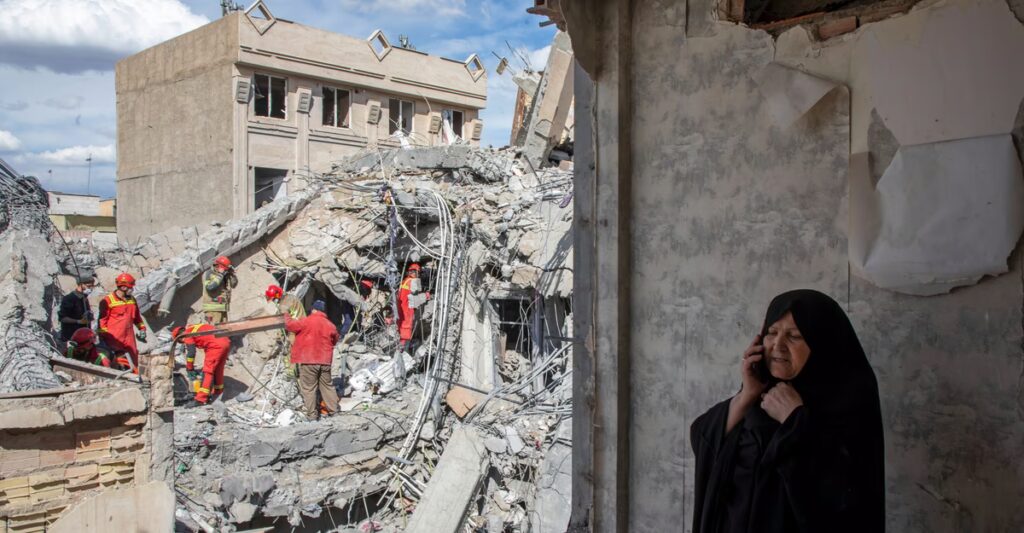
Both sides appear to have more reasons to negotiate than to return to the battlefield. Much of Iran has been reduced to rubble and is in dire need of relief. Trump is plainly ready to find a solution to skyrocketing oil prices. Regardless of the details, nearly any deal could have lasting consequences in Iran. If Qalibaf is able to make amends with a country that Iran has demonized for close to half a century, it will be the surest sign that he is ruling over a new Iran—still authoritarian and repressive but more economically and diplomatically open; more Vietnam and less North Korea.
The post Reasons to be Hopeful in Iran appeared first on The Atlantic.