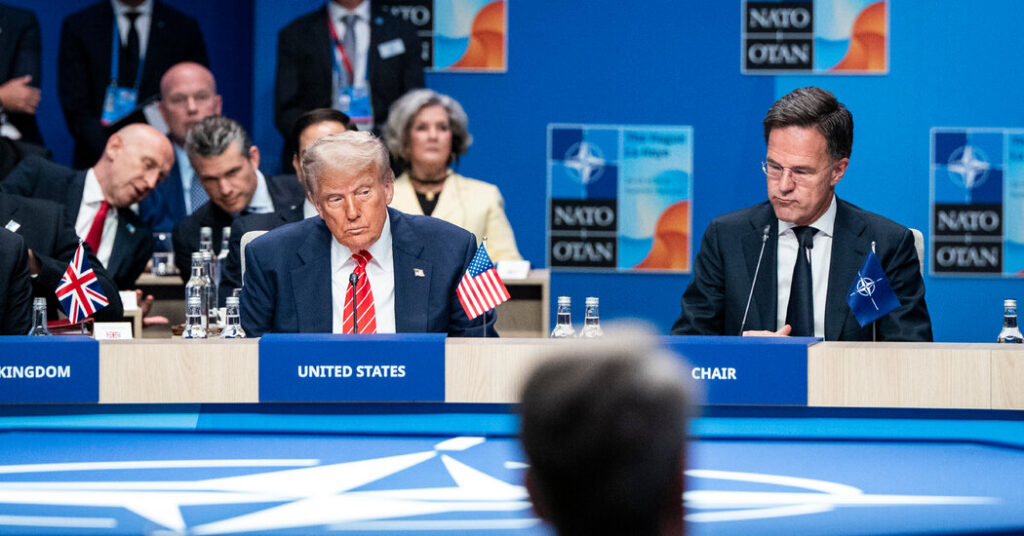
Mark Rutte, the secretary general of NATO, described his tense meeting with President Trump this week as a “conversation” that “was really between friends.”
Mr. Trump, in a social media post on Thursday, put it slightly differently: “our own, very disappointing, NATO” does not understand “anything unless they have pressure placed upon them!!!”
Even as it has violently upended the Middle East and put intense strains on the global economy, the war in Iran has deepened the gulf between Mr. Trump and America’s NATO allies. That is after those countries spent more than a year buffeted by the president’s threats, begun in his first term, to abandon the alliance.
Mr. Trump is training his anger at NATO as his cease-fire with Iran hangs in the balance and even some of his supporters question whether the United States really achieved its objectives. He is airing his discontent over his inability to take over Greenland, despite behind-the-scenes talks over the Danish island that the White House says are going well. And he is forcing European leaders yet again to try to keep him from abandoning them, even as their countries struggle to shoulder the economic costs of the U.S. war with Iran.
“We have, sometimes, the political home front to take care of,” Mr. Rutte said onstage at the Ronald Reagan Institute in Washington on Thursday, in a diplomatically phrased reminder that the war was deeply unpopular in Europe. “NATO is there, of course, to protect the Europeans, but also to protect the United States.”
Mr. Rutte, a former prime minister of the Netherlands, was making the point that the U.S. military benefits from its bases in Europe and, despite the tensions, has used them as staging sites for the war on Iran. But widening cracks in the alliance show that even if negotiators succeed in making a deal in the talks that start Saturday for a more permanent end to the war, the scars are likely to be lasting.
The Iran war “has become a trans-Atlantic stress test,” Chancellor Friedrich Merz of Germany said on Thursday, after acknowledging that his country was “massively suffering” from the energy market disruptions caused by the war. “We do not want — I do not want — a split within NATO.”
Mr. Trump’s disdain for the alliance dates back decades, underpinned by his conviction that Europeans have been freeloading off the American security umbrella. His latest fury stems from U.S. allies’ refusal to embrace his decision to join Israel in assaulting Iran, with Britain and Spain setting limits on the United States’ ability to use bases on their territory.
Mr. Trump escalated his threats against NATO even as he prepared to wind down the war — and despite the fact that he did not try to build a coalition with European countries before the bombing started. He told The Telegraph last week that he may pull out of the alliance entirely. In a news conference on Monday, a day before the cease-fire, Mr. Trump volunteered that he still sought control of Greenland, the semiautonomous Danish territory in the North Atlantic.
“It all began with, if you want to know the truth, Greenland,” Mr. Trump said after voicing his dissatisfaction with Europe’s lack of support for the Iran war. “We want Greenland. They don’t want to give it to us.”
He reinforced the point Wednesday, posting on social media in all capitals that “NATO wasn’t there when we needed them” and that Greenland was a “big, poorly run, piece of ice!!!”
Mr. Trump’s pivot back to Greenland was striking given that he said in January that he and Mr. Rutte had formed a “great” framework for a future deal over the island. Three-way talks between officials from Greenland, Denmark and the United States have continued since. There is no indication that those talks would grant control of Greenland to the United States, but a White House official said the administration was optimistic about the course of the talks.
In years past, many of Mr. Trump’s allies in Washington tried to rein in his attacks on NATO, seeking to remind him of the power that the United States gains from being able to base troops and warplanes in Europe. But in recent weeks, many of the war’s supporters in the United States have joined Mr. Trump in piling on against NATO, especially given the president’s frustration over Iran’s control of the Strait of Hormuz.
Sean Hannity, the Fox News host close to the president, said on his show Wednesday night that Europe was “a dying continent” and mused that “I’m not sure it’s worth going forward with NATO as we go on.”
Jack Keane, a retired general whom Mr. Trump awarded a Presidential Medal of Freedom in 2020, told Mr. Hannity that he did not think the president would pull out of NATO because “there is still value” in the alliance, but he predicted there would be consequences.
“I wouldn’t be surprised if we didn’t decide to move some of our troops out of Western European countries and move them into Eastern Europe countries,” General Keane said. “I think we’ll likely do something.”
The Wall Street Journal reported on Wednesday that Mr. Trump was considering moving U.S. troops stationed in Europe from countries seen as unhelpful in the war effort to ones seen as supportive, like Poland and Romania. The White House did not comment on the report, but a senior U.S. military official in Europe said that options were being reviewed.
Mr. Trump has threatened NATO many times, only to largely preserve the status quo. In the president’s latest outburst, some analysts also see a familiar inclination to attack a weaker party, especially given Mr. Trump’s inability to compel Iran to surrender after five weeks of bombardment.
“Beating up on Europe and NATO has really no domestic cost,” said Jeremy Shapiro, a former State Department official who is the research director of the European Council on Foreign Relations. “It’s quite typical for Trump: When things are going wrong, he finds the weakest person in the room and blames them.”
Eric Schmitt contributed reporting from Washington, and Christopher F. Schuetze from Berlin.
Anton Troianovski writes about American foreign policy and national security for The Times from Washington. He was previously a foreign correspondent based in Moscow and Berlin.
The post NATO Labors to Avoid Becoming Another Casualty of the Iran War appeared first on New York Times.