You’re reading The Checkup With Dr. Wen, a newsletter on how to navigate medical and public health challenges. Click here to get the full newsletter in your inbox, including answers to reader questions and a summary of new scientific research.
Last week, I reported on a company called JubileeTV that can turn your television into a communication and medical monitoring tool. Many readers were intrigued. Some expressed concern about the growing intrusion of technology, though many wanted to know what more might be possible.
“[JubileeTV] still depends on family being involved,” wrote Robert from Virginia. “But what about seniors who don’t have family? It seems to me that we should be at the point where robots could be companions and keep us company, maybe help with daily chores around the house. Are we there yet?”
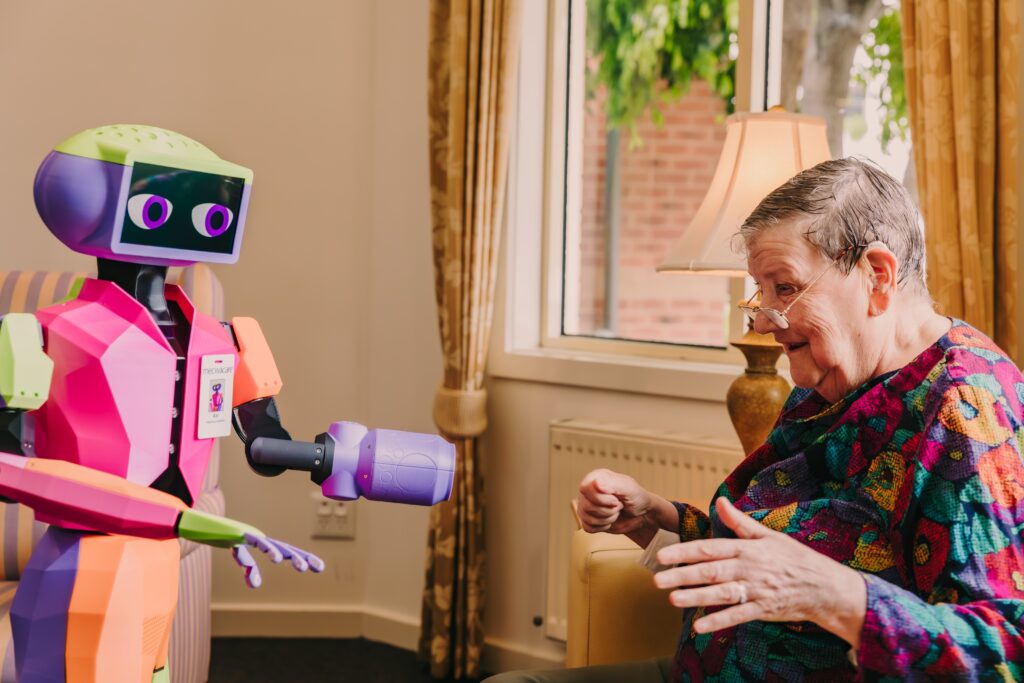
As it happens, yes we are. In response to my callout to learn more about “age tech” innovations that support older adults and their caregivers, I heard from Grace Brown, a 25-year-old Australian engineer and head of Andromeda Robotics who co-created a companion robot to address isolation in retirement homes and hospitals.
The robot, named Abi, is about 4 feet tall, brightly colored and, as Brown describes her, “very personable and sassy.” Unlike industrial robots that perform tasks like vacuuming or moving boxes, Abi serves as a companion. “A lot of people who interact with Abi on a daily basis actually refer to her as they would a grandchild who’s walking through the door,” she said.
Brown explained that Abi’s current uses can be divided into two categories. The first is group activities: Abi leads dances, tai chi, games and other sessions designed to get residents to be more physically active and to engage with one another. Many senior living facilities already offer these sessions led by human facilitators; Abi adds to the variety. Some of the most popular include music-based activities, such as quizzes with short song clips that engage residents in guessing the artist and title, as well as group jukebox sing-alongs.
This use feels relatively straightforward. Unlike a human instructor who only comes from time to time, Abi is scheduled on a regular basis and can be integrated into residents’ daily routines.
The second application of Abi is potentially more impactful — and more controversial: one-on-one interactions with residents.
Brown told me that Abi speaks up to 90 languages. This is important because people with cognitive decline often end up reverting back to their native tongues as dementia progresses, even if they spent years speaking another language.
Abi is not built to serve as a medical translator, but speaking someone’s language can help draw them out. Brown related a story of a man who lived in a senior care facility for more than a year without speaking. Staff prompted Abi to speak in his native language, Chinese, and he quickly began talking about his life. “Eventually they even started reading Chinese poetry to each other,” Brown said.
Abi also has an incredible memory that is personalized to each person she interacts with. “If you told Abi on a Tuesday that your granddaughter was coming to visit you on Thursday, and Abi came back on a Friday, she’ll remember to check and be like, ‘How was your granddaughter’s visit yesterday?’” Brown said.
Brown first launched Abi in Australia, where as many as 40 percent of residents in aging care facilities, by some estimates, do not receive visitors. Last month, the company announced plans to expand to the United States, with a limited rollout to select senior living facilities. It also has a wait list for those interested in participating.
She understands the fear many people have — that Abi could be the first step toward replacing staff. “That’s exactly what Abi was not built for, and we try to make that really, really clear,” Brown said. Rather, she said Abi is meant to help fill a gap in a system with an increasing number of older adults and a growing shortage of caregivers. There simply aren’t enough workers to recruit; technology has to play a role, she believes.
One difficult question: What does it mean if people begin to rely on robots for companionship? Won’t this lead to more isolation? And could it lead families, already overburdened by other responsibilities, to visit their loved ones less?
I think those concerns are real, though I can also see Brown’s view that technology like Abi can bring people closer. “A lot of families struggle to have conversations with their parents or grandparents,” especially as dementia progresses, she said. Some have told her that Abi has helped prompt topics that help people better connect with their loved ones.
In the future, Brown is looking to explore specific medical uses for Abi, such as detecting and preventing falls and alerting providers to concerning behaviors. I hope she does. How we care for an aging population is one of the most pressing medical, ethical and economic challenges of our time. I remain optimistic that technology, if deployed the right way, can help to meet that need.
What are your thoughts about companion robots? I’d love to hear from you!
The post Meet Abi, the AI-powered robot companion for senior care appeared first on Washington Post.