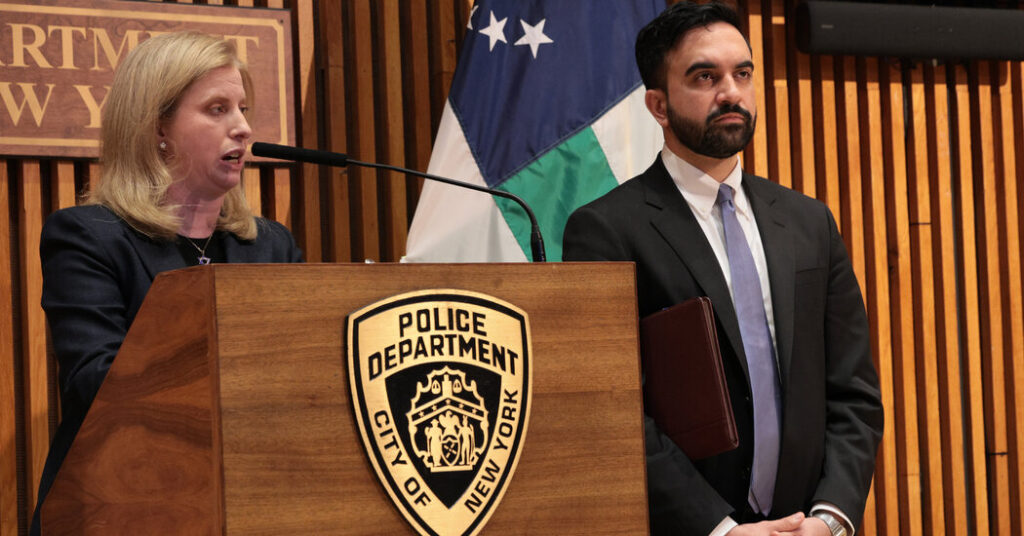
Mayor Zohran Mamdani sought to affirm his control over the Police Department on Wednesday, saying he would overrule its commissioner if he felt it necessary.
In a wide-ranging interview with The New York Times, the mayor said that he was willing to institute policy changes at the Police Department if he and the commissioner, Jessica Tisch, could not reach an agreement.
“Yes, ultimately I hold the final decision no matter which department or agency we’re speaking about,” Mr. Mamdani said, speaking from his offices at City Hall.
He was specifically responding to a question about whether to dismantle a unit known as the Strategic Response Group, which polices protests and other mass events and has been faulted for using heavy-handed tactics. Ms. Tisch, who was also police commissioner under former Mayor Eric Adams, has been dubious in the past about getting rid of the entity.
“I remain steadfast in my commitment to disband the S.R.G., to do so in a manner that upholds both First Amendment rights of New Yorkers and keeps New Yorkers safe. And that is the subject of an active conversation that we’re having,” the mayor said during the 22-minute sit-down interview.
Mr. Mamdani and Ms. Tisch have had their differences over other issues, including the use of gang databases, and the characterization of a snowball fight that left two police officers injured.
When asked whether he would ultimately overrule Ms. Tisch in potential areas of disagreement, like disbanding the unit, he replied that he would, affirming that he was ultimately responsible for police policy.
“Our police commissioner runs the N.Y.P.D., our police commissioner reports to me. And as the mayor, ultimately I am responsible for what happens in our city within each and every city agency and department,” Mr. Mamdani said. He also made a point of praising the commissioner’s record, days after they appeared together to herald a drop in crime during his first three months as mayor.
Mr. Mamdani ran for office promising to fundamentally alter the way the New York Police Department does business. He vowed to eliminate the Strategic Response Group, and he said he would support a City Council bid to eliminate the gang database, which compiles the names of people suspected of being gang members. Both entities have attracted the ire of civil libertarians.
Since taking office on Jan. 1, Mr. Mamdani has made no public moves to dismantle either the Strategic Response Group or the gang database.
In the case of the S.R.G., its heavy-handed response to the civil rights protests that swept the nation in 2020 over the killing of George Floyd by the Minneapolis police resulted in a legal settlement with the state attorney general’s office. As a candidate, Mr. Mamdani said the unit “cost taxpayers millions in lawsuit settlements + brutalized countless New Yorkers.” Critics have assailed the gang database for including people with tenuous ties to gangs.
Mr. Mamdani, as a candidate, described it as a “vast dragnet” that makes everyday activities “a mark of suspicion.” Late last year, the city implemented some reforms to the database, at the urging of the city’s Department of Investigation. Ms. Tisch has fiercely defended the program.
Yet shortly before winning the November election, Mr. Mamdani stunned some of his supporters when he announced that he would retain Ms. Tisch as police commissioner, a move that appeased some of his critics in the business community.
Mr. Mamdani’s comments on Wednesday came ahead of his 100th day in office on Friday.
Mr. Mamdani came up in the democratic socialist movement, which is generally distrustful of the police. Ms. Tisch favors a strong approach to criminal justice.
Despite their differences, they have largely presented a united front. Before Mr. Mamdani took office, Ms. Tisch acknowledged their differences in an email to rank-and-file officers.
“Do the mayor-elect and I agree on everything? No, we don’t,” she wrote in November. But even when the commissioner has openly disagreed with the mayor’s stance, she has been careful to not criticize Mr. Mamdani.
And on Wednesday, a spokeswoman for the Police Department said that it was working together with the mayor’s office on the S.R.G. issue. She said there was a group of department and City Hall officials in Ohio right now studying how the Columbus police department responds to protests.
New York mayors typically defer to their police commissioners. Under Mayor Michael R. Bloomberg, who took office in 2002 after the Sept. 11 terrorist attacks, the Police Department was notably powerful under its commissioner, Raymond W. Kelly, throughout Mr. Bloomberg’s 12 years in office.
Mr. Bloomberg’s successor, Bill de Blasio — a left-of-center Democrat like Mr. Mamdani — understood that any increase in crime would feed into voters’ fears about him. As a result of that, and a memorable dispute with a police union during his first year in office, Mr. de Blasio also largely deferred to his police commissioners.
Dana Rubinstein covers New York City politics and government for The Times.
The post Mamdani Asserts Control Over N.Y.P.D., Saying He Would Overrule Tisch appeared first on New York Times.