Handpicked for the role from a roster of nearly 20 expert climbers and scientists, Jim Whittaker pressed through blizzard-force winds and minus-30-degree air to become the first American to summit Mount Everest. Mr. Whittaker, an REI manager and veteran climber from Seattle, hammered a U.S. flag into the pinnacle of the planet for the first time on May 1, 1963, stoking a national interest in mountaineering that fed the expanding retailer he would later lead as CEO.
Mr. Whittaker, who died April 7 at 97, vaulted from a little-known mountain guide to a national celebrity, a symbol of American achievement at a time of roiling Cold War anxieties. As a literal flag-bearer, he became a role model who helped popularize climbing and crystallized American pride less than nine months after the Cuban missile crisis, said Broughton Coburn, author of “The Vast Unknown,” a book about the U.S. expedition to Everest.
His achievement was celebrated in a confetti-strewn parade in Mr. Whittaker’s hometown, a Rose Garden ceremony with President John F. Kennedy, and a National Geographic television special devoted to the Everest expedition, which continued with four other Americans from the team reaching Mr. Whittaker’s wind-tattered flag at the peak, three weeks after he made his historic ascent.
Years later, Mr. Whittaker drove a Chevrolet Trailblazer with the license plate 29028, for the feet of elevation then recorded for Everest. (The mountain is now believed to be about four feet higher.)
Charley Shimanski, executive director of the American Alpine Club, later called Mr. Whittaker’s accomplishment “a defining moment in American mountaineering,” saying it signaled U.S. climbers were of the same caliber as the Europeans.
Mr. Whittaker, who was nicknamed “Big Jim” for his rangy 6-foot-5, 200-pound frame, was taller than others on the expedition. He stretched head and shoulders above his climbing partner, Tibetan-born Sherpa Nawang Gombu, with whom he stepped side-by-side onto the top of the world.
Before Gombu and Mr. Whittaker, the people who stood on the globe’s apex were recorded only in the single digits. New Zealand climber Edmund Hillary and Sherpa mountaineer Tenzing Norgay were the first to reach the summit, in 1953.
The American expedition collected data sought by the U.S. military on how cold and altitude affect the human body, and it recorded the team members’ mood, fitness and vital signs. Mr. Whittaker, who was said to have done 60 push-ups a day while approaching base camp, lost 25 pounds over the course of the journey.
Asked what it felt like to strain his body in oxygen-depleted air, Mr. Whittaker said, “Take your pillow from the bed and put it over your face and then run around the block with the pillow pressed to you.”
His and Gombu’s ascent was followed by that of expedition members Lute Jerstad and Barry Bishop, who followed their route up the mountain’s South Col, and Thomas F. Hornbein and Willi Unsoeld, who pioneered a new approach up the West Ridge. Mr. Whittaker was the last survivor of the six summiters from the expedition. His death, at home in Port Townsend, Washington, was confirmed by his wife, Dianne Roberts.
Mr. Whittaker spent 24 years with the outdoor equipment retailer REI, starting in 1955 as the co-op’s first full-time employee. By the time he retired as CEO in 1979, he had helped build it into a $46 million business with more than 700 employees and 900,000 members. He initiated REI’s signature annual sale to clear out inventory, created a product testing department, added goods such as parkas and sleeping bags, funded conservation groups, and led the expansion to its first stores outside Seattle.
The co-op benefited from free advertising through Mr. Whittaker’s expeditions — photos of REI-branded tents appeared in the pages of National Geographic — and the baby boomers influenced by him enthusiastically took to the trails and swelled the business’s membership rolls. REI became the biggest consumer-owned retail co-op in the United States, with more than 25 million members.
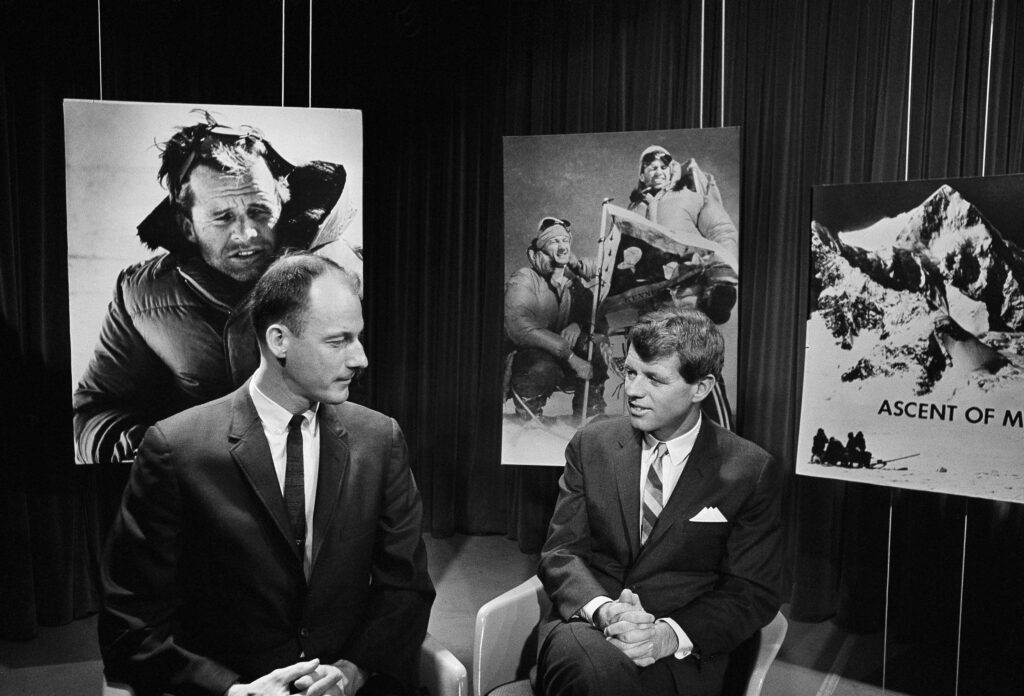
Mr. Whittaker forged a tight-knit friendship with Sen. Robert F. Kennedy (D-New York), whom he guided on a 1965 ascent of Mount Kennedy, a peak in the Canadian Yukon named for Kennedy’s slain brother, the former president. He went on to serve as Kennedy’s Washington state campaign manager during the 1968 presidential election and was a pallbearer at Kennedy’s funeral later that year.
In 1978, he directed the first American and third recorded ascent of K2, the world’s second-highest mountain at 28,251 feet, in the Karakoram Range of the western Himalayas. Mr. Whittaker reached Camp V at 25,200 feet and sent on four climbers who pioneered a route up the Northeast Ridge. Their triumph assuaged the disappointment he felt after having to abandon an earlier attempt in 1975.
“He was completely selfless on that K2 trip,” Louis Reichardt, who was part of the expedition, told National Geographic in 2003. “It’s hard to appreciate now, but we all felt that Americans had tried to climb this thing so many times, so much history was wrapped up in it, that there was a sense of purpose larger than self — a sense that would be inconceivable to someone climbing it today.”
Mr. Whittaker later became chairman of Magellan, the handheld GPS receiver company. He would use the tool on Mount Rainier, a 14,410-foot peak in Washington’s Cascade Range that he climbed more than 80 times, and in sailing across the Pacific with his family in a 54-foot ketch named Impossible.
He also organized the 1990 Peace Climb, which sent climbers from China, Russia and the U.S. to the top of Everest together and set a record for the most summiters there from a single expedition.
Mr. Whittaker was especially proud of helping organize a 1981 ascent of Mount Rainier, intended to raise awareness of the United Nations’ International Year of Disabled Persons, that included nine climbers with disabilities. Five were blind, two were deaf, one was epileptic and another was a Vietnam veteran who had lost a leg in the war. Mr. Whittaker led the group less than two weeks after an unrelated Mount Rainier expedition in which 11 people died in an avalanche, in what remains North America’s worst alpine disaster. Mr. Whittaker had helped search for survivors.
It was a mistake, he believed, to speak of “conquering” mountains, especially peaks like K2 or Everest, which has a limestone face more than 50 million years old.
“The mountain is so huge and powerful, and the climber so puny, exhausted and powerless,” he wrote in his 1999 autobiography, “A Life on the Edge.” “The mountain is forever; Gombu and I, meanwhile, were dying every second we lingered.”
An adventurous childhood
James Warren Whittaker was born in Seattle on Feb. 10, 1929, 10 minutes before his identical twin, Lou, who co-founded a guiding company for Mount Rainier and accompanied him on many of his climbs. His father sold bank alarms and vault doors; his mother, a homemaker, encouraged her boys’ independence in camping and tree-climbing, despite her twins’ childhood asthma.
Joining the Boy Scouts at age 12 connected Mr. Whittaker and his brother to the Mountaineers, a group of local outdoor enthusiasts who trained them in the disciplines and alpine rescue skills that would become their livelihoods. Basketball scholarships brought them to Seattle University, but they soon gave up the sport to work as climbing guides in the summer and volunteer with the ski patrol on winter weekends.
After graduating college in 1952 and serving in the Army, Mr. Whittaker was invited to work at REI, a Seattle importer of climbing and camping gear founded by Mountaineers members Lloyd and Mary Anderson.
Mr. Whittaker was enlisted for the 1963 Everest expedition by organizer Norman G. Dyhrenfurth, who tasked him with serving as the group’s equipment coordinator, sourcing climbing gear, clothing and other essentials carried by 900 porters during the trek. Much of the gear came from Seattle-based companies, including REI.
A shortage of oxygen at Camp VI, at 27,450 feet, propelled Mr. Whittaker to make his final push for the summit. Sherpas who helped carry gear to the camp unexpectedly took seven bottles with them for their own descent. With only two oxygen bottles left apiece, he and Gombu had a small window to act.
Fueled by freeze-dried crabmeat, tea and two cups of Jell-O, they set out at 6 a.m. carrying 45-pound packs in a ground blizzard — a whiteout below the chest — as Mr. Whittaker’s water bottle and left eye temporarily froze, impairing his depth perception.
Taking five to six breaths per step, he and Gombu staggered upward to the nearly vertical face called the Hillary Step and tried to distinguish sections of solid rock from the adjoining snow cornice.
“We came to prefer climbing to walking — at least we had something to hold on to,” Mr. Whittaker wrote in his autobiography. After topping the Step, just below the summit, he realized his oxygen bottle was empty. He credited his resulting cognitive impairment with a fearlessness that helped drive him onward, propelling him the last 50 feet to the summit.
Four decades later, in 2003, Mr. Whittaker reunited with Gombu at Everest’s base camp, hiking 40 miles and reaching 17,500 feet.
Mr. Whittaker’s first marriage, to Blanche Patterson, ended in divorce. In addition to his wife of 52 years, Dianne Roberts, survivors include three sons, Bob, Joss and Leif Whittaker; three grandchildren; and a great-granddaughter. He was predeceased by his sons Carl and Scott Whittaker.
In part because of REI’s cooperative ownership structure, Mr. Whittaker did not amass the wealth of many of his peers in business. An endorsement deal with the North American manufacturer of Vibram rubber boot soles, the industry stalwart he wore atop Everest, brought in double his day job’s salary, he said.
More than 900 other Americans, including Mr. Whittaker’s son Leif, have since followed him to the mountain’s summit. Mr. Whittaker often emphasized the descent, rather than the climb itself, recalling his awe as Everest’s rock and ice incrementally gave way to spring in vibrant fields and villages. The beauty and abundance of the first outpost he reached overwhelmed him so much, he said, that he sat and embraced a dog that licked him as he sobbed.
“When you come off the mountain and see the first blade of grass, then go lower and see a flower … get down on your knees and smell that beautiful smell of dirt, the life that exists, you feel so humble and grateful to be alive,” he told National Geographic Adventure in 2003. “We’re so damn lucky to be able to share the magic of this planet.”
The post Jim Whittaker, the first American to summit Mount Everest, dies at 97 appeared first on Washington Post.