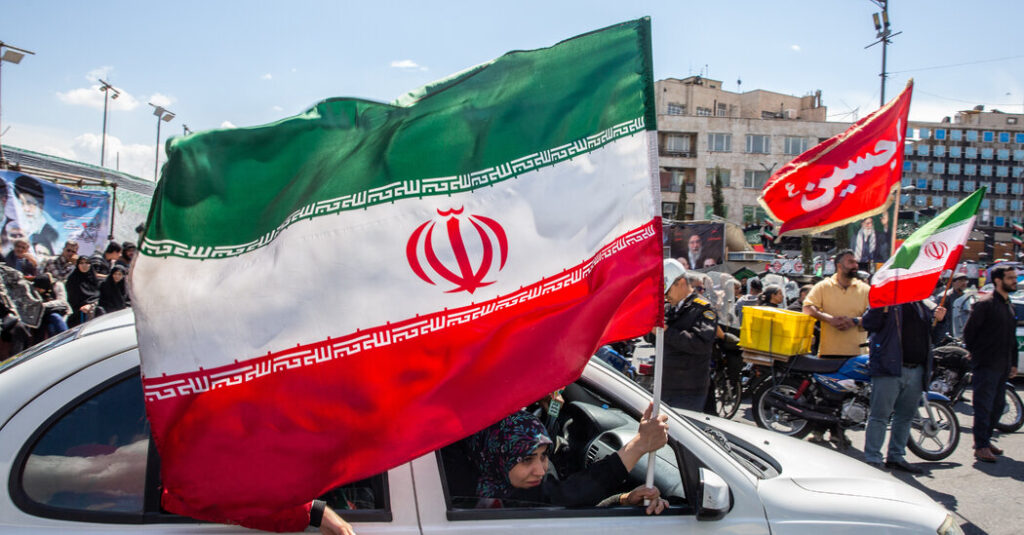
Their supreme leader and top commanders were killed. Military bases, factories and bridges were reduced to rubble. Their economy has taken blow after blow. Yet Iran’s authoritarian rulers believe they have emerged from this war in a stronger position than when it began.
After six weeks of an intense U.S.-Israeli campaign and with a temporary cease-fire in place, Iran’s leadership isn’t conciliatory as it enters into renewed negotiations with the United States. Instead, it has a new set of maximalist demands.
“Good morning to victory! Today, history has turned a new page,” Iran’s first vice president, Mohammad Reza Aref, wrote on social media the day the cease-fire took hold. “The era of Iran has begun.”
Just surviving the U.S.-Israeli war was a triumph for the Islamic Republic and its supporters — proof of their ability to withstand an onslaught from two of the world’s most powerful militaries, and confirmation, in their view, of the ideology of resistance that helped sweep the clerics into power in 1979. They also maintained firm control of the domestic sphere and continued to enact repressive force, despite a population that is broadly dissatisfied with their rule.
“They managed to overcome, in their view, two superpowers,” said Danny Citrinowicz, a former head of the Iran branch of Israeli military intelligence. For Iran’s theocratic rulers, he said, that is a “divine win.”
On top of that, Iran may feel it is in a stronger negotiating position than before the war.
Its continued ability to exert its will over the strategic Strait of Hormuz — despite bombardment that U.S. and Israeli officials assess to have largely destroyed Iran’s air force and navy — has provided a tried and tested means for wreaking havoc on the global economy. Iran aims to finish the war with effective control over this shipping lane, through which a fifth of the world’s oil usually passes.
“It’s actually more of a leverage than the nuclear program ever was,” said Hamidreza Azizi, an expert on Iran security issues at the German Institute for International and Security Affairs. “Now they are in a better position to bargain.”
In January, Iran’s leaders were grappling with one of the most precarious moments of their 47-year rule.
Iranian security forces unleashed a bloody crackdown to silence nationwide dissent, and a large swath of the population was still seething as the country sunk deeper into economic free fall. The network of militias they used to project power across the region had been battered by Israeli strikes, leaving them exposed to ever-more-aggressive American and Israeli demands.
But those allies were still able to join Iran in inflicting a heavy cost, through drones and missile strikes, on Gulf Arab countries that host U.S. bases and whose economies are based on their image of prosperity and stability.
“Two months ago the global news story was Tehran massacring its own people,” said Karim Sadjadpour, an Iran analyst at the Carnegie Endowment for International Peace. “Today the global news story is Tehran successfully resisting America and Israel.”
As the strikes on Iran grew deadlier and more destructive, many Iranians opposed to or ambivalent toward their government began to see the suffering inflicted on them as unacceptable. Some Iranians who once voiced hopes that bombardment could dislodge their rulers say they are now worried that they have ended up with the worst of both worlds — abandoned in a country in ruins, governed by an entrenched, emboldened leadership who they fear could act more aggressively against dissent.
Ali Alfoneh, a senior fellow at the Arab Gulf States Institute, said he expected a large wave of emigration from Iran.
Iranians could soon face deeper isolation from the world, he said, as their new leaders are likely to believe survival depends not on international negotiations and moderation, but on tougher deterrence — and perhaps even a race toward a nuclear bomb.
“This model will transform Iran into the North Korea of the Middle East: diplomatically isolated, impoverished, nationalist and revanchist,” Mr. Alfoneh said.
And yet even as Iran’s leaders declare victory, the war they have survived could slowly be laying the groundwork for their next crisis.
Iran was in economic crisis before the war — and the pain that it caused many Iranians was a driver of the recent protests. Rebuilding will be a monumental, costly challenge, and how Iran’s government can afford to do so is an open question. Major steel producers that supplied domestic manufacturers have halted production, possibly for months, after being hit in airstrikes, and many retail businesses have seen their sales wither during the last few months of unrest and war. Several Iranians said in interviews that they worried about mass job losses on the horizon, which would shrink government revenue from taxes.
Iran will embark on the rebuilding process with even fewer friends in the region: Relationships that it spent years fostering with Gulf Arab neighbors have now been shattered.
Among their base, Mr. Azizi, the expert on Iran security issues, said Iran’s leaders could potentially be at risk.
Many hard-liners did not want to accept a cease-fire, he said, but rather to push the war further. If the planned talks lead nowhere, “this can actually lead to some real fragmentation within the system,” he said.
And with both Washington and Tehran declaring that they have the advantage in this round of conflict, many regional experts believe more war, not reconciliation, lies ahead.
“All of the issues that separated the U.S. and Iran have only grown harder to solve through compromise,” said Behnam Ben Taleblu, senior director of the Iran program at the Foundation for Defense of Democracies, a think tank that is hawkish on Iran. “Another round of fighting, sooner or later, is therefore likely to come.”
Yeganeh Torbati is the Iran correspondent for The Times.
The post Iran’s Battered Leaders Emerge From War Confident — and With New Cards appeared first on New York Times.