“Nothing is more powerful than a teenage girl.” That’s the message of “The Testaments,” Hulu’s new follow-up to “The Handmaid’s Tale,” which concluded last year.
Picking up 15 years later, “The Testaments” traces the maturation of Agnes (Chase Infiniti), the kidnapped teenage daughter of June (Elizabeth Moss) and Luke (O-T Fagbenle), who has been raised in Gilead. In the Vilda School for prepubescent girls and her claustrophobic home, Agnes navigates life as a commander’s daughter living under suffocating surveillance.
At Vilda, Agnes is surrounded by teenage girls known as “Plums,” all dressed in vibrant purple dresses, who are training to become the Wives of older men. Daisy (Lucy Halliday), raised in Toronto, is recruited by June to infiltrate Gilead. The relationship between the two girls brings Agnes’s ambivalence about her status and fate to the surface and, in time, the curiosities and ideologies that they nurture with the rest of the sisterhood become their salvation and a simmering threat to Gilead.
“The Testaments” is based on Margaret Atwood’s Booker Prize-winning novel, which was published 34 years after “The Handmaid’s Tale,” during that series’s popular TV run. Bruce Miller, who adapted both books for the screen, felt the huge difference between Agnes’s world and that of her mother.
“These girls are at the top of Gilead society, and in a world that’s built to look beautiful for them. And it’s still hell,” he said. “They’re taught to be optimistic and look forward to the future. In ‘The Handmaid’s Tale,’ you were praying for someone who had been traumatized just to escape. Here, I think you’re praying for these girls to hold on to their girlness, to their friendships, all the things they were trained not to do. They’ve made a very good life here. And when that life starts to be pulled away from them, they’re not going to let it.”
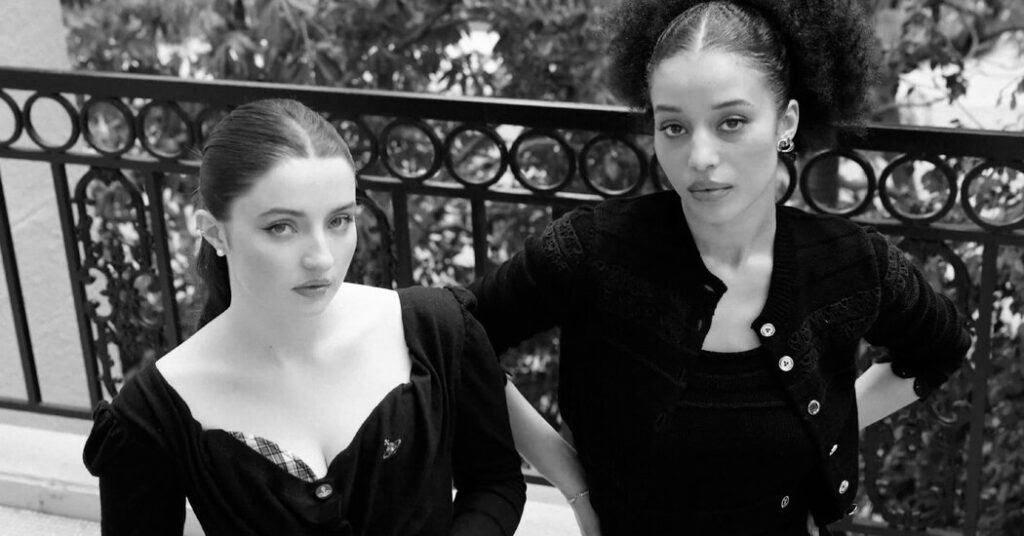
With its focus on the possibilities and vulnerabilities of teenage girls, “The Testaments” feels as present and prescient as ever. In a recent video interview, Chase Infiniti, 25, the breakout star of the movie “One Battle After Another,” and the up-and-coming Scottish actor Lucy Halliday, 22, discussed their version of Gilead, holding on to girlish confidence and the pressure to not screw up the source material. These are edited excerpts from the conversation.
Were you intimidated by the success of those novels and the television show? And who helped you navigate it?
HALLIDAY I think we both definitely felt a weight of responsibility stepping into this because “The Handmaid’s Tale” was loved by so many people, and neither one of us wanted to be the cog that messed that machine up. We were also fortunate that Elisabeth Moss was an executive producer on our show. If we had any questions, we could approach her. She gave us the space to step into these characters and the reassurance that we wouldn’t screw anything up. Day to day, especially at the very start, Mike Barker was incredibly helpful because he was so key to “The Handmaid’s Tale,” directing our first three episodes and the finale.
INFINITI You could tell he truly loves the story and these characters. On top of that, we felt like he truly loved us as individuals and as young actors, and wanted to be there to protect and guide us as much as he could, since he’s been in that world for so long. He came to us at ground zero and was like, “What do you need? What can I help clarify?”
What was it like to play a teenage girl in Gilead?
INFINITI A lot of what Agnes is experiencing, specifically, is universal. Having a crush for the first time, going through puberty, and experiencing friendships at the intensity that she does. Going back to that, after I had experienced it myself when I was her age, was very refreshing. And it was extra special when you were in the scenes with all the girls, because you all felt like you were literally back in high school.
Because there are so many heavy topics in the show, from an audience perspective, there is a stronger sense of lightness because you’re also following girls who have never lost anything, or they don’t even realize that they’ve lost anything. Whereas “The Handmaid’s Tale” is told from the perspective of somebody who’s lost everything and is fighting to get any bit of their past back. You’re seeing Gilead in a positive light, in the best way possible, through the daughters of high-ranking commanders.
HALLIDAY When Daisy comes into Gilead, she obviously has to put on a front and assimilate. But what was very important to me in my conversations with Bruce [Miller] was that she never loses the essence of who she was before she came here. And even though she’s not always able to put that on full display, we wanted to find opportunities to continue sprinkling it in.
Did any aspects of your own adolescence shape your character?
INFINITI I fought for Agnes to wear a bonnet. At first, there wasn’t a head covering for her to go to sleep in, and I was like, “That’s not accurate for somebody with her hair.” So we created a bonnet for her. I also knew that I look younger when I have twists in my hair, and you can manipulate them to do whatever you need. I really wanted to make sure that seeing texture was something that you could relate to on the screen. And I hope that people see it and they’re like, “Oh, her hair kind of looks like mine.”
Your characters start the story in completely different places: Agnes as a commander’s daughter in Gilead, Daisy as an orphan in Toronto. How did you envision their character arcs intersecting?
INFINITI Awakening is a pretty great word to use for Agnes because it can apply to things happening in her life or just having that moment of being a teenager and going through puberty and going, “Oh, stuff is changing really fast, and I’m just trying to get my bearings.” She learns from Daisy’s ability to be unapologetic and not shy away from going with her gut. Listening to her intuition is something that Agnes has suppressed her entire life; Daisy acts on hers. That really helps Agnes.
HALLIDAY Daisy comes into Gilead with a very strong preconceived notion of who she thinks these girls are based on information she’s had from back home. She looks at them with disinterest and disgust. She quickly realizes she cannot live without friendship or community.
What did you two learn from each other?
HALLIDAY She taught me the importance of using your voice, standing up for yourself, and being your biggest supporter, and that no room is ever too big for you to speak up in. By the time we finished filming, I was already a different person in terms of that approach.
INFINITI I learned from Lucy not to lose this sense of joy. It was the same with working with Ann Dowd [cast as the head of school, Aunt Lydia], who is that rare sunshine. With them, you feel this bundle of excitement that’s literally bouncing around that set. I really admired that about Lucy because even on the days when I was really tired or very drained, she would walk onto the set with that spirit that would boost me, the crew and the rest of the cast. It reinvigorates you in a way and brings you out of the routine.
How do you think this story resonates today?
HALLIDAY It shows the difficulty of being a teenage girl and how they are perceived in society. There are so many generalizations and presumptions projected upon girls when they’re that age, and most of them are actually never correct. It’s tough going through that point in your life. And I feel like this show does a successful job at showcasing the universality of the struggles of being an adolescent girl and how those milestones transcend the borders of Gilead.
INFINITI I did an interview not that long ago where somebody asked me, “What was it like to channel from the perspective of a girl who’s living in a world where women are never equal to men?” And I was like, “Well, that’s technically society now.” That was always at the forefront of our minds.
What does the culminating idea that “Nothing’s More Powerful Than a Teenage Girl” mean to you?
HALLIDAY I wish we hadn’t lost that confidence, self-assured nature and drive we had at that point in our lives. I wish that we could bottle it up because if, as adults, women continue to feel that, then we could be running it all, because we should be. As time progresses, our narratives tell us we need to dilute those feelings. But that power, drive and fire are so valuable to us.
INFINITI When I was in high school, a lot of my power came from my friends and the connections we made, because, if you think about it, the things that a group of girls can get done and the information they can find out is powerful. Especially when they have strength in numbers. That’s something I think that we carry over into adulthood, which I love. We never lose that sense of girlhood.
Salamishah Tillet is a contributing critic at large for The Times and a professor at Rutgers University. She won the Pulitzer Prize for criticism in 2022, for columns examining race and Black perspectives as the arts and entertainment world responded to the Black Lives Matter moment with new works.
The post In ‘The Testaments,’ Teen Girls See Gilead Differently appeared first on New York Times.