AUSTIN — Shaimaa Zayan, in beige headscarf and floor-length skirt, walked swiftly toward the microphone at the front of the packed meeting room, passing people wearing buttons with a red slash through the word “sharia.”
Zayan, 42, a former Texas teacher who works for the local chapter of the Council on American-Islamic Relations (CAIR), the nation’s largest Muslim civil rights group, had come on Tuesday to the state’s board of education hearing to talk about proposed changes to the state’s social studies curriculum that she thought unfairly portrayed Muslims.
But before she could speak, board member Brandon Hall, a Baptist pastor from rural North Texas, objected.
“CAIR has been designated a terrorist organization by the state of Florida, by the United Arab Emirates and by the state of Texas, by a proclamation from Governor Abbott,” Hall said. “Will you have a designated foreign terrorist organization testify at the State Board of Education?”
Board Chair Aaron Kinsey, the Republican CEO of a West Texas oil pipeline company, was quick to respond: “As covered in previous meetings, the testifier still has First Amendment rights, and I will take the testimony at this time.”
That’s when Hall and board member Julie Pickren — a Houston-area Republican, small-business owner and home-school mom — walked out.
This moment of drama — as well other confrontations on the sidelines of the day-long public hearing by the GOP-dominated board — provides a window into the heated political environment in Texas, where Republican state lawmakers increasingly speak of Muslim extremism as a threat.
A combination of a high-profile election year, the war against Iran and a deadly shooting in Austin last month by a gunman who killed three people while wearing a hoodie that read “Property of Allah,” has encouraged GOP state lawmakers in recent months to try to limit the influence of Muslim groups. In the process, they have embraced rhetoric that critics call Islamophobic. One GOP candidate for statewide office, Bo French, told a national conservative conference outside Dallas last month, “We call it sharia, but the problem is actually Islam.”
Gov. Greg Abbott, Texas Attorney General Ken Paxton and other state lawmakers have pledged to ban “sharia law” and successfully blocked Islamic housing developments. State officials initially refused to allow Muslim parents to apply to the new $1 billion state voucher program for their children to attend Islamic schools but caved last month after parents sued, alleging religious discrimination. On Monday, Paxton — who is running against Sen. John Cornyn in the Republican primary runoff election for U.S. Senate — announced he was investigating a Dallas-based Islamic religious court.
Sharia, based mainly on the Quran and the teachings of the prophet Muhammad, is a body of religious rules meant to guide the day-to-day lives of Muslims, but it is open to a broad range of interpretations. The term, however, has often been used by some conservative lawmakers to frame Islam as a threat to American values and its judicial system.
For Zayan, the antagonism toward her faith expressed by officials at the highest levels of U.S. politics has presented challenges as a representative of the more than 300,000 Muslims who live in Texas. At previous education board hearings, she received death threats and had to be escorted to her car by a state trooper. She accused Pickren of posting a video on social media in February that misrepresented her testimony, and Hall of calling for CAIR members to be deported on Stephen K. Bannon’s “War Room” podcast. (Last month, Hall posted on Facebook: “It’s time for mass deportations and a ban on Muslim immigration.”) Zayan alerted the board to both incidents but said nothing happened.
“They just want to erase Muslims from history,” she said, and “push biblical things” in a curriculum that influences education in many other conservative-run states.
On Tuesday night, after the board members walked out, Zayan had two minutes to share the message she had waited 10 hours to deliver: The proposed social studies curriculum contained few mentions of Muslims, and those that remained portrayed them as terrorists.
But she would have to spend more time defending her organization than addressing the curriculum.
“It’s not a safe environment,” she said. “The way they harass people is just very aggressive, and the board chair is permitting it.”
Dueling rallies
Early Tuesday morning, Zayan arrived at the state building where the board meets, named after civil rights pioneer Rep. Barbara Jordan (D-Texas), to find the halls unusually crowded with hundreds of attendees. Many wore red T-shirts that said “Patriot Academy” on the front and “Defend freedom, defeat sharia” on the back.
“Who are they?” she asked.
Zayan picked up the 11-page list of those registered to speak, 330 total, and searched for her name. She found it on the last page, number 313. Zayan would probably have to wait until at least 8 p.m. to testify. On the speakers list, she saw members of Rise Align Ignite Reclaim Foundation, a conservative Texas-based group that claims to fight Islamist extremism. But she also saw fellow opponents of the new curriculum, including a half-dozen women also in hijabs, who greeted and hugged her.
“This is really a lot,” Zayan said of the crowd. “I’m overwhelmed.”
She felt lightheaded and went downstairs to the building’s cafeteria to get a halal snack and prepare to speak at a noon rally on a grassy square outside. A friend from the progressive nonprofit Texas Freedom Network warned her that conservatives planned a competing rally in the lobby.
While Zayan was gone, some of the attendees who had filled the meeting room and two overflow rooms began talking out in the halls, quoting scripture and the Quran. Members of the Patriot Academy, a West Texas nonprofit organization that trains “citizen leaders” to “help restore our Constitutional Republic and the Biblical principles,” asked women in hijabs why they supported sharia law that allows husbands to beat their wives and marry underage girls.
The women told them Islamic law did not allow either of those crimes, asking, “Where in the Quran does it say that?”
The men couldn’t cite a verse.
Brody Huff, 22, who works for Patriot Academy, said it was the first time he had spoken to a Muslim. “It’s really unusual to have that sort of exchange. Usually it’s just people shouting at each other,” he said, as he stood near the women, dressed in a cowboy hat and boots.
He had come to the meeting, he said, because he didn’t want to see public education “influenced by religions I see as false.” While his conversation with the Muslim women wasn’t going to change that, he said he planned to look up some of the things they mentioned once he got home.
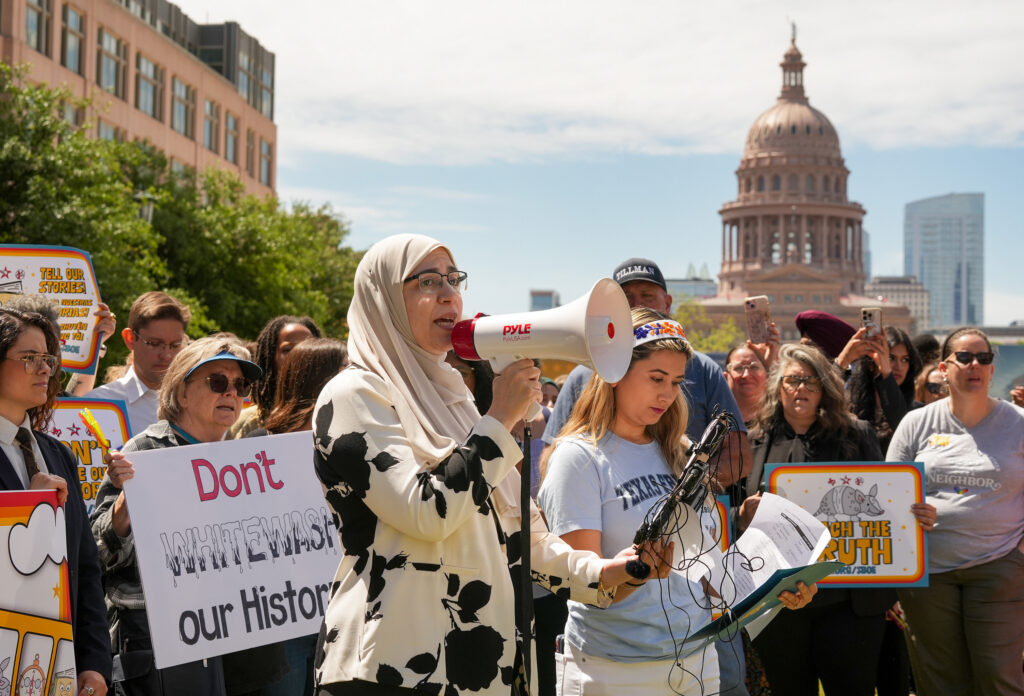
Outside at Zayan’s rally, a heckler shouted, “America is a Christian nation!” Zayan took the megaphone.
“Yes, I am the person they try to bar from testifying every time I show up,” she said to cheers and applause.
“We have come together today at this turning point in history to protect our education, our constitution, our civic life and our democracy,” she said. “Public education must serve every student, regardless of faith. No single religion or ideology should dominate a classroom.”
Inside the lobby, Hall, the board member, prayed over conservative supporters. He stood with fellow board member Pickren; Abraham George, the state GOP chairman; and several Republican state legislators in front of a banner that read: “Don’t sharia my Texas. Sharia under the Islamic regime gouges out the eyes of women.”
“Lord, we invite you into this building, we invite you into the room,” Hall said. “We pray for social studies standards that will give our children the excellent education that they deserve.”
Later, Pickren explained that she walked out when Zayan spoke because she was following the will of her constituents, who live along what she referred to as “the Gulf of America” — the name President Donald Trump chose to relabel the Gulf of Mexico.
“The over 2 million people I represent don’t care what a terrorist has to say,” Pickren said.
In the afternoon, Zayan went to a friend’s hotel room to pray. When she returned to the meeting, crowds in the hallways had thinned, but overflow rooms remained full and divided. She watched two young men testify that they had been threatened in the hallway. One of them, who is Pakistani American and was born in Texas, said he was told, “This is our country.”
‘Labels matter’
By the time Zayan took the lectern, it was past 6 p.m.
“I’m a former certified Texas teacher, a graduate of the special-education and diversity program at UT Austin, and the operations manager with the Austin chapter of one of our nation’s largest civil rights organizations,” she began.
The proposed social studies curriculum, she said, “lacks a definition of terrorism and falsely associates it with one religion by using the controversial phrase ‘radical Islam.’”
“When terrorism is not clearly defined and used only in association with Muslims, we ignite hate and prejudice against the Muslim community,” she said. “Definitions and labels matter, and our students deserve standards that help them objectively and critically evaluate both historical and current events.”
After Zayan’s time expired, Hall returned to the room so he could question her, but not about her views on the curriculum.
Was she a CAIR employee, he asked.
Yes, she said.
“Okay, so you were paid to be here,” he said.
Hall then asked whether CAIR had been declared a terrorist organization by the United Arab Emirates.
“CAIR has no evidence of any violence. We are a domestic civil rights organization in the U.S.,” Zayan said.
“Did they designate CAIR?” Hall interrupted.
“Before you question me, I have a question,” Zayan said. “If a state board of education member refused to listen to me …”
Kinsey, the board chair, banged his gavel.
“This is your warning, ma’am,” he said. “We are about nine hours into this meeting and it has gone pretty well, much better than I expected. The member will ask the questions, you will respond, please, if you so wish.”
Zayan conceded that CAIR had been designated a terrorist group by the UAE, but noted that CAIR had challenged the designations by U.S. states in court and “a designation is not a law.”
One of the five Democrats on the 15-member board said Hall’s questions were not germane to the discussion of the social studies curriculum. Hall said it pertained to history; Kinsey agreed.
Hall then asked whether the prophet Muhammad married a 6-year-old girl. Zayan said that was inaccurate.
Marisa Perez-Diaz, a San Antonio Democrat and former school administrator, quipped that Hall’s questions might be answered “if we had more representation in diverse religions in our studies.”
Staci Childs, a Houston lawyer on the board who served on the education team of President Barack Obama’s Domestic Policy Council, asked Zayan to “talk just a little bit about if we don’t revise the standard that you provided here, the impact to the students.”
“It opens the door to bullying, bullying of Muslim students, name-calling as terrorists,” Zayan said, noting that she had been invited to participate in a Texas Department of Public Safety terrorism prevention course and that in the proposed curriculum, Islam “is the only religion, the only ideology, even, that’s associated to radicalism, that’s associated to terrorism, which is not true and not factual and unfair.”
Once she finished, Zayan walked outside and was greeted by grateful supporters. She chatted with the state trooper who had escorted her to her car after a meeting months earlier.
The Tuesday meeting would drag on into the next morning, but the social studies curriculum would not be resolved: There was at least one more meeting scheduled.
“I’m not submitting,” Zayan said as she left, this time without an escort. “I’m coming again in June.”
The post In Texas, a state hearing on social studies becomes a clash of religions appeared first on Washington Post.