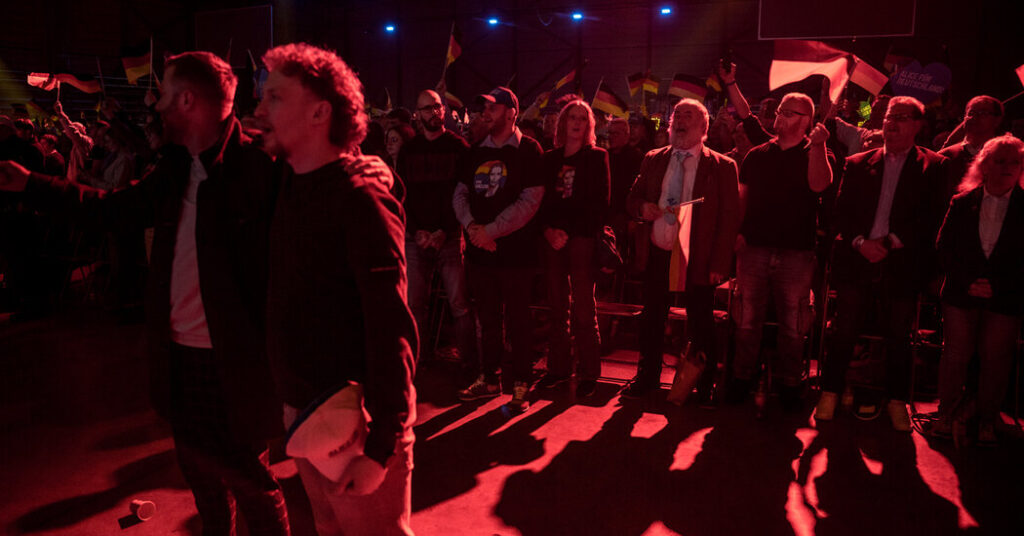
Since the end of World War II, no far-right political party has held power in German state or federal government. That could change this fall in a small pocket of eastern Germany, as economic stagnation and voter backlash toward mass migration batter the centrist political establishment.
Polls show the Alternative for Germany party, or AfD, could win an outright majority of seats in September in the state of Saxony-Anhalt, near Berlin. The party’s agenda, if put in place, would give the country its first look at what the AfD, the second-largest federal party today, hopes could ultimately be a cultural and demographic overhaul of German life.
Leaders of the party laid out their goals for the state in interviews and a 156-page platform. They appear partly unworkable, far exceeding the power of a state government. The more attainable elements amount to a vision for turning Saxony-Anhalt, a relatively small state, into a magnet for large, German-born, socially conservative families, and a hostile environment for many immigrants.
Under their proposals:
-
Refugees would be deported or moved into group homes.
-
Large families would get tax breaks.
-
Child care, already heavily subsidized by the government, would be free.
-
Public broadcasters would lose funding.
-
Schools would ban gay pride flags.
-
They would also teach more Russian.
Some of the proposals echo the conservatism of President Trump, while the family welfare ideas evoke those of Zohran Mamdani, the liberal New York City mayor.
“I want to give the citizens in Saxony-Anhalt their good, old, secure Germany back,” Ulrich Siegmund, the AfD’s candidate to govern the state and a TikTok star, told us in an interview. We met in the scenic, centuries-old heart of Tangermünde, a town on the Elbe River popular with bicycle tourists.
“It will be a very beautiful country with a very good spirit of optimism,” he added, “certainly for the children, for the families.”
To its critics, the policy platform exacerbates long-running concerns about the party, which German intelligence has formally investigated for extremism, and whose leaders have variously belittled the Holocaust, revived Nazi slogans and maligned foreigners.
Eva von Angern, a state lawmaker from the far-left party Die Linke, called the AfD’s plans “a violation of human rights and unconstitutional” and predicted the party would fall short of a winning majority.
“They repeatedly demonstrate who, in their view, doesn’t belong in Saxony-Anhalt,” Ms. von Angern said, including “people of different skin color, people with a migrant background and L.G.B.T.Q.+ people.”
Saxony-Anhalt, with about 2.2 million people in a country of more than 83 million, may seem an unlikely place to root a political overhaul centered on expelling immigrants and nurturing young families. It has the oldest population of any state and one of the country’s smallest concentrations of migrants, according to German census numbers. About one of every 13 residents has an immigration background, compared with two of every five in Berlin.
But Saxony-Anhalt combines several of the factors that have helped fuel the AfD’s rise.
It lies in the former communist East, where residents are less wedded to mainstream parties that were founded in the West and more open to anti-establishment messages. It is also one of Germany’s poorest states. The unemployment rate there last year was 8.3 percent, 2 percent above the national average.
For those reasons, “the politics of migration is a very strong factor, despite the low visibility of migrants here,” said Marcel Lewandowsky, a political scientist at Martin Luther University Halle-Wittenberg in Halle, the state’s second-largest city.
In its section about migration, the AfD’s governing platform for Saxony-Anhalt contains 43 points. Some, like ending the right to asylum and barring some immigrants from settling in the state, appear to violate federal law and could prove impossible for a state government to enact.
Others are more achievable, though contentious. They include converting a government welcome center for migrants into a deportation detention facility and segregating the children of asylum seekers into refugee-only schools.
We met a lead author of the platform, Hans-Thomas Tillschneider, at the state capital building in Magdeburg. He had a graying red beard, large round glasses, a maroon turtleneck and tan slacks. He showed off his red MAGA mug.
Mr. Tillschneider is an immigrant himself, born in Romania to ethnic Germans. His parents fled that country’s dictatorship when he was young, and Mr. Tillschneider grew up in southwest Germany. Vacationing in the Middle East as a child, he told us, he grew fascinated with the sound of the Quran. At university, he studied Islam.
Today, he said, Saxony-Anhalt’s largest problems start with migrants who are slated for deportation but remain in the state.
He said the party would not deport anyone who was in the country legally. “We want a new government here, we don’t want a revolution,” he said.
But, he said, the party does want major changes in a wide range of other areas like a removal of gay pride displays from schools, a moratorium on new wind turbines and a rollback of other green policies.
It also wants to normalize German relations with Russia after years of hostilities related to Russia’s invasion of Ukraine. It calls for an end to sanctions on Moscow — another federal issue, not a state one — and more Russian language instruction in schools.
Mr. Tillschneider, who attended a birthday celebration for President Vladimir V. Putin of Russia at the Russian embassy in Berlin last year, called the Russian language and literature pillars of European culture. “When Biden still ruled the U.S.A., I was very pro-Russian,” he told us, “because then Russia was, so to speak, the only partner of values.” Now, he added, “I am also a big friend of Trump.”
He is one of a few AfD members named by German intelligence in a report that was the center of its investigation into the party for extremism. The report, currently under judicial review, criticized Mr. Tillschneider for accusing all mainstream parties of helping “plunder” Germany. In our interview, Mr. Tillschneider said the intelligence agency was “becoming more and more like the Stasi,” the former secret police of East Germany.
If Mr. Tillschneider is a policy brain behind the AfD’s plans, Mr. Siegmund, the candidate for governor, is its smiling face. His social media posts are relentlessly upbeat, whether he is explaining policy, hanging out with school children or organizing a park cleanup. He has more than 600,000 followers on TikTok and says he will use social media prolifically once he is in government, explaining challenges and even admitting mistakes.
Mr. Siegmund, wearing a Tommy Hilfiger sweater, met us at a bakery in Tangermünde. He talked about improving hospital care and schools and reversing economic decline. He was eager to emphasize the AfD’s plans to encourage native-born Germans in “traditional families” — with a mother and a father — to have more children. “I want to think long-term across generations,” he said.
Ms. von Angern said that focus threatened to make life harder for working mothers. “For the AfD, women are supposed to support men and, ideally, focus solely on children and the household,” she said.
AfD party leaders acknowledge that Germany needs workers and that it will need even more if the party’s deportation agenda is successful. So they want to offer large financial incentives for German families to grow — a three-child family, for example, would receive a roughly $9,200 stipend.
We asked if there was room in that future Saxony-Anhalt for new migrants.
“It depends on the migrants,” Mr. Siegmund said, “whether they want to behave themselves and whether they want to make a contribution.”
We left the bakery and walked through town. Nearly everyone waved or smiled at Mr. Siegmund as he passed. We came to a large church with a chimney, where a bird had built a large nest. He asked if America had those.
The bird stood up on long legs.
It was a stork.
Tatiana Firsova contributed reporting from Berlin.
Jim Tankersley is the Berlin bureau chief for The Times, leading coverage of Germany, Austria and Switzerland.
The post In Germany’s East, the Far Right Could Soon Take Power. This Is Its Plan. appeared first on New York Times.