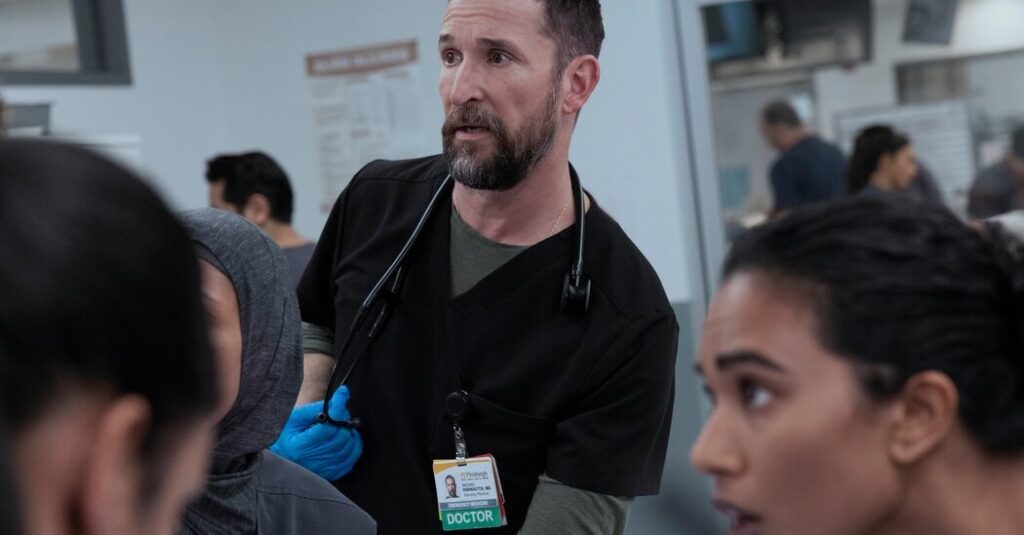
There are as many memoirs about emergency medicine as there are sick people languishing in the waiting room in “The Pitt,” HBO’s gritty, gutsy medical drama. Here are a few that replicate the feel of watching the show — the high-octane pace, the roller coaster stakes, the unforgettable personalities — as Season 2 races toward its conclusion.
The Blood of Strangers
by Frank Huyler
Suffused with the same intensity and abiding humanity as “The Pitt,” this slim collection of vignettes — by a physician and poet in Albuquerque — evokes the blood-soaked sights and smells of the emergency room.
It opens like this: “We had no warning on the radio at all. The paramedics were urgent, moving quickly and breathing hard. Multiple gunshot wounds, they said, with unstable vital signs. … I took the young one. He lay soaked in sweat, with a blue-red hole in his neck. ‘I can’t move my feet,’ he yelled, over and over.”
Between crises, Huyler pauses to witness. “It suddenly seemed very important that I look closely, as closely as I could,” he writes, “at this man taking on for the moment the role of the father to the dead son, kissing him softly, holding his hand.”
Code Gray
by Farzon A. Nahvi
In the E.R., doctors have to make split-second, life-or-death decisions, and then act on them (remember Dr. Al-Hashimi coolly performing that slash tracheotomy during a tense scene in Episode 10 this season?). Nahvi recounts dozens of such moments in “Code Gray,” adding that when people learn he is an E.R. doctor, they “often ask how I deal with encountering death.” He usually tells them, “You get used to it.”
“That is a lie,” he writes. “You don’t get used to it.”
The Beauty in Breaking
by Michele Harper
The details crackle over the radio: A baby, not breathing, is on the way in. “My physician assistant had just left, there were six patients in the E.R., one had just been brought in, and three more were in the waiting room,” Harper, an E.R. physician, writes. “The truth is, there is never a good time for a pediatric code.”
Like the doctors on “The Pitt,” even when the job is overwhelming, she refuses to close herself off from her patients’ pain: “We need to stand face-to-face with it … so we can choose exactly how we want to be in this world.”
She also tells us, plainly and without obfuscation, what it’s like to be a Black doctor on the front lines.
Something for the Pain
by Paul Austin
The pressure of an emergency room in crisis, dialed up to the max, thrums through the pages of this memoir. Austin opens up about how the stress of the job affected him: He once broke the back door of his house after a shift because he was annoyed that it was locked, and his wife told him that after he left for work each morning, “she’d lean against the wall and slide down until she was sitting on the floor. Crying about the tension I’d left in my wake.”
On “The Pitt” we watch, over and over again, as the staff bends under the weight of suffering and strain. Austin describes what that feels like so beautifully it’s impossible to look away.
Singular Intimacies
by Danielle Ofri
Reading Ofri’s memoir about her medical training at Manhattan’s Bellevue Hospital, where she “struggled to find a place for my ill-adapted body, feeling vaguely like a dinosaur in the age of mammals,” it’s impossible not to think of Dr. Mohan, navigating the emotionally grueling grind and trying to find her purpose on this season of “The Pitt.” Ofri reminds you, on every page, that doctors are people, too: fallible, overwhelmed but doing their best.
The Emergency
by Thomas Fisher
Fisher, an E.R. physician at the University of Chicago Medical Center, opens his memoir as Covid-19 begins to smash through the city’s South Side, and his account of that time is more gripping than any thriller.
He also captures the intense, blood-spattered choreography we have watched unfold so many times on “The Pitt” as colleagues scramble to save a patient.
“The beauty of emergency medicine,” Fisher writes, “is the way an entire team can enter a flow state — perfect immersion and focus with no gap between thought and action.”
Patient Care
by Paul Seward
“My goal in writing this book is to tell the reader what it’s like to work in the emergency room,” Seward explains. “I don’t mean just what happens there; rather I mean what it feels like to work there.” And so, as he unspools stories from the past 40-odd years, we are in his head as he assesses situations, thinks through possibilities and makes decisions.
“Does that sound difficult?” he asks after taking the reader through a touch-and-go intubation. “Did your palms sweat a little as you imagined yourself doing the procedure? It is, and they should.”
Elisabeth Egan is a writer and editor at the Times Book Review. She has worked in the world of publishing for 30 years.
The post If You Love ‘The Pitt,’ You’ll Love These Books appeared first on New York Times.