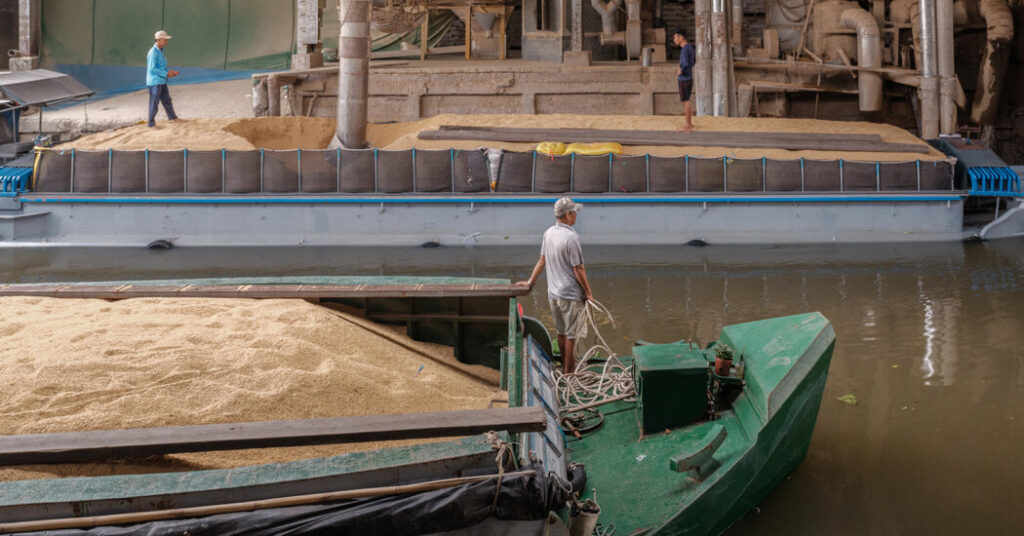
A dozen barges, heavy with just-harvested rice, cut their engines and floated to a halt. Two huge rice mills upriver stopped de-husking and bagging as electricity prices peaked.
It was midmorning in Vietnam’s Mekong River Delta — one of the most productive agricultural areas on Earth, in a nation that is the world’s second-largest exporter of rice.
Only birds and a stray motorbike could be heard.
And in the quiet, anxieties unfurled.
Boat captains talked about diesel prices doubling, surging higher and for longer than they did after Russia invaded Ukraine in 2022. Workers on the water and near forklifts worried about having to find new jobs. The scarcity of fuel and fertilizer from the Middle East was already seizing up a food producing giant, and no matter how the war in Iran goes, the next planting looked shaky too.
“If I grow new crops, I’m just pouring money into the ground,” said Vo Minh Tam, a rice farmer who owns a farm supply store where he’s stopped stocking fertilizer because so many neighbors have paused plans for the May growing season. “I’d rather leave it abandoned.”
Vietnam’s stalled land of plenty shows how the war — even with the two-week cease-fire announced on Tuesday — has caused an immediate shock to the global food supply that’s sparking a chain reaction of long-term disruption. Until the massive backlog of fuel tankers pass through the narrow Strait of Hormuz that Iran has now promised to stop blocking, and until long-term peace looks probable, pain for farmers will continue, along with the risk of under-fertilized crops, lesser yields and higher grocery prices worldwide.
Asia is especially reliant on the Middle East for oil and fertilizer. The Mekong Delta and its 19 million residents are not easily disturbed or defeated, but even before the war, climate change was pushing saltwater into fields, twisting arms and budgets. The gut punch of an oil shock has added to frustration with an energy source that already felt like tainted treasure — black gold once just valuable, now looks cursed.
The war spurred fuel rationing within a week. Vietnam lacks ample reserves, so resource allocation has been zero-sum. One sector ends up pitted against another, creating a dilemma for this one-party Communist state.
Who wins in a fight for scarce resources? City-dwellers, manufacturers or the Mekong Delta, a pump-irrigated plain that exports eight million tons of rice, four million tons of fruit and nearly two million tons of seafood every year?
The Mekong Delta sprawls across Vietnam’s southern tip, covering an area larger than the Mississippi Delta. Complex irrigation networks run like capillaries through lands where shrimp are farmed, poultry is raised, and citrus, durian and rice grow side by side. Everything, including water and fertilizer, has been costlier to move since the start of the war, and no one knows whether the nations negotiating for peace can be trusted to create stability.
“These leaders, I think maybe they’re crazy,” said Nguyen Thanh Tam, 71, a rice farmer with deep family roots in the Mekong. “I wish we could go back to the old days,” he added, “when our weather and lives were more stable.”
Mr. Tam, a soft-spoken man with deep wrinkles from a life in the sun, had started the harvest a few weeks ago feeling good. He expected to earn enough for a new Honda scooter costing about $800 — the first of his life. Now, even after hearing about the cease-fire, he’s sticking with his silver bicycle.
“I remain very worried,” he said on Wednesday, soon after the cease-fire was announced.
Mr. Tam said he fears that prices will stay high, especially for fertilizer. A third of the world’s supply comes from the Middle East and global prices for urea, a common fertilizer for rice, are up more than 70 percent since January.
The farm supply store owned by Mr. Minh Tam is usually crammed full of the stuff. He’s got room for 100 tons. In late March, he had only four. Empty pallets gathered dust on his concrete floor near a pink rice cooker with a mouse’s face.
“I’d be certain to lose money if I stockpile fertilizer now,” he said. “Farmers are all complaining about how expensive it is.”
Inactivity is an aberration in Vietnam. Fifty years after a brutal war followed by grinding famine, the country moves with more throttle than brake. When the Covid pandemic hit, farmers bought drones for seeding to reduce clustering by seasonal workers.
But studies of agricultural economics have shown that uncertainty freezes enterprise. Not even the Mekong is immune.
On a recent afternoon near the Cai Be market, 60 miles from Ho Chi Minh City — where traders usually clog traffic, moving rice to highways and ports — men with thick shoulders sat still on red plastic chairs.
In one warehouse, a laborer swung on an army green hammock between walls of premium rice stacked to the ceiling.
“Normally, we’d be racing against time, loading sacks of rice onto trucks to fill orders,” said Phan Van Suong, 56. “But now there are no orders.”
Around 90 percent of the rice Vietnam ships — mostly to the Philippines, but also to Africa and the United States — comes from the Mekong. Normally.
In today’s abnormal times, buyers are hesitating. Shipping delays of 10 to 15 days have become common as carriers slow steam to conserve fuel. Basmati rice from India bound for the Middle East has been unable to get through the Strait of Hormuz. In the Philippines, wholesalers are not sure when there might be enough diesel to move imports around the country.
That means rice has been piling up across Asia, creating a short-term paradox: wholesale prices declining as production costs rise. After a year of healthy harvests, traders are paying farmers less right now to hedge against future risk.
If that tamps down inflation, it may not be for long, according to food economy experts, who expect sharper price hikes for crops like vegetables that are harder to stockpile.
“Complex systems have a habit of creating wicked problems,” said Paul Teng Piang Siong, a senior fellow in food security at Singapore’s ISEAS — Yusof Ishak Institute.
Even if a lasting peace emerges, he added, the consequences of America’s latest military adventure will likely linger for agriculture. In Vietnam, where the soil still holds unexploded American bombs from more than 50 years ago, anger has been firing in many directions.
Nguyen Thanh Can sells diesel at a floating gas station on a major waterway. His tanks can hold around 100,000 liters (about 26,400 gallons) but since the war started, his distributor will only give him a few thousand at a time. When he ran out on a recent weekend, barge captains were furious.
“They accused me of holding onto fuel, waiting for prices to go up,” he said. “I had to show them the tanks.”
He swung open a hatch, revealing mostly empty space.
“I’m selling everything I have,” he said. “It’s not just about high prices. I don’t have enough.”
Tung Ngo contributed reporting.
Damien Cave leads The Times’s new bureau in Ho Chi Minh City, Vietnam, covering shifts in power across Asia and the wider world.
The post How War in the Middle East Paralyzed an Asian Food Giant appeared first on New York Times.