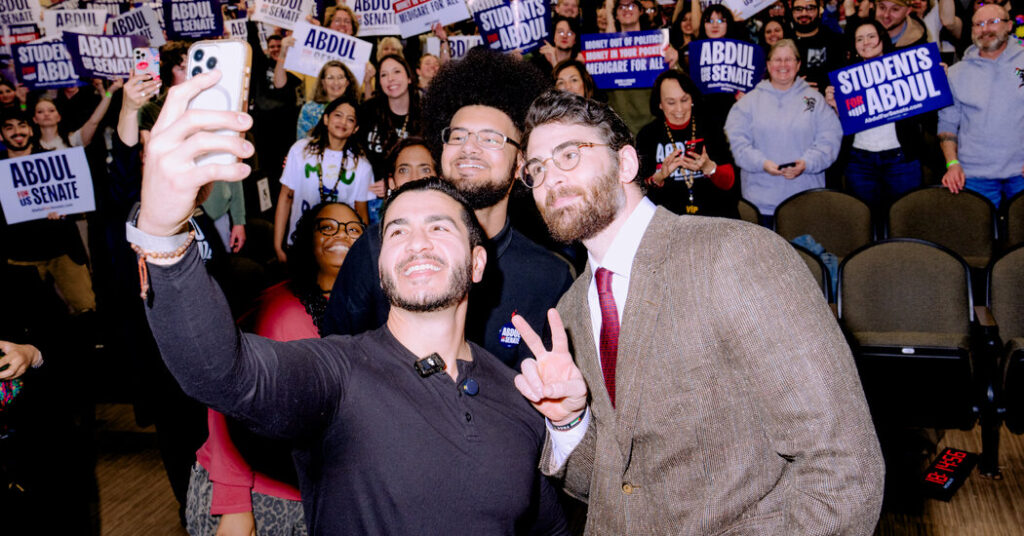
Deep inside the sprawling campus acreage of Michigan State University, the leftist political pundit and streamer Hasan Piker stood before a packed lecture hall, taking in a rapturous welcome.
The crowd of about 400 people, many wearing hoodies and headphones, plus the occasional kaffiyeh scarf, had waited hours outside on a frigid Tuesday afternoon to see Mr. Piker and Dr. Abdul El-Sayed, a progressive Muslim candidate running for U.S. Senate in Michigan’s tightly contested Democratic primary.
“For the last two and a half years they smeared people like myself and people like yourselves,” Mr. Piker said, pointing a finger toward his listeners. “They claimed we were radical, said that we were wrong, and yet we persevered because we understood the violence that was taking place.”
The implied “they” here wasn’t Mr. Piker’s normal opposition on the right, but instead his critics within the Democratic Party. In recent weeks, they have dredged up the streamer’s past comments about the Hamas-led Oct. 7 attack on Israel (which he has called the “direct consequence” of Israeli and U.S. actions) and the Sept. 11 attacks (which he once said America “deserved,” though he later apologized).
It’s a charge amplified by the founders of the center-left think tank Third Way, which wrote a Wall Street Journal opinion piece last month, urging the Democratic Party to break ties with Mr. Piker for his “Jew hate.”
Onstage, the avowed socialist had but one short response to his detractors.
Screw ’em, Mr. Piker said — though he opted for a four-letter word that shattered the crowd’s attentive silence into a roar of defiant approval.
This anti-establishment rebel, who has a professed love for things like streetwear, anti-imperialist politics and marathon streaming sessions, is now at the center of white-hot debate among some in the Democratic Party during his professional turn on the stump. In recent months, Mr. Piker’s stream has featured a number of prominent Democratic politicians, including Mayor Zohran Mamdani of New York; Representative Ro Khanna, Democrat of California; and Saikat Chakrabarti, a progressive candidate running to fill Representative Nancy Pelosi’s seat.
With the approaching midterm primary elections, Democrats seem to want what Mr. Piker has — a devoted audience of young voters, mostly male — yet will not embrace the 34-year-old commentator. Despite the party’s well-documented struggles with winning over highly online young voters, some Democrats representing the party’s establishment, pro-Israel flank are making a coordinated push to drive Mr. Piker out of their coalition.
CNN and Fox News have made Mr. Piker the subject of round tables; Politico has surveyed Democratic politicians about the so-called Piker pickle.
And now, Mr. Piker’s primary antagonist, Third Way, has begun to circulate a letter demanding that Dr. El-Sayed disavow Mr. Piker over his past comments. The website Jewish Insider has imitated this tactic to pressure Democrats who have received even a whiff of support from Mr. Piker, as in the case of Senator Jon Ossoff of Georgia, to publicly condemn the streamer. (Mr. Ossoff’s Senate re-election campaign has so far ignored the group’s inquiry.)
Ahead of the rally, Mr. Piker’s planned appearance had also drawn attacks from Dr. El-Sayed’s primary rivals.
It’s a debate that many of the students at the Michigan State rally found laughable. “I just don’t think Hasan’s antisemitic at all,” said Colin Smith, 20, who was taking a selfie with the stage in view as Mr. Piker was introduced.
Mr. Smith, a student at nearby Western Michigan University in Kalamazoo, like many at the event, first came to watch Mr. Piker’s stream as a teenager during the pandemic years. He is also a supporter of Dr. El-Sayed, whom he discovered through Senator Bernie Sanders during a Fighting Oligarchy event in the state.
Mr. Smith felt that much of the criticism was motivated by religious bias, given Mr. Piker’s Muslim identity.
“He’s done so much for the Jewish community, constantly pushing back against actual antisemites like Nick Fuentes,” Mr. Smith said, referring to the 27-year-old white nationalist streamer.
Mr. Piker likes to describe himself as a “megaphone” for his ability to call out the failures of the Democratic establishment and, in turn, lure back disaffected young men, some of whom have drifted to the right or dropped out of the political process entirely.
Nick Seraphinoff, a 29-year-old project manager who had traveled from Detroit to attend the rally, described himself as one of those disillusioned young men. After Mr. Sanders’s exit from the presidential primary in 2016, he stopped voting, a decision he now regrets. He credits Mr. Piker for bringing him back into the fold after learning about Dr. El-Sayed on the nightly stream.
Like many of the young voters who listen to Mr. Piker, Mr. Seraphinoff is frustrated by Democratic Party’s refusal to condemn the war on Gaza.
“There has to be a willingness to meet the people where they are,” he said.
Earlier that day, Mr. Piker, in an interview with The New York Times, described the criticism of him as “boomer desperation.”
During the conversation, Mr. Piker said his opponents in the Democratic Party had little understanding of the “new media landscape.”
He then began the day’s livestream, commenting on President Trump’s threat to destroy Iran’s entire “civilization.” For the next nine hours, Mr. Piker’s every move could be followed on Twitch as he traversed green rooms and campaign vans, press gaggles and auditorium stages, accompanied all the while by a shaggy-haired cameraman named Mauricio Miranda.
The stream, which held steady at about 35,000 viewers throughout the day, seemed to exist as a parallel universe. The chat furiously commented on Mr. Piker’s surroundings in a thread that moved too fast to follow. Students thronged around Mr. Piker asking the streamer for selfies. At Michigan State, one student asked Mr. Piker to autograph a copy of the labor manifesto “Secrets of Successful Organizing.”
“Obviously, he’s tapped a nerve for a lot of folks who do not trust traditional media to sift through our politics,” Dr. El-Sayed said in an interview.
Dr. El-Sayed, who lost his bid to be the Michigan governor in 2018, appeared alongside Mr. Piker last summer as the two men traveled to Dearborn, home to one of the largest Muslim communities in the country. They met locals and indulged in some manosphere-style recreation, working out and eating kebabs.
Dr. El-Sayed, a former health director in Wayne County, has stood by Mr. Piker during a fraught moment, refusing calls to disavow the streamer’s past comments. He told reporters on Tuesday at Michigan State that these efforts amounted to “cancel culture.”
While speaking with The Times, Dr. El-Sayed, who is a practicing Muslim, stopped short of describing himself as “anti-Zionist,” as Mr. Piker does.
“Do I believe that Palestinians deserve equal rights to things like dignity, self-determination and peace?” he said. “Yes, I do. And if that makes me anti-something, I don’t know. I guess I’m just more pro-something.”
For Muslim Americans like Dr. El-Sayed, the memories of the 2024 presidential election are still “painful,” he said, partly because of what he sees as the Democratic Party’s refusal to engage with pro-Palestinian activists.
At the time, Dr. El-Sayed supported the “uncommitted” movement, an Arab American-led push for Democratic candidates to back a cease-fire in Gaza.
Ali Allam, 21, a senior at the University of Michigan and a chair of the Muslim Coalition on campus, pointed out that in 2024, Kamala Harris had campaigned alongside the Republican former congresswoman Liz Cheney, a political figure he considered to be far more contentious than Mr. Piker.
“She literally helped architect mass murder overseas,” said Mr. Allam, referring to Ms. Cheney’s support for the Iraq war. “But we didn’t hear any of the backlash we’re seeing now for a Twitch streamer.”
In a brightly lit classroom, Mr. Piker and Dr. El-Sayed wrapped up their final interviews of the day as weary campaign staff members collapsed onto chairs.
“It’s different,” Mr. Piker said of his experience on a campaign trail. His livestream, after nine consecutive hours, had finally come to an end. “You’re thinking about how the things you say might negatively impact the candidate. It’s hard to dial it back for me. But I think I did it.”
Nathan Taylor Pemberton is a reporter covering politics and culture for The Times.
The post Hasan Piker Can Stream, but Can He Stump? appeared first on New York Times.