If you were a teenager in the age of the video store, you may have heard of a taboo 1978 horror film called “Faces of Death.” It was, as the story went, a documentary in which a pathologist named Francis B. Gröss showed many videos he had compiled of people dying, the better to understand the moment of transition between life and whatever comes next. If you managed to rent it, you’d see people get killed by animals, electric chairs, wars, cannibals and a lot more.
“Faces of Death” is probably the first true viral video, long before the internet laid that laurel on more banal clips of cats and cooking. Was it real? Was it fake? Did it matter?
The truth was somewhere in the middle: It was technically a mockumentary, and nobody (we’re told) was murdered for the film. Dr. Gröss was played by the actor Michael Carr. Some of the deaths were staged. But some of the footage was real, purchased from news stations, medical researchers, other documentaries and other sources. A relief, but still unnerving, any way you slice it.
Daniel Goldhaber’s new horror-chiller “Faces of Death” purports to be a remake of the 1978 flick, but that’s a bit sly. It’s more of a meta-remake, less about watching death than about how watching itself has changed in the almost 50 years since the first version came out. Blood-soaked and intense, it is occasionally uneven in tone, with varying degrees of skill from the cast. But story-wise, it mostly holds together, a thinker of a thriller that, even when it heads into pure slasher territory, still has its brain turned on.
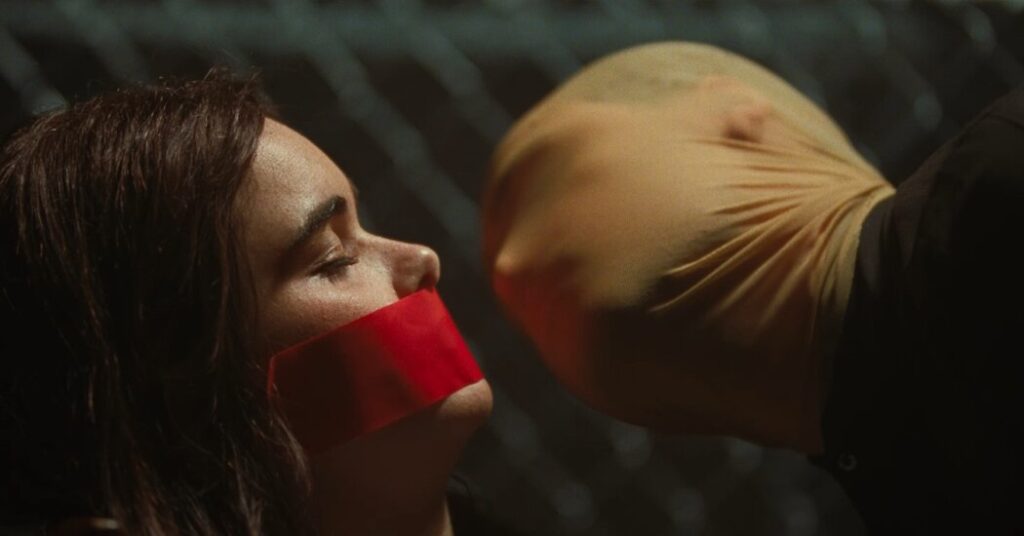
The new “Faces of Death” centers on Margot (a very good Barbie Ferreira), who has one of the worst jobs in the world: She’s a content moderator at Kino, a TikTok-style app. Every day, all day long, she rapidly culls through a never-ending feed of videos uploaded by users, tagging them for content, deciding when one is too obscene or gruesome to let through the filter. Most videos get through, even the disgusting ones; only the clips she deems beyond the pale — depictions of sexually-oriented material or, say, killing a living being — get sifted out.
Margot tells herself that she loves her job, that protecting the impressionable and innocent gives her purpose. But humanity’s worst impulses are coming at her through a fire hose. You can only take so much of that. One co-worker (Charli XCX) engages in increasingly destructive behavior just to get through the day. No wonder that Margot gives a presentation to new recruits with a peppy section entitled, “Do You Have Burnout?”
One day, a highly stylized video depicting a beheading appears on her screen. She’s startled. But it’s so well-produced that it can’t be real, she surmises. So she lets it through, labeling it as “likely fake.” Yet, within days, similarly styled videos with other grisly executions start showing up. Could this be real?
But when Margot realizes that the videos bear a striking resemblance to some of the deaths in a certain cult-classic horror VHS tape that her cheerfully macabre roommate (Aaron Holliday) keeps on the shelf, she puts two and two together: Someone (Dacre Montgomery) is recreating deaths from the film. This time, she suspects, they’re not staged at all. When internet-famous people start to go missing — including a popular Kino influencer (Josie Totah) — she knows she has to do something.
Virality — the idea of something so popular that it spreads on its own — is a gross metaphor for something people nonetheless crave: to be seen, to be recognized, perhaps to be admired. Even hated might be OK. (Margot knows a little about that.) The engine of virality once was whispers. Now, algorithms do the heavy lifting, and the companies that own them tend to favor whatever keep us on the platform longer — things that excite or titillate or outrage us.
That’s a shift that “Faces of Death” captures, turning clout-chasing into a silent villain in the background. There’s a low-budget, teeth-grinding quality to the cinematography (by Isaac Bauman) and score (by Gavin Brivik) that often works well: It feels like falling down a nightmarish TikTok rabbit hole, then dropping asleep into an actual nightmare, strung out and spent. The screenplay, written by Isa Mazzei and Goldhaber, is short on motivations beyond getting those proverbial eyeballs (what a phrase, really), and contains lines like “The algorithm loves remakes. People love remakes. If it’s a remake, you can get away with murder.” A little unwieldy, perhaps, but not untrue: What is a meme but a remake, times a million?
But my attention snagged on another element, one that was less intentional on the filmmakers’ part but no less interesting. When Margot sees the beheading video, she examines it carefully before deciding nobody actually died. Yet to her there are only two options. If it’s an actor, then it’s fine; it’s just like the movie we are watching right now, or some scenes in the original “Faces of Death.” If it’s real, though, it’s a snuff film.
Either way, she assumes that actual people were on camera, and it’s only the framing — fiction versus documentary, you might say — that matters. Yet if you’re an internet denizen watching her in 2026, a third option instantly presents itself, one that seems obvious: Why doesn’t she stop to consider that it might be artificial intelligence? And when did we become hyper-aware that every moving image is a kind of Schrodinger’s video, somehow obviously real and also probably fake?
By coincidence, I emerged from my screening of “Faces of Death” to discover OpenAI had announced that they’d be shutting down Sora, the A.I. video generation tool largely responsible for the flood of real-looking fake videos all over your social media feed. The Sora shutdown isn’t the end of hyper-realistic phony clips, but it was shocking enough to remind me how quickly we’ve become unable to believe what we see.
The original “Faces of Death” was enticing because audiences weren’t sure whether what they were watching was real or fake. Now everything we see dwells in that uncanny valley: Even a video of your friend or your movie star crush or your president could be totally synthetic, and you don’t know. Which takes that frisson of intrigue and surprise out of every video. Who cares if it’s real? Nothing is. And everything is.
It turns out this “Faces of Death” is set in 2024, just before the advent of A.I. video — you can tell from a hashtag the characters keep using — simply because it was shot in 2023, and has taken a long time to open in theaters. But it reveals how seismically and rapidly the relationship of what we see to what we believe has changed. It’s hard to imagine the 1978 “Faces of Death” going viral the way it did back then. It’s hard to imagine any video jarring us that way anymore. Call it collective burnout.
Faces of Death Rated R, mostly for all the faces of death. Running time: 1 hour 38 minutes. In theaters.
Alissa Wilkinson is a Times movie critic. She’s been writing about movies since 2005.
The post ‘Faces of Death’ Review: Is It Real? Does It Matter? appeared first on New York Times.