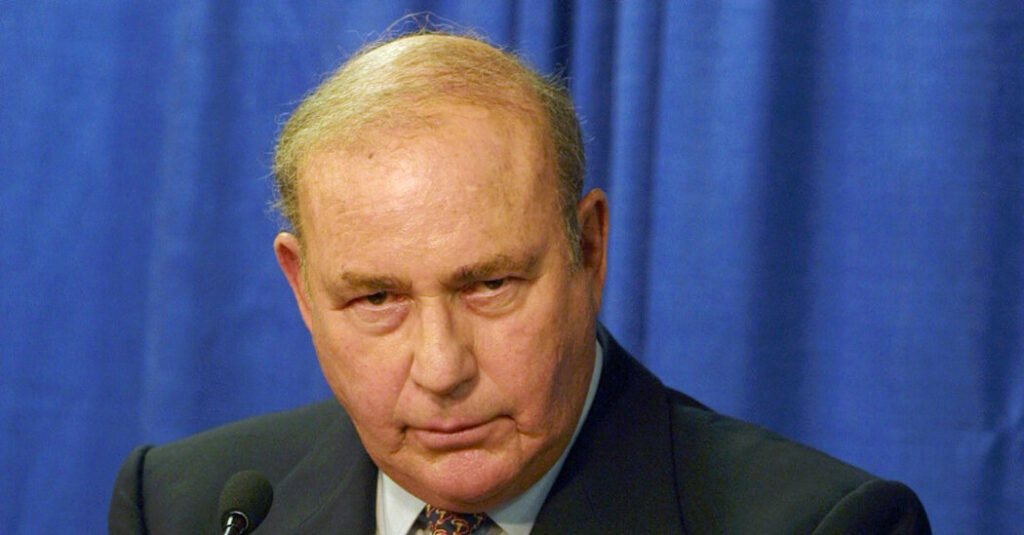
David B. Cornstein, a jewelry-counter magnate from Manhattan who, as the U.S. ambassador to Hungary from 2018 to 2020, played a key role in building a strong bilateral relationship between the Trump administration and the right-wing populist government of Prime Minister Viktor Orban, died on March 26 in Palm Beach, Fla. He was 87.
His daughter-in-law, Natasha Cornstein, confirmed the death, in a hospital.
Mr. Cornstein, who had known President Trump for decades as a fellow Manhattan tycoon, arrived in Budapest at a critical time. Mr. Orban, in office since 2010, was deep into his campaign to wield influence over the country’s democratic institutions, muffle dissent and deepen relations with Russia — all steps that the United States formally opposed.
But where the Obama administration had taken a hard-line approach to Mr. Orban’s illiberal campaign — for example, by avoiding high-level contacts between the two countries — Mr. Cornstein, on behalf of President Trump, tried flattery instead.
He arranged for Mr. Orban to visit Mr. Trump at the White House and for several top U.S. officials, including Secretary of State Mike Pompeo, to visit Mr. Orban in Budapest.
During a lavish 2019 reception for him at the U.S. Embassy, Mr. Cornstein called Mr. Orban “the perfect partner” and “a very, very strong and good leader.” The ambassador had even flown in the singer Paul Anka from California, who serenaded Mr. Orban with a personalized version of “My Way.”
Close relations between President Trump and Mr. Orban continued long after Mr. Cornstein left office: Ahead of pivotal Hungarian elections on April 12, Vice President JD Vance visited Budapest on Tuesday, at one point telling a crowd, “I love Viktor.”
Like Mr. Trump, Mr. Cornstein seemed to view diplomacy through a lens of business transactions, human rights groups said.
His approach had mixed success. In 2019, he helped oversee a new Defense Cooperation Agreement between the two countries, which deepened the working relationship between their militaries.
Yet Mr. Cornstein failed to reverse Mr. Orban’s decision to evict Central European University, an institution founded by George Soros, the Hungarian-American billionaire investor and liberal philanthropist. C.E.U.’s faculty was home to several critics of Mr. Orban, and Mr. Soros was among the president’s greatest nemeses.
Officially, Mr. Cornstein held to the formal American position that the university should remain in Hungary (it ended up moving to Vienna in 2019). But in statements, he also seemed to blame it for not currying favor with the government.
“I was a guest in another guy’s store,” he said in a 2019 interview with The Washington Post. “The university is in another country. It would pay to work with the government.”
State Department officials and foreign-policy experts said Mr. Cornstein took an unorthodox approach to the job: He often eschewed briefings before and after meetings with Hungarian officials, and sometimes kept his staff in the dark about conversations he had with Mr. Orban and others.
And they said that he seemed intent on shutting down American efforts to expose corruption within the Hungarian government, traditionally a central goal of the delegation to Budapest.
“Cornstein is the worst, most detrimental of diplomats — not just of the United States, but of all the countries,” Miklos Ligeti, a former official at the Hungarian Ministry of Justice, who went on to work with the human rights group Transparency International, told The New York Times in 2019. “He is actively working against the voices of anticorruption.”
Mr. Cornstein dismissed the accusations, adding that corruption was a relative term.
“Is there corruption in Hungary? I’m sure there is,” he told The Times. “Is there corruption in New York City and Chicago? I’m sure there is.”
David Bert Cornstein was born on Aug. 17, 1938, in the Bronx. His father, Irwin, operated a rug store, and his mother, Fannie, was a teacher. His maternal grandparents were Jewish immigrants from Hungary.
He received a bachelor’s degree in 1960 from Lafayette College in Pennsylvania, and he received a master’s degree in business administration in 1963 from New York University.
While in graduate school, he pitched J.C. Penney on the idea of leasing a watch counter in one of its department stores. The company declined, but then returned with an offer to sell jewelry instead, at one of its Long Island locations.
Mr. Cornstein did not know the first thing about jewelry, but he had shown a skill for salesmanship. Eventually, he leased counters in 1,200 department stores across the country.
In 1985, he and a group of investors bought a larger jewelry vendor, Seligman & Latz; through a series of acquisitions, it became Finlay, with Mr. Cornstein as president and chief executive. He retired as its chairman in 1999.
A Republican, he flirted with politics several times, considering a run for New York City mayor in 1991 and New York governor in 1994. In 2001, he ran for New York state comptroller but dropped out during the primary.
Mayor Rudolph W. Giuliani appointed him in 1994 to run the city’s Off-Track Betting Corporation, at the time a poorly functioning backwater. Over his term, he modernized the system and increased its revenues, coming to relish horse racing in the process.
He served as a vice chairman of the Empire Development Corporation, the state’s lead economic development institution, and on the boards overseeing the Battery Park City neighborhood in Lower Manhattan and the Jacob K. Javits Convention Center. And he was chairman of the New York Olympic Games Commission, in an unsuccessful bid for the 2012 Olympics.
He is survived by his wife, Sheila (Schiff) Cornstein; their son, Marc; and a grandson.
Mr. Cornstein announced his resignation from his ambassadorial post in November 2020, just before the presidential election. In a farewell video, he expressed some regrets.
“Sure, not everything in my tenure has been as successful as I would have liked,” he said. “I still think that C.E.U.’s departure is a loss for Hungary, and I remain hopeful there can be a resolution in the future.”
Clay Risen is a Times reporter on the Obituaries desk.
The post David B. Cornstein, Envoy Who Built U.S. Ties to Orban, Dies at 87 appeared first on New York Times.