In the Most Influential Modern Artist sweepstakes, Pablo Picasso and Marcel Duchamp are the top candidates. Picasso has an edge in the polls because A) he worked in the traditional (i.e., displayable, marketable) mediums of painting and sculpture, and B) because he influenced Duchamp, at least early on.
But I’ll hand the election to Duchamp, not just because he single-handedly changed — to the degree that any one artist can — the entire art game and redefined what art is and what can be art. Through the elasticized version of it that he practiced, he also gave art a promise of life and value defying a production-line future that is looking bleak.
Still, it’s a tight contest, mainly because of a visibility issue. Picasso is seen everywhere; Duchamp is hard to find. Before the sweepingly detailed retrospective — titled, plainly, “Marcel Duchamp” — that opens at the Museum of Modern Art on Sunday, there hasn’t been a full-scale reckoning of his career in the United States, his adopted home, in more than half a century.
And his art can be hard to grasp even when right in front of you. With a couple of major exceptions, his output consists of enigmatic small objects, hardware store items, and piles of scrappy notes handwritten in a minuscule script. These can make for hard-to-parse viewing at a time when audiences seem to prefer attention-arresting gallery experiences like the Ruth Asawa survey that preceded “Marcel Duchamp” on MoMA’s sixth floor, and the assaultive, sensurround “New Humans: Memories of the Future” show at the reopened New Museum, in which Duchamp (albeit almost invisibly) appears.
MoMA’s “Marcel Duchamp” isn’t like these. Thanks to its chronological layout, its introductory galleries of rarely exhibited early Duchamp material look sparely, neatly old-style. The first thing you see is a cluster of watercolor drawings of children at play, portraits by a teenage Duchamp of his sisters: Magdeleine, Suzanne and Yvonne. And there’s a little Monet-ish oil painting of a Roman Catholic church in Normandy in which the artist was baptized.
Next come some satirical and mildly misogynistic urban scenes, done when the young Duchamp moved to Paris and toyed with the idea of becoming a professional cartoonist. These are followed by a Cézanne-esque 1910 oil portrait of his father, and another of his two older artist-brothers absorbed in a plein-air game of chess, a family obsession.
Then old-style stops. Two other portraits from the same year are bizarre. One titled “Portrait of Dr. Dumouchel” depicts a childhood friend, Raymond Dumouchel, by then a medical student, whose face looks strangely battered. And he appears in a second painting, nude, with a masklike head, and accompanied by a crouching dark-skinned woman. Titled “Paradise,” the image is like a nightmare Gauguin, and radiates a theme of arrested eroticism that would run through much of his later art
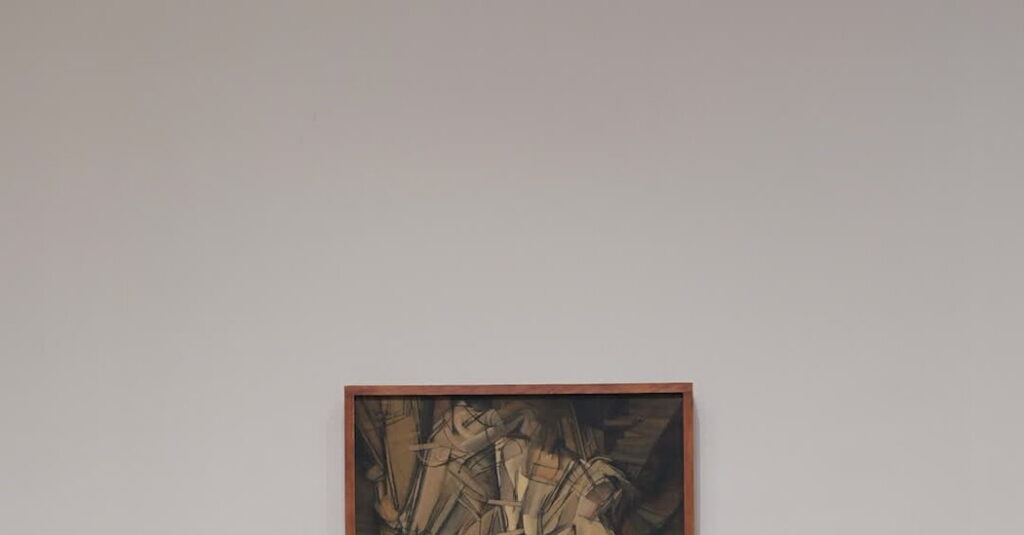
And thanks to its veteran curators — Ann Temkin and Michelle Kuo of MoMA and Matthew Affron of the Philadelphia Museum of Art — things stay strange. Duchamp picked up on Cubism but saw that its signature technique of fracturing reality was already devolving into sellable shtick. He tried to do something new with it. Fascinated by scientific advances in motion photography, he wanted to capture the sensation of physical and temporal change on canvas. And in 1912 he adopted Cubist moves to create the equivalent of live-action paintings, one being of a studio model walking, step by step, down a flight of stairs.
That year. he submitted the picture, “Nude Descending a Staircase (No. 2),” to the Salon des Independents in Paris, technically a non-juried affair, only to have it angrily scorned by other artists, including his brothers, who took it as a sendup of Cubism, a style in which they were invested. Humiliated, Duchamp pulled the piece, and began to remove himself from the art world. “I wasn’t much interested in groups after that,” he said
A year later, in 1913, when the same painting was selected for New York City’s fabled Armory Show — which introduced hot new European art to the United States — it caused a sensation and made Duchamp, still in France, a superstar. Whether cheering or jeering, American audiences, always susceptible to the Barnum-style hype and loving a public fight, were entertained by the fuss that the picture caused.
By this point, though, Duchamp had decided he was finished with painting, though he still had a picture or two left in him. One, titled “Bride,” from 1912, is extraordinary. Here Cubism morphs into Futurism in an image of a monstrously sensual erotic machine composed of fleshy bulges, pumps and tubes. Although superb as a stand-alone picture, “Bride” is also an early study for what will become after several years of sporadically intensive labor, one of Duchamp’s most radical works, the nine-foot-tall sculptural painting called “The Bride Stripped Bare by Her Bachelors, Even (The Large Glass),” from 1912-1923.
With its commanding size (9 feet tall, 6 feet wide) and its abstract depiction of sexual war (the wasplike bride floats, unreachably, on high, while the masturbatory bachelors jostle frantically below), “Large Glass” may be called, discrepant chronology aside, Duchamp’s “Guernica.” It’s certainly one of his landmark achievements, but it’s not in the MoMA version of the show. The piece was permanently and unmovably installed in the Philadelphia Museum of Art in 1954. So that’s where you’ll have to see it when the retrospective opens there next fall.
Does its absence here matter? Not really. One of the cultural clichés that Duchamp debunked was our fixation on the value of “the original” in art. By his lights, a small beta version of “Large Glass” that’s at MoMA — titled “To Be Looked at (From the Other Side of the Glass) With One Eye, Close to, for Almost an Hour” and dating from 1918 — does fine as a stand-in. And a full-scale “Large Glass” near-replica made, with Duchamp’s permission, in the 1960s, also at MoMA, is better still.
Anyway, with or without “Large Glass” there’s a lot going on in the show, as it continues to trace Duchamp’s career. Claiming to despise the art world for its tradition-worshiping, money-grubbing ways, he for a while considered alternative ways to make a living. He went back to school to study library science. With a level of persistence akin to obsessive he labored to hone his chess skills to grandmaster levels.
He began to experiment with the idea of being an artist-collector. He brought premade, sometimes odd objects into his studio — a bicycle wheel, a bottle rack, a urinal — and transformed them into an aesthetic category that he called “the readymade”: art that was art because he said it was, flipping the notion of aesthetic value based on skill, rarity, beauty, “genius” on its head. Was penciling a goatee on a pocket-size reproduction of the “Mona Lisa,” as he did in 1919, a joke? A homage? A creative act? Your call.
During these years he functioned, culturally, as a kind of artful dodger, out of sight, yet always there. One way he maintained this active non-presence was by assuming an alter ego, that of an invented artist, one of a different gender, named Rrose Sélavy. Her image — Duchamp in drag as photographed by the American artist Man Ray — and name were attached to a variety of objects representing fake entrepreneurial endeavors: a new line of perfume; stock certificates; a museum promoting Duchamp’s work.
Because the mainstream art world still didn’t know what to do with him, Duchamp was, for a long time, ignored by museums. And he addressed an artist’s natural anxieties surrounding the institutional preservation of his continuing output by creating, throughout the 1930s, a series of portable museums dedicated to himself and collectively titled “Boîte-en-Valise” (“Box in a Valise”).
Initiated in Paris and continued in New York after Duchamp moved there in 1942 to escape the war, the series includes some 300 custom-made. compartmented boxes, of a kind used by traveling salesmen, each packed with miniature versions of works.
A collection of them are set out on long tables in a low-lighted MoMA gallery and make for an astonishing and exhausting sight. They invite us to compare details of the no-two-alike containers and the inventive crafting of the objects they hold, all the work of an artist who had made the radical point, specifically in his readymades, of diverting attention away from the fashioning hand and directing it toward the selecting eye and mind.
Museums eventually came around to Duchamp, largely through the enthusiasm of patrons. And Duchamp came around to the art world, assuming the roles of curator, art adviser and art dealer. But all the while he also kept a secret.
Although there was a general assumption that he had given up making art in favor of playing chess, from 1944 to 1966 he’d been working on a project that he kept under wraps in his Manhattan studio. The work was a diorama-like tableau — he termed it a “sculpture-construction” — called “Etant Donnes: 1. La Chute d’Eau, 2. Le Gaz d’Eclairage” (“Given: 1. The Waterfall, 2. The Illuminating Gas.”)
It was installed in an enclosed space about the size of a closet, hidden behind two big antique wooden doors in which a pair of peepholes had been cut. Visible through the holes is the life-size form of a nude woman lying on a bed of grass and leaves, her face hidden from view, her legs splayed, a lighted gas lamp held upright in her left hand. Behind her is a painted landscape and what looks like a glinting waterfall flowing through.
What are we seeing? A voyeuristic fantasy? An erotic pastoral scene? The aftermath of a rape? There has been ceaseless speculation about the work’s meaning since it first went on permanent view at the Philadelphia Museum of Art in 1969, a year after Duchamp’s death, at age 81.
In 2009 that museum presented a terrific show focused on it. A book about it, “Impossible: The Love Affair between Marcel Duchamp and Maria Martins and the Artwork It Inspired” by the art historian Francis M. Naumann, has just been published. The only pretty much indisputable observation on it was made by the artist Jasper Johns, a Duchamp admirer, who called “Etant Donnee” “the strangest work of art in any museum.”
Alas, it too is fixed in place in Philadelphia, though a group of black-and-white photos taken in 1968 gives a sense of the strangeness that Johns speaks of. These could be shots of a grisly homicide scene, or an autopsy.
That strangeness, found in different registers lin all of Duchamp’s art, is often of an enigmatic, teasing, needling kind that we need to value. He believed that art should take no role in politics. But when asked the direction he felt art of the future should take, he said that “the great artist of tomorrow will go underground.”
This is the direction he effectively took. And from the depths he shook the foundations of culture in a way no other Western artist of his era did. I can’t remember a more conservative moment in our culture than the one we’re in now, in which “classical” values are, blatantly or obliquely, being so relentlessly asserted. We need foundation-shaking badly. “Marcel Duchamp” is a timely reminder of what that can mean.
Marcel Duchamp
Member Previews, through April 11; opens Sunday through Aug. 22, the Museum of Modern Art, 11 West 53rd Street; 212-708-9400, moma.org. The survey travels to the Philadelphia Museum of Art, Oct. 10 through Jan. 31, 2027.
Holland Cotter is chief art critic and a senior writer for the Culture section of The Times, where he has been on staff since 1998.
The post And the Most Influential Modern Artist Is … appeared first on New York Times.