While medications can help manage the symptoms of Parkinson’s disease, there’s a natural remedy that can play a big role, too: movement.
“Exercise should always be part of the prescription for Parkinson’s for everyone,” said Jori Fleisher, a neurologist at Rush University Medical Center. “It’s right up there with medication.”
And it may offer a benefit that pills, tablets and patches can’t replicate. “No medication has yet been shown to slow down the progression of Parkinson’s, but exercise looks like it does,” Fleisher said.
How exercise helps people with Parkinson’s
Parkinson’s is a progressive neurological disorder that targets brain cells that produce dopamine, a neurotransmitter that helps communicate messages in your mind. Consider dopamine like the gas in your car that makes it go, Fleisher said; we need it to start moving.
“That lack of dopamine results in the typical movement problems that you observe in Parkinson’s disease, such as tremor, slowness, muscle stiffness, gait and balance problems,” said Sule Tinaz, a neurologist and associate professor at Yale School of Medicine. Movement can also become smaller; just as handwriting can shrink, so can stride and arm swing. Parkinson’s commonly causes nonphysical symptoms, as well, including anxiety, depression, cognitive issues and sleep problems, which can “sometimes even be more debilitating,” she said.
Exercise can help with both the physical and mental symptoms of the condition. On the physical front, it can strengthen muscles, improve mobility, loosen tightness and boost balance. On the mental side, it can reduce stress, build confidence and sharpen memory, and group classes can foster social connections.
Moderate to vigorous exercise has long been known to lower the risk of getting Parkinson’s in the first place, and some research suggests it might improve the viability of the dopamine-producing neurons in the brains of people who already have the condition.
“It’s not a cure, but by doing the right types of exercises, I’ve actually seen people make improvements in their function and not just get worse over time,” said physical therapist Kelly Hussey, a board-certified neurologic clinical specialist at Mass General West Medical Group.
As for the best kinds to do, newly updated guidelines from the Parkinson’s Foundation and the American College of Sports Medicine recommend a multifaceted exercise program that incorporates the following components and frequencies:
- Aerobic activity: three days a week at moderate to vigorous intensity for at least 30 minutes a session
- Strength training: two to three nonconsecutive days a week for at least 30 minutes each of all major muscle groups
- Stretching: at least two to three days a week
- Balance, agility and multitasking (BAM): at least two to three days a week
Here are some examples of exercise types to try:
1. Cardio
“Aerobic [exercise] is critical,” Tinaz said. “That really is the core [of the exercise program].” Research shows it can improve disease severity and quality of life; high-intensity exercise may bring an even greater boost to motor function and mobility than moderate exercise. And Tinaz’s small 2024 pilot study even suggests intense exercise helps nerve cells produce stronger dopamine signals, hinting that it may be able to reverse some aspects of the neurodegeneration caused by Parkinson’s.
The type of cardio you choose isn’t really important. “The one that you’re going to keep up and enjoy is going to bring you the most benefit,” said Fleisher. You just want to make sure your activity is challenging enough. An easy way to check: With moderate exercise, you can talk but not sing. With vigorous, you can get only a few words out. Running, biking, using the elliptical or swimming can all qualify.
If symptoms make your favorite form of cardio difficult, try to modify it, Fleisher said. Treadmills can help runners avoid uneven terrain outside. And if you’re a cyclist struggling with balance, an indoor bike or outdoor bike with extra stability features may help. Tandem bikes may also be a good choice — if your partner pedals at a cadence faster than your preferred pace, forcing you to speed up may actually improve motor function, research suggests.
2. Strength training
With Parkinson’s, your extensor muscles in the back of your body can weaken, leading to slouching, slumping or leaning forward. “We want to strengthen your upper back, lower back and glute muscles because they allow you to maintain a more tall, upright posture and keep your stride’s length longer,” Hussey said. And stronger core muscles keep you steady and balanced when you’re moving, which can help prevent falls, Tinaz said.
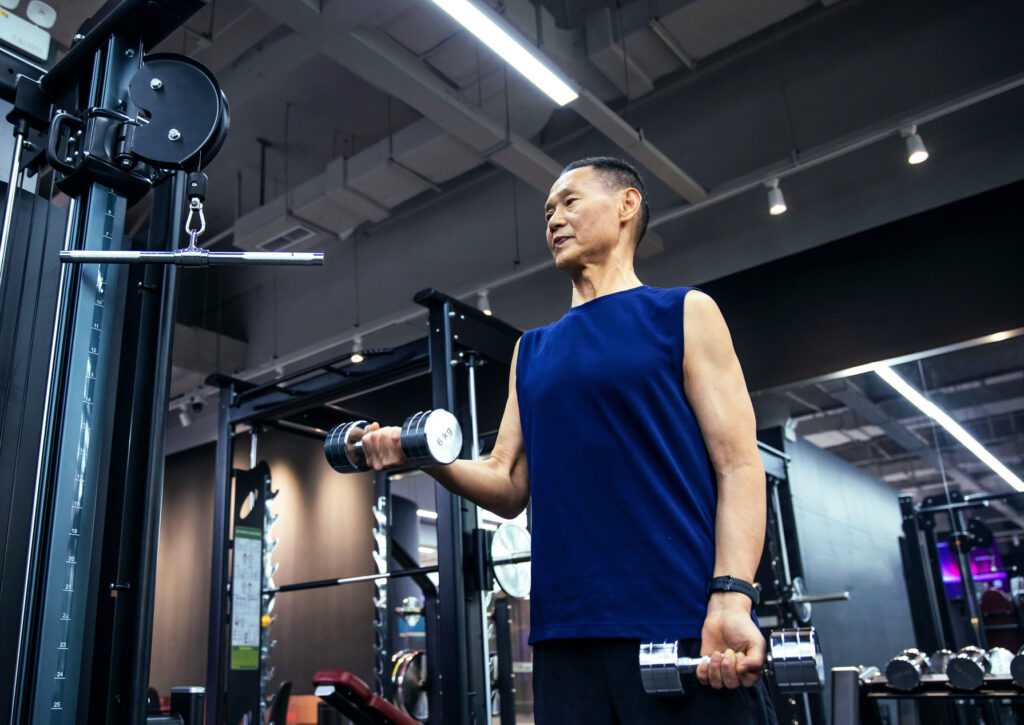
You can strength-train with dumbbells, resistance bands or body weight alone. Machines can also add extra support if balance is a concern, since the path of motion is fixed. Helpful exercises include rows, banded shoulder extensions, sit-to-stand (squatting to a chair), glute bridges and lunges, according to Hussey — and feel free to hold onto a wall for support.
Make sure you’re moving your body through its full range of motion; so when you’re coming up from the squat, stand up tall before lowering for your next rep. “Often with Parkinson’s, the tendency is for movements to get a little bit smaller,” Hussey said. “That is something that you can overcome by moving your body fully to the max.”
3. Yoga
With Parkinson’s, muscles can become more rigid. Over time, this can cause them to shorten and reduce their range of motion, Hussey said. Stretching can be helpful: Yoga poses can improve flexibility in your hip flexors, hamstrings, core, trunk and spine, among other areas, and they often do so in a way that incorporates core strengthening and balance, too. In fact, in a meta-analysis in Brain Sciences, researchers looked at 10 forms of exercise and concluded that yoga was the best for improving performance on the timed-up-and-go test, which measures functional mobility, lower-limb strength and fall risk for people with Parkinson’s.
What’s more, as a holistic form of exercise, the benefits of yoga go beyond the physical, Tinaz said. Because of its focus on mind-body connection, breath and mindfulness, yoga is also helpful at managing the mental health effects of Parkinson’s, such as anxiety and depression. If yoga isn’t your thing, tai chi can provide similar flexibility and feel-good benefits.
4. Karate
Karate packs a punch for Parkinson’s: Kicks and arm strikes to pads or punching bags increase your heart rate; choreographed katas, or sequences, jog your working memory; and big, sweeping movements help fight the tendency to go smaller, Fleisher said. Learning the moves also provides a sense of mastery and confidence, and doing it alongside other folks builds social connection and camaraderie. So it’s not terribly surprising that when she and her team studied this, they found 10 weeks of karate significantly improved people’s quality of life and well-being.
Another bonus: While the karate moves boost balance, the modality also often teaches participants how to fall safely if they become unsteady. “When we take away the fear of falling, when they know that they can do it and they’re safe and they’ll be able to get up, people have this different confidence and they’re able to move differently,” said Fleisher. This can help in the dojo, but also well beyond it — navigating sidewalks in slippery weather or going up and down stairs at home, for instance.
5. Boxing
Noncontact boxing classes — using gloves and punching bags — have been growing in popularity for Parkinson’s, and for good reason. Like karate, it’s a beneficial combination: “Several studies have shown that boxing helps with coordination, balance, agility, explosiveness of movements and power,” Tinaz said.
Boxing increases your heart rate and gets you moving in all directions: You’re sidestepping with your feet, rotating your torso and crossing your body with punches. “You have to maintain your balance when you’re doing that,” Hussey said. Boxing classes also include sequences or routines, so you need to turn your mind on to follow along with the instructor and remember what’s next.
6. Dance
Dance shares some similarities with karate and boxing: It has a cardio component — depending on the type, it can certainly crank up your heart rate — gets you moving in many directions and requires you to follow along with choreography. Tango is a particularly popular choice, according to Fleisher, because it helps folks with Parkinson’s practice big, sweeping steps and arm movements.
There’s also social camaraderie — and a bit of humor. “If they make a mistake, they can laugh,” she said. “It’s an environment that lets us know that we’re all learning constantly. It’s never super easy to learn a new skill, let alone when you’ve got a neurologic condition, but it’s absolutely possible.”
The post 6 science-backed exercises that may help people with Parkinson’s appeared first on Washington Post.