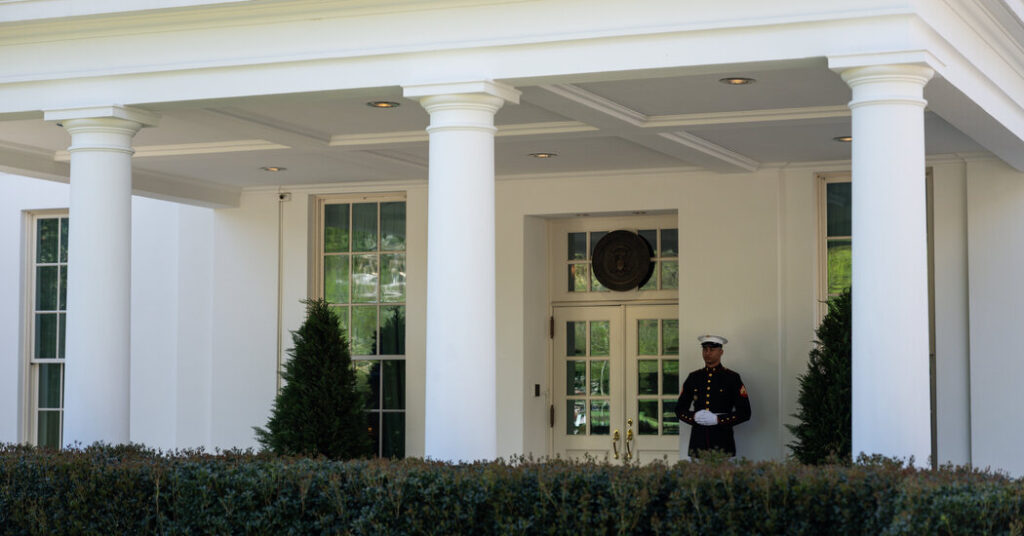
President Trump sat behind the Resolute Desk as Tuesday evening approached, ruminating about what might unfold in the next few hours.
He had vowed to wipe “a whole civilization” off the map if his 8 p.m. deadline for Iran to reopen the Strait of Hormuz had passed. As a series of unrelated meetings unfolded, Mr. Trump would interject to list the number of bridges and power plants he was prepared to strike in Iran.
He was briefed about Iranians gathering on those bridges and in front of those power plants. He watched the images of people gathering around the structures on television, and told aides it would be the Iranian government’s fault if U.S. forces struck and killed them. He called Iranian leaders “evil” for putting innocent people in harm’s way. Then in the middle of the afternoon in Washington, an encouraging message about an agreement taking shape was vetted by the White House and posted on social media by Pakistan’s prime minister. Shortly after, an agreement that was hastily brokered by a series of mediating governments, including Pakistan and China, reached a president who was looking for a way out of a deeply unpopular war.
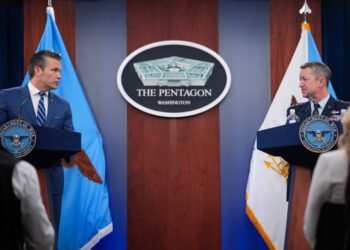
The victory lap started quickly: Defense Secretary Pete Hegseth and Gen. Dan Caine, the chairman of the Joint Chiefs of Staff, declared on Wednesday morning that all their military objectives had been achieved in what Mr. Hegseth called “a historic and overwhelming victory on the battlefield.”
But less than one day after Mr. Trump had logged on to social media to announce a truce, the fragile accord was showing signs of fraying, in large part because the two nations would not publicly agree to a shared set of goals for ending the war.
After a tumultuous 36 hours spent careening from one diplomatic extreme to another, Mr. Trump finds himself, in some ways, close to where he started. His efforts to circumvent the reality on the ground and move into a peace process have been hampered by an adversary that continues to hold leverage.
The status of the Strait of Hormuz is unclear, even though it was the basis of Mr. Trump’s apocalyptic ultimatum. And the fate of Iran’s enriched uranium, which Mr. Trump had rosily suggested could be recovered by Americans with the help of Iranians, is unresolved.
The fluctuations were emblematic of Mr. Trump’s approach to diplomacy with Iran: scorched-earth threats, scrambled markets, alarmed allies and adversaries, widespread civilian panic and an eleventh-hour off-ramp that has both sides accusing the other of being disingenuous.
Now Mr. Trump and his advisers are watching closely to see whether the strait remains open. If it does not, one senior official said, the deal will fall apart.
This account is based on interviews with nearly a dozen people in the United States, Israel and Iran, most of whom spoke on condition of anonymity to discuss a swiftly moving conflict.
A threat sets off widespread panic
On Monday, the day before Mr. Trump sent a message threatening to wipe out the Iranian civilization, talks had privately been progressing and Iran’s supreme leader had appeared to signal an approval to move forward with negotiations, according to multiple Iranian and Israeli officials. Pakistan continued trying to mediate talks between Iran and the United States in an effort to reach a cease-fire and buy time for extensive peace negotiations.
But by Tuesday morning, the Americans were growing impatient. Mr. Trump issued his public threat to annihilate Iran, a message that Iran had also received in private via Pakistan, according to three Iranian officials familiar with the negotiations.
Iranian leaders, already furious about Mr. Trump’s deadline to blow up power plants, and a wave of attacks on critical infrastructure such as railroads, bridges and industrial plants, decided to call it quits. They told Pakistan that Tehran would halt messaging with Washington and that plans for cease-fire negotiations would be on hold, the three officials said.
Iranian officials, from the president to the vice president to commanders of the Islamic Revolutionary Guard Corps, posted messages of defiance on social media. The military leaders believed that Iran had the upper hand with its leverage over the strait and should double down, the officials said.
“Iran has clearly won the war and will only accept an end game that solidifies its gains and creates a new security order in the region,” Mahdi Mohammadi, an adviser to Mohammad Bagher Ghalibaf, a brigadier general who is the speaker of Iran’s Parliament, said in a social media post.
In Iran, panic among civilians set in as Mr. Trump’s deadline for attacking power plants approached. Iranian media started circulating guidelines on how to survive if power, gas and water went out. Residents of Tehran flocked to supermarkets to stock up on dry food and bottled water, cleaning out the aisles in many supermarkets by the evening.
“We bought a cooler and blocks of ice, in case we lost power and the fridge stopped working,” Nazy, a resident of Tehran who asked that her last name not be published for fear of retribution, said in an interview. “I also bought lots of dried goods, candles and batteries for my mother, who is bedridden and can’t evacuate.”
Tens of thousands of people fled for the shores of the Caspian Sea, creating such a heavy traffic jam that the police closed the mountain road to all traffic except for those making their way out of Tehran to the northern shores.
In the United States, allies of Mr. Trump called for him to clarify his bellicose messaging, and others publicly expressed hope that the president was not actually going to carry out his threat. Senator Ron Johnson of Wisconsin, a close Republican ally of Mr. Trump’s, left room for the possibility that Mr. Trump was posturing. “I hope and pray that President Trump is just using this as bluster,” he said.
Top Democrats quickly promised to force another vote on a resolution to rein in the use of the military in Iran.
Frantic negotiations unfold
With the Iranians threatening to pull out of talks, frantic diplomatic efforts stretching from the Middle East to China quickly unfolded. Officials worked the phones to salvage a cease-fire plan and pull Iran and the United States from the brink of a bigger catastrophe, according to the three Iranian officials and a Pakistani official familiar with the efforts.
Pakistan’s prime minister and foreign minister worked the phones, speaking to both the Iranian president, Masoud Pezeshkian, and Foreign Minister Abbas Araghchi. Turkey, Egypt and Qatar also reached out to Iran, the officials said. But ultimately it was China, which has close economic ties to Iran, that broke the impasse, according to the Iranians and the Pakistani official.
China maintains close commercial ties to Iran — it is the biggest purchaser of Iranian oil — and also cooperates with the Iranian military. Chinese officials told their Iranian counterparts to agree to the cease-fire now because it might be their only opportunity, the Iranian officials said. China also asked Iran to show more flexibility and open the Strait of Hormuz to maritime navigation for two weeks and consider the economic impact of the war on its allies, including China.
Shortly after 5 p.m., Pakistan’s army chief, Field Marshal Syed Asim Munir, called Mr. Trump to discuss the contours of the cease-fire agreement. Mr. Munir told the president that the Iranians had agreed to Pakistan’s proposal.
If the Iranians agreed, Mr. Trump told Mr. Munir, then the Americans would.
The president then called Prime Minister Benjamin Netanyahu of Israel to tell him that the United States would enter into a two-week cease-fire.
A fragile deal begins to fray
At 6:32 p.m., Mr. Trump announced on Truth Social that he had agreed to suspend the bombing campaign in Iran for two weeks to work out a peace agreement. But even some of Mr. Trump’s advisers were skeptical the pause would hold.
Disagreements over the scope of the deal emerged almost immediately.
At 7:50 p.m., Prime Minister Shehbaz Sharif of Pakistan announced the cease-fire agreement and said it applied “everywhere including Lebanon.”
But on Wednesday morning, the president told a PBS reporter that he viewed the conflict between Israel and Hezbollah, which is backed by Iran, as a “separate skirmish.” On Wednesday, Israel launched its heaviest bombardment of Lebanon in more than a month of war with Hezbollah.
Mr. Trump and his aides, meanwhile, said they would not publicly lay out the terms that they said they were negotiating over for bringing a lasting end to the war, but they disparaged a separate 10-point proposal that the Iranians made public on Wednesday.
“It was literally thrown in the garbage by President Trump and his negotiating team,” Karoline Leavitt, the White House press secretary, told reporters at the White House.
Still, she announced that Vice President JD Vance, along with Steve Witkoff, the president’s special envoy, and Jared Kushner, Mr. Trump’s son-in-law, would travel to Pakistan to hold talks with the Iranians. It would be the highest-level meeting between U.S. and Iranian officials since 1979.
But shortly after Ms. Leavitt’s announcement, top Iranian officials accused the United States of violating the agreement.
Mr. Ghalibaf, the speaker of Parliament, who is expected to attend the meeting in Pakistan, wrote in a statement that the truce and negotiations with the United States were “unreasonable” because Israel was attacking Lebanon, a hostile drone entered Iran’s airspace and the United States continued to oppose Iranian nuclear enrichment.
Asked about Mr. Ghalibaf’s statement, Mr. Vance questioned his language comprehension.
“I actually wonder how good he is at understanding English, because there are things that he said that frankly didn’t make sense in the context of negotiations that we’ve had,” he told reporters as he departed Hungary.
Reporting was contributed by Ronen Bergman in Tel Aviv and Edward Wong in Washington.
Tyler Pager is a White House correspondent for The Times, covering President Trump and his administration.
The post 36 Hours of Chaos: The Scramble for a Cease-Fire in Iran appeared first on New York Times.