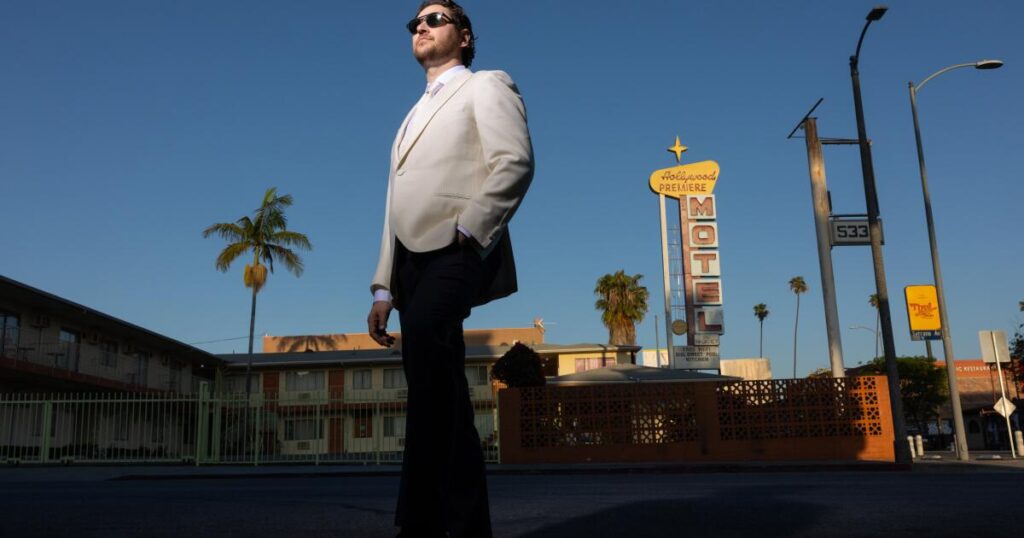
In the back corner booth at a diner in Los Feliz, writer Luke Goebel is shaking off last night’s drive down from San Francisco. “I will just have to warn you I drove like 100 miles an hour through Big Sur,” he says, leaning in over the Formica table. “OK, 90 miles an hour through Big Sur last night, just blasting ‘Dark Star,’” referring to the Grateful Dead song known for its galactic endlessness in live versions. He took the famous California coastal route the 1 back to his home in L.A. He’s preparing to launch his second novel, “Kill Dick”, which is also a winding Californian golden road with lots of sharp twists. He has been long inspired by the ’60s Californian counterculture that spawned the Grateful Dead, talking about how he called up “One Flew Over the Cuckoo’s Nest” writer (and Merry Prankster) Ken Kesey on the phone when he was 12.
Ten years in the making, “Kill Dick” takes a big swing at the great American novel in a time when both taking big swings and the idea of the great American novel are in a free fall of decline. To promote the novel, his Instagram recently showcased KILLDICK.COM stencil art being spray-painted across multiple squares of cement in various L.A. locales with the tag line “Not AI. Analogue. LA” set to a new wave song soundtrack. “Kill Dick” fliers are plastered all over the city. He also has posted a glut of social media sizzles of book-inspired photo shoots. “It’s something I believe in,” says Goebel. “I’m driving a $4,000 car, and I’m putting my money into what I love, and I’m learning from it.”
What is “Kill Dick” about? He describes the book as “a humorous, dark satire, emphasis on dark and humorous, about a privileged girl who wants to be an artist who becomes the female Luigi Mangione,” adding “and it’s set in 2016 with a backdrop of Los Angeles during a string of serial killings and amidst the opioid crisis.” The fictional events and themes of “Kill Dick” feel very timely — a wild plan to disrupt a big Hollywood awards show, a scheme to assassinate a medical business mogul who has made money off pain and addiction, and the ever widening gap between the ultra wealthy and the destitute. The novel careens between the highs and lows of L.A.’s vast architectural vernacular, traveling from green-lawned Brentwood mansions to Skid Row encampments, up into the hills for art and entertainment world excess, all the way back down to crappy motels with beautiful neon signs.
Affable and tall with an owlish face, Goebel found inspiration for “Kill Dick” in the “sunshine noir” of writers like Bret Easton Ellis, Nathanael West and Joan Didion. But his main motivation was to fictionally avenge the death of his real-life brother from the painkiller Oxycontin. “It was a way of grieving the loss of my brother and processing the rage and sorrow that I felt at his overdose on Oxy,” he reveals. The book’s title concerns an opioid mogul named “Richard ‘Dick’ Sickler,” but when asked if he was inspired by any particular similarly named dynasty of pill-pushers Goebel politely pleads the fifth. He has been in Los Angeles for 12 years, after a childhood spent in small-town Ohio followed by Portland, Ore., where he fell into the ravages of addiction firsthand after being prescribed pills for a broken femur. “I became a morphine addict, a pill addict, an alcoholic drug addict, from basically that day on. I didn’t understand it, and I come from generations of addicts,” he recounts. “But I was like, as soon as the pills ran out, I was like, I want to burn to death.” After a string of harrowing experiences that left him living in his car, he got sober, got fired from a tenure-track job in East Texas, and moved to the high desert, telling his little sister “we’re gonna find utopia.”
He was living in the desert, teaching English at UC Riverside and writing a since abandoned book he calls “the quintessential bad male novel” when the Los Angeles Review of Books asked if he wanted to interview fellow writer Ottessa Moshfegh. They had mutual friends and he was a fan of hers, but when they met it felt like kismet. “She had already had a meeting with her Vedic astrologer who told her that she could move to a cabin in the darkest woods and the love of her life, her husband, was going to show up at her door,” he recounts. “She was like ‘I don’t want a husband, and I don’t want anyone coming to my door.’ But long story short, I showed up for the interview, and the minute she saw me and I saw her, it was like we never stopped. The interview went on for 10 years.” After spending a month-plus straight together, he went home for Christmas and asked his grandmother for a ring, which he used to propose. He also hesitates to talk about their relationship any further, saying “All I can say is, like, I’ve learned so much from Ottessa. She’s offered me a world that I never imagined in every way possible.”
Goebel toiled on “Kill Dick” for the better part of the last decade, and without spoiling it there is a time frame reveal in the book that evinces a hearty, bitter laugh. He sent the book out to the “Big Five” publishing companies and was rejected, eventually deciding to publish it with the Pasadena small press Red Hen after they expressed fervent interest in acquiring it.
Kate Gale, co-founder and managing editor of Red Hen,says Goebel’s agent sent her the book, but when he decided to go elsewhere she kept after him. “I wanted a big stomping Los Angeles novel in the tradition of Carolyn See and Nathanael West,” Gale says. “This dark thriller of a novel is it.”
At the time Goebel was recovering from stomach surgery and ironically taking painkillers again for it. “Although I refuse to take Oxy,” he says. “I’ve never taken Oxy in my life. I don’t know if you can tell, I have a little grudge against that drug.”
His grassroots approach to promoting “Kill Dick” befits his indie publisher while the crumbling “Big Five” book publishing industry increasingly looks for sure bets on stuff like fan fiction with the IP scrubbed off or TikTok-viral “spicy” romance novels. While he’s being tactical about courting attention and publicity, he hopes the book will find its audience based on good old word of mouth once people get to read it. He’s also at work with a few others reviving New York avant-garde small publisher Tyrant Press. His L.A. novelist friend Matthew Specktor has watched all of this hustle with awe. “He’s got certain virtues writers maybe aren’t supposed to have — dude is handsome, socially adroit. But he’s also insanely insightful and genuine.”
Goebel mentions the Beatniks as another major inspiration. He aims for “Kill Dick” to connect with an audience starved for art that is not apathetic about the insanity of the world we live in now. “Why else write a book?” he says, “You’re not gonna get rich … like, there’s people to feed and gardens to grow and things to do. I mean, the truth is, we all probably should be finding a way to find a place to hide out for the next four years and exist outside of a nuclear fallout range, where we have water and food and we can work together, and we probably ought to have some weapons. So if you’re not doing that, you better write a g— good book or movie or song, or fall in love profoundly. Do something! You know?”
Lambert is a writer and creator of the podcast JennaWorld: Jenna Jameson, Vivid Video & The Valley.
The post Why this author’s spray-painted ‘Kill Dick’ stencil art is all over L.A. sidewalks appeared first on Los Angeles Times.