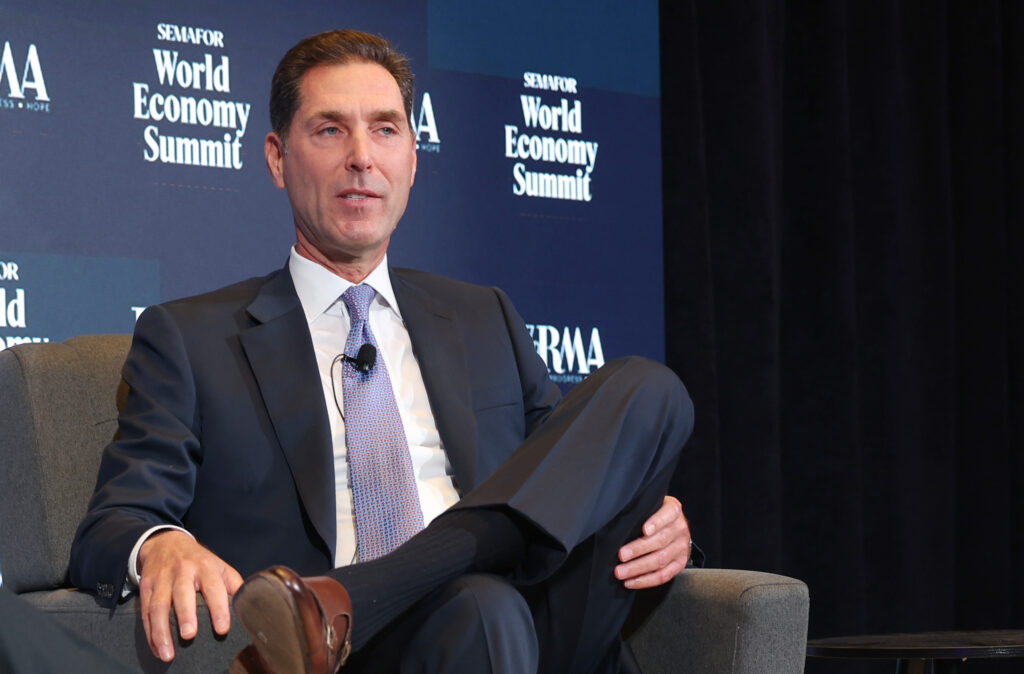
For the past year, the pharmaceutical industry has wrestled with Washington, as President Donald Trump has demanded that drug companies cut their prices or face his wrath — including the threat of punishing tariffs.
Now the industry is set to lose its top lobbyist, as Steve Ubl, the long-serving CEO of the Pharmaceutical Research and Manufacturers of America (PhRMA), prepares to step down. The plainspoken Ubl, a staple on health industry and Washington “most influential” lists, navigated the drug industry through the coronavirus pandemic and led its battles with Obama, Biden and Trump officials seeking to impose new curbs on drug prices.
“What I’m most proud of is really putting the organization on offense,” Ubl said in an interview Tuesday, citing initiatives to deflect criticism from drugmakers and shift the spotlight to other industry players that PhRMA says deserve more scrutiny for their roles in the nation’s high health care costs. He also touted his team’s efforts to defeat “bad policy ideas,” such as ballot measures in Ohio and California that would have set new limits on drug prices.
Ubl plans to stay on as PhRMA’s leader until the organization finds a replacement, and then transition to a mix of teaching, consulting and board service. He first considered stepping down after the 2024 election but said he was persuaded to remain by PhRMA’s board.
Rob Davis, Merck’s CEO and PhRMA’s board chair, praised Ubl as a “great role model” and said he had navigated difficult moments with Trump, lawmakers and foreign leaders. “He’s the person who drives for compromise in the best interest of all parties.”
Ubl has led PhRMA’s lobbying efforts for more than a decade and helped build a more aggressive, nationalized industry machine — one that beat back earlier reform efforts but is now showing cracks as companies cut their own deals with the White House. He has been a relentless cheerleader for companies’ medical breakthroughs, such as the rise of GLP-1 drugs to combat obesity and other health conditions.
Most Americans have a favorable opinion of prescription drugs but take a dimmer view of the companies that make them, polls have shown.
A Gallup survey last August found that just 28 percent of Americans had positive views of the pharmaceutical industry, lagging nearly two dozen other sectors. Only the federal government had lower favorability ratings than the pharmaceutical industry among surveyed sectors, Gallup found.
Ubl and PhRMA have also often faced frequent pressure from politicians, such as Sens. Bernie Sanders (I-Vermont) and Elizabeth Warren (D-Massachusetts), who have probed industry price hikes and its lobbying efforts. Sanders, particularly, has focused on pharmaceutical companies’ influence machine, asking why there are far more drug industry lobbyists than members of Congress.
Meanwhile, other health industry players, such as hospitals and pharmacy-benefit managers, have complained about PhRMA’s ad campaigns that try to shift blame to them for high drug prices.
“We’re an easy target,” Ubl said, adding that he understands why many Americans blanch at high-priced drugs that retail for more than their annual salaries.
In the interview, he reflected on shifting public sentiments toward drugmakers. The coronavirus pandemic briefly elevated the industry, as companies like Pfizer and Moderna produced vaccines credited with saving millions of lives. But that goodwill has since curdled into backlash, complicating new vaccine investments.
Ubl also lamented disappointments, like the Biden administration’s drug-pricing changes that PhRMA has blamed for harming investment and curbing development of some drugs. President Joe Biden and Democrats also achieved a long-held goal to empower Medicare, the government program that provides health insurance to older Americans, to negotiate the price of some drugs directly with drug companies, an idea that the pharmaceutical industry had long opposed.
“A lot of my work and focus is to make sure that we continue to operate with context,” Ubl said, touting statistics about the need for drug industry research and development as well as the wide availability of cheap, generic medicine.
PhRMA — composed of the pharmaceutical industry’s largest companies — is one of Washington’s deepest-pocketed trade associations. Its annual spending regularly tops $500 million per year, according to public filings, with the group helping coordinate efforts to blunt lawmakers’ would-be reforms through lobbying, advertisements and persistent counter-messaging. Ubl’s annual compensation topped $7.6 million in 2024, according to public filings.
The industry’s push to shape the health care debate is set to be particularly intense this year, as Democrats and Republicans compete to convince voters that they are doing more to lower health costs, a top midterm election issue. That fight has often put the pharmaceutical industry at odds with lawmakers in both parties and increasingly with Trump, who has spent the past year pressuring executives to lower their prices.
Sixteen drug companies have since struck deals with the White House, even as Ubl has repeatedly warned that Trump’s tactics could harm industry innovation.
“Historically, medicines have been excluded from tariffs for a good reason — that they lead to shortages, they lead to cost increases for consumers,” Ubl said. Other advocates, including opponents of the drug industry, have criticized Trump’s tariffs too.
Wall Street analysts have largely shrugged off the deals’ impact, saying that voluntary price cuts represent a relatively small hit to drugmakers’ revenue while defraying the risks of an angry Trump.
But the companies’ willingness to make deals directly with the White House — on the heels of Biden and Democrats’ own drug-industry wins — has undercut some of the mystique around PhRMA, once seen as nigh-invincible in Washington’s corridors of power, thanks in part to its ample war chest and willingness to spend money. Modern Healthcare, a popular health care-industry newsmagazine, ranked Ubl as the health care industry’s 28th most influential person in 2023; its 38th most influential in 2024; and its 49th most influential in 2025.
Davis, PhRMA’s board chair, deflected suggestions that the lobbying group’s defeats at the hands of Biden and Trump had dulled its teeth.
“It’s not a competition. It’s about what is the priority policy objective we need to do, and then how we work together to achieve it,” Davis said. “My own view of this is we need to find a way to lower out-of-pocket costs for patients at the pharmacy counter.”
Ubl, a former medical-technology lobbyist, joined PhRMA in 2015, a moment of strength for the pharmaceutical industry. Drug companies had dodged numerous attempts by lawmakers to rein in their profits, including escaping from Democrats’ sweeping Affordable Care Act that cut into the finances of other health care sectors. An Obama-era idea to change how Medicare paid for drugs also died in the final year of his presidency, hammered by PhRMA and other opponents.
PhRMA leaders at the time often seemed less concerned with Washington and more worried about the risk of self-inflicted damage from industry profiteers, such as investor Martin Shkreli, a hoodie-wearing pharmaceutical investor who bought the rights to an old anti-infection drug and hiked its price by more than 4,000 percent. The episode drew national attention, investigations from lawmakers and scorn from Ubl, who launched a new PR campaign for PhRMA — which he dubbed “less hoodie, more lab coats,” in a bid to focus on the industry’s scientific breakthroughs.
But Trump’s ascendance as a major presidential candidate — coupled with the rise of Sanders in the 2016 Democratic primary — helped catalyze new anti-industry sentiment, with both men frequently decrying high U.S. drug prices and asking why other countries paid less.
Some of Trump’s initiatives to pressure drug companies floundered in his first term. But he has redoubled his efforts, announcing plans last May to pressure the industry to voluntarily lower drug prices through an initiative dubbed “most favored nation,” an effort linking U.S. prices to those of other countries with lower costs.
“I am doing this for the American people. I’m doing this against the most powerful lobby in the world, probably, the drug lobby,” Trump said. He went on to praise pharmaceutical companies and their executives — sort-of.
“I think they did one of the greatest jobs in history for their company, convincing people for many years that this was a fair system,” Trump said. “Nobody really understood why, but I figured it out.”
Trump has intensified that pressure, calling for Congress to codify the most favored nation policy into law and threatening tariffs on companies that refuse to cut deals. He has also elevated critics of the industry, such as Health secretary Robert F. Kennedy Jr., to key positions in his administration.
Ubl insisted Tuesday that his departure from PhRMA wasn’t related to Trump, his people or his policies — some of which, including Trump’s tax and regulatory agenda, Ubl said have benefited the industry.
“Maybe I have a special kind of sickness. But I relish this kind of engagement,” he said. “I’ve learned the art of being, of disagreeing without being disagreeable.”
The post Washington’s most powerful drug industry lobbyist is stepping down appeared first on Washington Post.