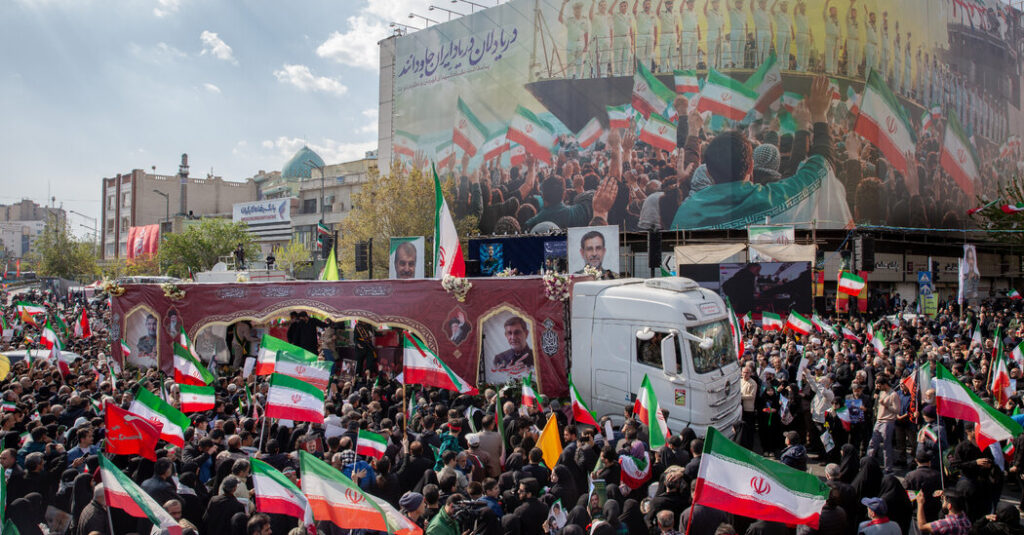
The nearly six-week U.S.-Israeli bombardment of Iran has decimated the country’s clerical, military and political leadership, throwing domestic politics into disarray and opening the door to even greater military control of Iran’s government.
The dust has yet to settle on a cease-fire agreed Tuesday evening, and it’s unclear exactly what near- and medium-term impact the war may have had on Iran’s leadership or on how the country’s political system evolves. Iran’s government, always a challenge to understand, has become more opaque than ever.
The new supreme leader, Ayatollah Mojtaba Khamenei, has not been seen in public since gaining the post, after his father was killed at the outset of the war. He has so far communicated only through written statements. His absence has fueled speculation that the country is actually being run by the Islamic Revolutionary Guards Corps, an ideologically hard-line military force that became a heavyweight player in Iran’s politics and economy over the past four decades.
Though Ayatollah Khamenei is head of state, he “appears largely reduced to a ceremonial role,” Ali Alfoneh, a senior fellow at the Arab Gulf States Institute, said in an email.
Authority in recent years had already been effectively delegated to other power centers, including the president, the speaker of Parliament, the head of the judiciary and members of the I.R.G.C., Mr. Alfoneh said. Within that collective leadership, the Guards had the upper hand, he added.
Brig. Gen. Ahmad Vahidi, the commander of the Guards, and Mohsen Rezaei, a former commander who is now a senior adviser to Ayatollah Khamenei, are both pragmatic figures, Mr. Alfoneh said. They are committed to a strategy of “leveraging economic pressure on the global system — and, by extension, U.S. domestic politics — to deter further American military action against Iran in the near term.”
For Iran, Mr. Alfoneh wrote in a social media post on Wednesday, “survival is victory.”
By decapitating Iran’s military leadership, the war has also enabled the rise of a younger generation of leaders in the Guards who will take on more significant roles in the coming years, said Hamidreza Azizi, an expert on Iranian security issues at the German Institute for International and Security Affairs, a research organization.
While the older Guards had been shaped by the Iran-Iraq War of the 1980s, Mr. Azizi said, the younger crowd were shaped by the 2003 U.S. invasion of Iraq, the Arab Spring uprisings and Iranian interventions in the Middle East.
Those events have given them a better grasp of the hybrid nature of modern warfare, he said, and an understanding of the links between social discontent and external threats. Though members of this younger generation may not be less ideological in their way of thinking, they may be more pragmatic about addressing the Iranian people’s economic grievances, he added.
And whereas the Guards’ current leaders learned military strategy ad hoc on the battlefield during the 1980s, the new generation had benefited from professional military universities and formal education.
“These guys know what modern warfare means, what military doctrine means,” Mr. Azizi said. What would likely emerge from this, he added, was “a transformation that could actually strengthen their position if the system survives.”
Mr. Azizi noted that, in the hours after the cease-fire was announced, he had observed some dissatisfaction and frustration in the commentary of people close to the younger Guards.
If Iran’s demands were to be cemented in an eventual peace agreement, that younger generation may accept it, he said. But if Iran is instead attacked again in the coming weeks or months, that could result in a “serious gap” between the younger generation and the Guards’ current leadership.
Yeganeh Torbati is the Iran correspondent for The Times.
The post War Decimated Iran’s Leadership and Pushed Up a New Generation appeared first on New York Times.