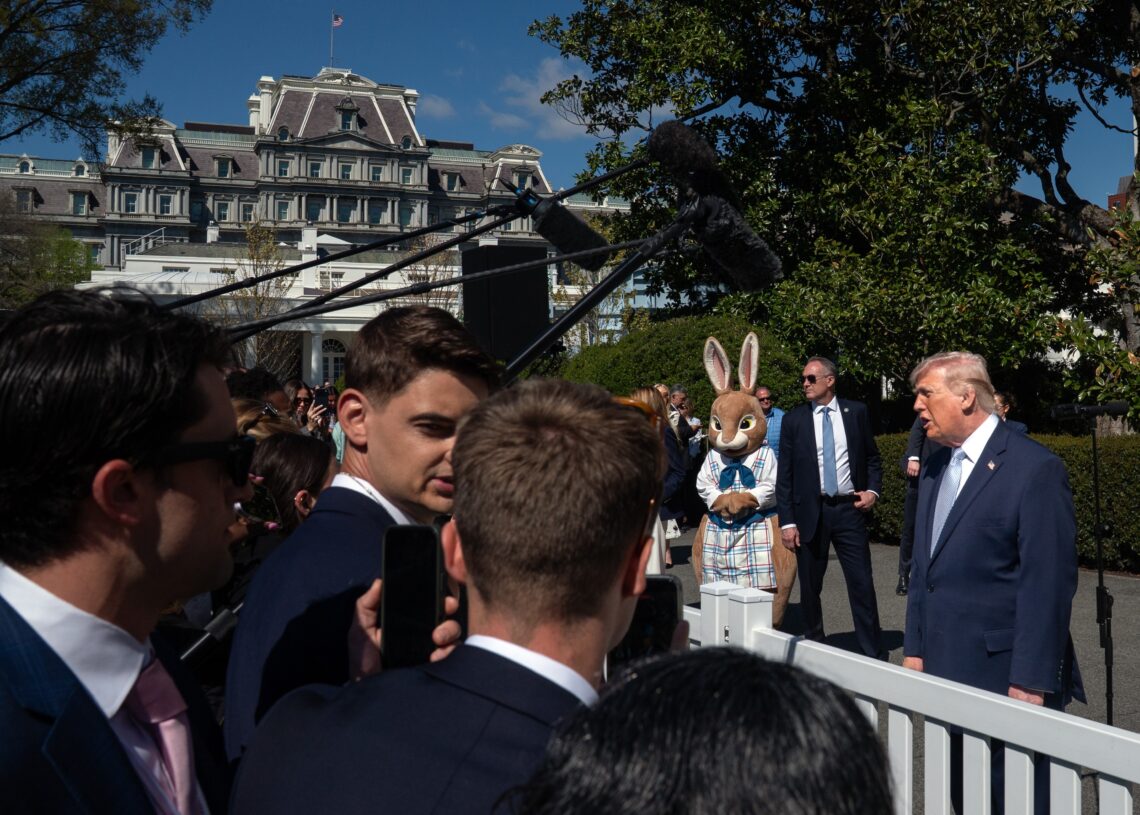
President Donald Trump spent part of Easter morning cursing out Iran, calling its leaders “crazy bastards” and threatening that the nation will be “living in Hell” if it didn’t open the Strait of Hormuz. The next morning on the White House lawn, steps away from the Easter Bunny and military families hunting for eggs, he doubled down. “They don’t want to cry, as the expression goes, ‘uncle,’” he told reporters, “but they will. And if they don’t, they’ll have no bridges, they’ll have no power plants, they’ll have no anything.”
Making Iran beg for mercy is only the latest objective for the war. In just five weeks of military operations, the rationale has shifted from preemptive strikes against nuclear and missile facilities to regime change and liberation. Once Iran restricted access through the Strait of Hormuz, sending oil and gas prices soaring globally, the new military objective was to compel its reopening. But now, the national security crisis has ceded to a crisis of identity — for Iran and the United States, for Trump and the American people.
Nations, like individuals, have egos — and each will wage war to protect its own. Scholars of international relations call this ontological security, which holds that nations need a stable sense of identity just as much as they need physical and economic security. They will prioritize affirming that identity even when it compromises their well-being. Iran and the U.S. would benefit from the end of war — extended conflict and a blockaded strait are in no one’s interest. Though a temporary ceasefire agreement was reached late Tuesday, the hostilities persisted because both nations have become more concerned with saving face than saving lives, a telltale sign that the threat is ontological, not strategic.
Iran’s rejection of an earlier peace deal is proof: Rather than agree to open the strait in exchange for a 45-day ceasefire, Iran demanded sanctions relief and a permanent end to the war. Experts note that the 1979 revolution and hostage crisis transformed the nation’s identity to one of resistance and Islamic redemption. Defying the U.S. and Israel, supporting a network of non-state actors abroad, and securing its religious regime all became central to Iran’s claim to legitimacy. It will open the strait only if doing so can be framed as successful resistance, something the temporary ceasefire apparently delivered. More valuable to Iran than its oil reserves is its sense of self; even if the military conflict is lost, victory is defined by not surrendering — and especially not to Uncle Sam.
Besides, he’s got his own issues. America’s shifting, contradictory goals are symptoms of a country that’s no longer sure of its place in the world. It wants to be treated like the indispensable nation, but under Trump, it’s also become uninterested in multinational alliances and international accountability. This contradiction is colored by partisanship, causing Americans to experience the resulting anxieties differently. For the MAGA faithful, the only acceptable outcome is for Iran to lose heart and quit or for Trump to lose interest and leave, declaring victory along the way. The rest of the nation experiences the moment as vertigo — a national identity dizzied by instability, capriciousness and distrust.
In these instances, the traditional metrics of war — such as sorties flown and targets destroyed — cannot reveal when the conflict will end because they track the wrong things; the only metric that matters is who blinks first. Neither side feels it should back down because, for Trump and the Iranian regime, retreat is more than a military defeat; it ruptures the ego. To submit would be to admit that the story they’ve told their people — and themselves — was a lie, an admission even more costly to those in power than bridges and missile facilities.
In this way, the battle over the Strait of Hormuz has been reduced to a test of wills. It’s now a war on hold where Iran’s endurance is fueled by the rigidity of its identity while U.S. threats of escalation is driven by the nation’s insecurities. Trump complicates the matter by conflating national security interests with his own self-interest, as in Venezuela when his quest to be a wartime president provided justification for seizing a head of state. When a state’s identity is undermined by presidential vanity, it’s harder for the nation to understand why it’s waging war at all.
But for the U.S. under Trump, economic coercion and military dominance are how its ego is affirmed — making countries “cry uncle.” Modern history shows, however, that when nations believe resistance is existential, military success rarely produces submission — quagmires are the more likely result.
How to get unstuck? The unconditional ending of the war and reopening of the strait is an easy win, but it will feel like defeat to Trump and to the Iranian regime if they have to give an inch. Nations can escape these ontological stalemates by agreeing to a story of events that allows both sides to claim victory — an Easter egg for everyone. Iran will tell the world it defeated a superpower, and the U.S. will claim credit for restoring the global economy and regional balance. The threat of the war persists because neither nation has accepted that being the hero of its own story will make them the loser in the eyes of everyone else.
The post Trump’s Easter tirade reveals what the Iran war has become appeared first on Washington Post.