Democrats “need a vision that’s not just anti-Trump,” Representative Alexandria Ocasio-Cortez said last year. As Democrats reflexively do, she then ticked off a list of policy markers, like “guaranteed health care for every American.”
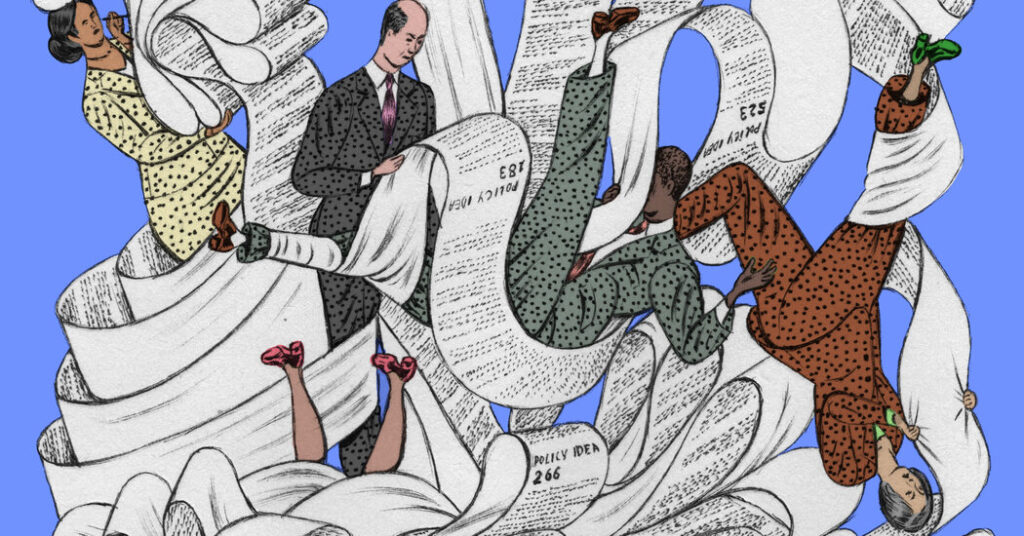
Democrats insist that policy agendas are what determine a party’s political success and failure. Recently, Senators Cory Booker and Chris Van Hollen promoted splashy, dueling plans to reduce the federal income tax burden for the lower and middle classes. For its part, a prominent think tank offered a handy “161 practical ideas” for the next Democratic administration.
The problem is that policy-as-politics doesn’t work. Parties can, and historically have, forged stronger, more sustainable connections with voters through other means.
Pursuing those alternatives now would require Democrats to become a real political party again — and that’s no easy feat. The essence of mass politics is engaging with people in civil society — and not just an engaged layer of activists — in a sustained, repeated way that’s visible to fellow citizens with whom they are linked in work and community. For Democrats, it’s a lost art.
Expecting political rewards from policy has precluded good political thinking — setting priorities to sustain and expand who is in the party and looking ahead to see how today’s moves shape tomorrow’s battles. And it has led Democrats to neglect the kind of organizational renewal and civic revitalization necessary to repair their fraying ties to working Americans.
Policy does not produce its own political reward, even if Democrats continue to believe otherwise. Scholars of policy’s downstream effects (called “policy feedback”) show that policies can just as easily generate backlash as enthusiasm. When policies do generate public support, the commitment goes to the policy itself rather than the party that enacted it.
The long path that the Affordable Care Act has traveled from politically damaging to popular offers a recent illustration. Policy feedback eventually helped to protect the law from repeal. But it’s done nothing to help Democrats win the support of the people who have most benefited from the law.
Polarization limits the credit voters are willing to offer for policy achievements. Swing voters unattached to either side are the least likely to be politically informed enough to connect public policies to their partisan authors.
Recognizing this reality is not an argument against parties’ pursuing good policy. It is an argument to evaluate policy on its substantive merits, while tackling political challenges directly.
The Biden presidency offered a case in point for the policy bet’s false promise. To counter Donald Trump’s appeal and save American democracy, Biden-era Democrats perceived their core political challenge to be reversing the defection of lower-income and lower-education voters from the party.
To address this challenge, Democrats pursued an ambitious economic policy agenda framed around moving beyond neoliberalism. Saving democracy from MAGA, the logic went, would require the forging of a post-neoliberal political economy newly open to bold welfare-state expansion, ambitious industrial policy and aggressive antitrust enforcement.
The stimulus spending of the American Rescue Plan, industrial policy initiatives of the CHIPS and Science Act and the Inflation Reduction Act, and administrative and regulatory activity across the executive branch added up to an agenda both notably left-leaning and decisively more focused on economic than cultural issues.
All that activity did essentially nothing to slow the defection of working-class voters from the party. In 2024, the party’s losses among lower-income and less-educated voters reached into nonwhite constituencies long considered sturdy Democratic loyalists and helped put Mr. Trump back in the White House.
This is where the memory of being a mass political party would be helpful. State and local party organizations once generated political know-how that sustained loyalties through connections to people’s lives first, with public policy following. Across the 20th century, labor unions and federated civic groups, including ethnic fraternal organizations like the Polish National Alliance, normalized political support for Democrats while keeping party leaders informed about what was on their members’ minds.
The postwar partnerships between organized labor, most notably the United Auto Workers, and middle-class liberal reformers in state parties like Minnesota’s Democratic-Farmer-Labor Party and Michigan’s Democratic State Central Committee offer examples of how organizations with genuine memberships helped to anchor policy goals to political needs.
But starting in the 1970s, such organizations atrophied, and educated professionals came to dominate civic spaces. Democrats’ political gravity shifted in turn to activists and institutions in a sprawling, nationalized and thoroughly policy-minded party network. In place of organizations connecting policy to people and politics came ubiquitous surveys and message-testing deployed on behalf of policy professionals.
Democrats’ current debates highlight their organizational disconnect. Alumni of the Biden administration appear to see the 2024 electoral failure as a sign that the policy program wasn’t big enough. The Roosevelt Institute report, with its 161 tips, ultimately amounts to a case for the policy-first strategic status quo.
Among Democrats further to the left, the same fundamental problem applies: Organizationally thin, they have offered few plausible answers for how to consistently win elections and build a durable project for power.
Moderate Democrats have also gotten in on the factional action. A recent report from the centrist outfit Welcome PAC uses reams of survey data to document party leaders’ disconnect from the priorities and positions held by majorities of voters. The new think tank Searchlight Institute calls for a return to Democratic “heterodoxy” — a big-tent ethos that would accommodate and encourage a wider range of ideological and issue positions taken by politicians responsive to the views of their own constituents.
The need to meet voters where they are, both physically and ideologically, is very real. But exhorting politicians to follow the polls will go only so far. A successful version of the heterodox vision would require hard organizational work to revive subnational parties and to foster civil-society groups that reflect ordinary citizens better than the elite-led liberal professional outfits the moderates disparage.
The alliance between the Nevada Democratic operation termed the “Reid machine” (named after Senator Harry Reid) and the Las Vegas-based Culinary Workers Union offers a rare contemporary instance of this kind of politics. The union connected the party to working people at the grass roots while the party combined its well-resourced political operations and its expertise at picking more competitive candidates.
More recently, the former Wisconsin party chair Ben Wikler proved masterful at drawing national attention and fund-raising to his party’s relentless field work in an intensely polarized swing state. By strengthening the state party to beat back Republican efforts at entrenchment via gerrymandering and other procedural gambits, Mr. Wikler showcased what party-building can do tangibly for the fight against democratic backsliding.
The rich organizational dynamism of Zohran Mamdani’s mayoral campaign in New York City also warrants appreciation, even if its national application has obvious limits. It reached immigrant citizens across the city and made campaign work fun. That Mr. Mamdani did this while sustaining a thematic message focused on the cost of living points to how policy can be forged effectively to a political pitch rooted in solving people’s problems.
The first steps to fixing Democrats’ disconnect from working people come in identifying the problem: Policy deployed as a substitute for politics makes for bad policy and worse politics.
Sam Rosenfeld, associate professor of political science at Colgate University, and Daniel Schlozman, professor of political science at Johns Hopkins University, are the authors of “The Hollow Parties: The Many Pasts and Disordered Present of American Party Politics.”
The Times is committed to publishing a diversity of letters to the editor. We’d like to hear what you think about this or any of our articles. Here are some tips. And here’s our email: [email protected].
Follow the New York Times Opinion section on Facebook, Instagram, TikTok, Bluesky, WhatsApp and Threads.
The post The Last Thing Democrats Need Is More Policy Plans appeared first on New York Times.