Georgica Pond is the brackish coastal pond in East Hampton, Long Island, around which sit the summer homes of the filmmaker Steven Spielberg and the hip-hop mogul Jay-Z.
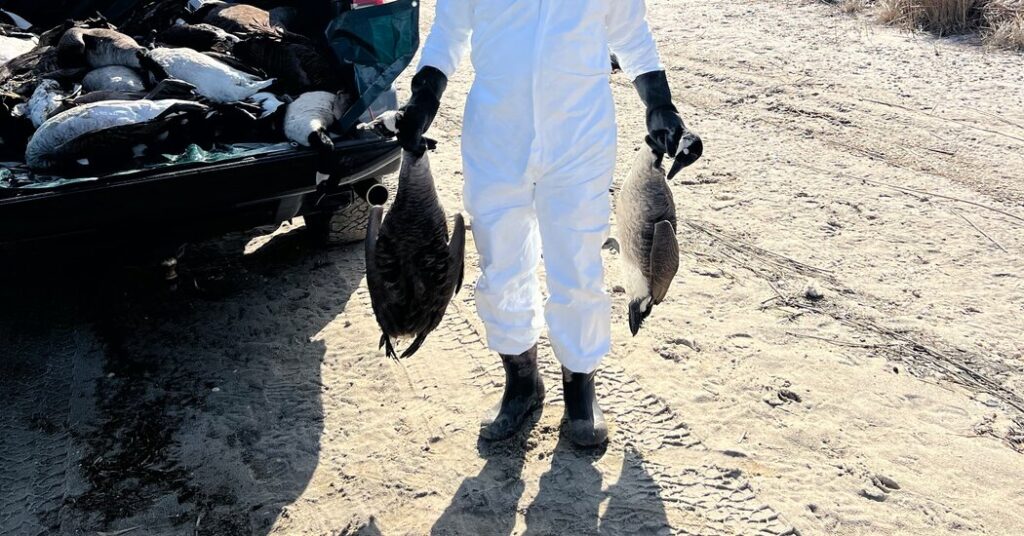
This winter, however, the pond went from a picturesque location to a horror scene when more than 700 dead geese lined its sandy shore and the surrounding area.
Their deaths came at a time when much of the North Fork of Long Island was hit with a scourge of H5N1, also known as bird flu.
Wildlife conservationists believe the outbreak was principally caused by an unusually long spell of freezing temperatures, which meant birds were dealing with scarce resources and weakened immune systems. Whenever birds can find small patches of water, they flock straight to them, breathing all over one another and quickly spreading germs. Once symptomatic, the birds typically become disoriented and start dropping dead, often within a day.
Birds have been hitting the beach in Southampton as well, with hundreds showing up on the shores of Sagg Pond in Sagaponack, according to Ryan Murphy, the emergency manager for the Town of Southampton.
“Since 2022-ish, it has been an ongoing issue,” he said. “But typically, the impact has been toward agricultural chickens and ducks that are intended for consumption. This is the first year it’s been seen in a large number of wild water fowl.”
Transmission to humans is relatively rare, according to Dr. Nahid Bhadelia, a founding director of Boston University’s Center on Emerging Infectious Diseases.
“But it’s not zero,” she said.
And, according to Dr. Richard Webby, a virologist at St. Jude’s Hospital, when the pathogen does jump to humans, the worldwide fatality rate among confirmed cases over the past two decades has hovered around 50 percent, although, for reasons scientists don’t fully understand, only two of the past 71 cases in the United States have resulted in death.
“Clearly there needs to be better preparation,” said Dr. Webby. He added that he believes the pathogen is likely to mutate, becoming more infectious to humans; and that he has no idea which agency — local, state or federal (if any) — bears responsibility for managing potential outbreaks.
In a likely outbreak near Cincinnati, chronicled in The Times last December, different agencies haggled over who was responsible for removing 72 dead vultures from a Catholic school’s athletic fields. The Ohio Department of Natural Resources Division of Wildlife did not agree to help dispose of the carcasses until after township officials complained to a local news station.
The town trustees of Southampton elected to deal with the problem there by hiring Suffolk County Deer Management to cart away the birds. In East Hampton, cleanup landed in the lap of Jim Grimes, a local landscaper who also serves as a trustee for the town. According to Mr. Grimes, the town’s trustees first heard from East Hampton Marine Patrol sometime around Feb. 27.
Almost no one seemed to want to lend a hand to dispose of the bird carcasses, he said.
Certainly not the town board, which has a spotty relationship with the town trustees dating back to colonial times, when East Hampton’s most notable residents were local fishermen and the government was divided, more or less, between the people who managed the beaches and waterways and those who managed other stuff, like the police and taxes.
Of course, that was a time before agencies like the Centers for Disease Control, the Environmental Protection Agency, the Department of the Interior and the National Institutes of Health had been established. It was also a time when infectious disease specialists did not worry about avian flu jumping to various members of the animal kingdom, whether they are Fortune 500 CEOs or their $4,500 goldendoodles. “The kneejerk reaction of the town board was, ‘We don’t want to touch this,’” Mr. Grimes said.
When The Times spoke by phone on Friday with Patrick Derenze, the public information officer for the town, he assigned the responsibility to the town trustees.
Mr. Grimes said calls had also been placed to the New York State Department of Environmental Conservation. It advised that the dead birds could be triple-bagged and taken to Stony Brook University for testing. The website also provided disposal recommendations, either by incineration or burial.
Whatever method was chosen, the D.E.C. website made it clear that the agency would be unlikely to parachute in with a team of infectious disease specialists overseen by a Harvard-trained leader evoking the demeanor of Viola Davis or Jodie Foster.
“There is currently no way to effectively manage this disease in wild birds,” the website says in bold letters, and, “In most cases, there will be no direct response.” (“In a post-Covid world, we are on our own,” said Mike Tessitore, who cleaned up the birds in Southampton.)
Mr. Grimes asked several of his fellow trustees for help.
“I said, ‘Are you here? Can you give me a hand?’” Mr. Grimes recalled. “I thought, Let’s just deal with this in-house,” adding, “I’ve never heard so many lame excuses.”
So with a little advice from his son, Noah Grimes, a Texas-based equine veterinarian, Mr. Grimes put on a white coverall suit and an N95 mask and went to work. He dug a two-foot-deep, four-foot-wide, 30-foot-long trench in a secluded area on the southwest side of the pond (past the intertidal zone, he noted), and used his Ford Ranger truck to transport some 200 birds to the site. He hopes it will be their final resting place.
Within days, more than 500 other dead birds were found nearby, although these were buried by Mr. Grimes and his small landscaping crew in a field on Accabonac Road, a few miles away.
Kathy Cunningham, the executive director of the Village Preservation Society of East Hampton, was one of many nearby residents who said Mr. Grimes had behaved heroically.
“The fact that Jim did this all on his own was a real kindness,” she said.
But Mr. Grimes was also paid nearly $6,000 by the trustees to conduct the cleanup operation. That led to sporadic complaints of insider dealing in a community that is known for it.
“There’s no business card that says Jimmy Grimes, pet interment!” Mr. Grimes countered. “I was just trying to deal with the problem as efficiently as possible.” (The cost for Southampton’s cleanup effort was well over $20,000, according to James Mack, the president of the town trustees.)
Dell Cullum, a wildlife photographer who previously served as a town trustee, penned a diatribe posted on Nextdoor calling the beach “the absolute WORST place to bury infected birds.” Doing so, he said, was “NO DIFFERENT THAN BURYING INFECTED MEDICAL WASTE IN THE SAND.”
In an interview last week, Mr. Cullum called the beaches of East Hampton a “superhighway” for foraging raccoons.
“They’re going to be digging in the soil!” he said. “Foxes are going to be digging in the soil!”
“I don’t want to say someone’s crazy even though they really are,” Mr. Grimes shot back, going on to say that he has yet to meet a raccoon that digs two to three feet into the ground.
But, he said, if the situation were to recur, “I wouldn’t bury them on the beach again!”
Jacob Bernstein reports on power and privilege for the Style section.
The post The Hamptons Has a Bird Flu Problem appeared first on New York Times.