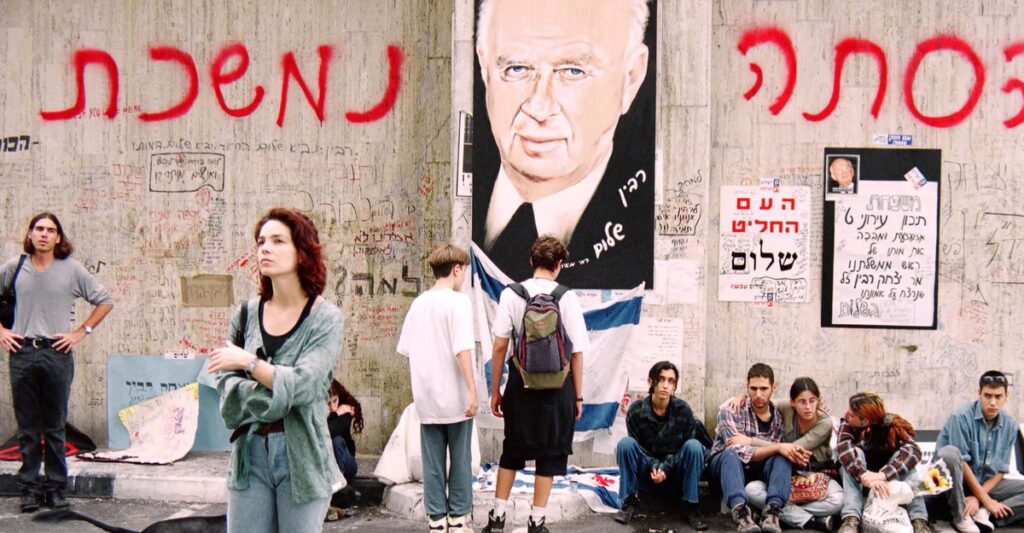
The most important war that Iran has fought was largely undeclared and is almost entirely forgotten. It was a war against regional peace and the agreements that might have secured it. Iran began that struggle more than 30 years ago and effectively won it. The current conflict in the Middle East is inseparable from that legacy.
My adolescence was shaped by that forgotten war. As a teenager in Israel in the 1990s, I watched the great hope of the peace process rise and violently die. First came reports of a breakthrough in secret talks in Oslo, and a wave of developments that seemed almost miraculous: agreements between Israel and the Palestine Liberation Organization, which until then had been designated a terrorist organization, followed by the normalization of Israel’s relations with parts of the Arab world, culminating in a peace agreement with Jordan.
Almost immediately, and in parallel, came actions meant to derail the peace process. An Israeli far-right extremist massacred dozens of Palestinian worshippers at the Cave of the Patriarchs in Hebron. That was one terrible event. But those years were defined above all by a wave of terror attacks directed at Israelis, carried out by Hamas and Palestinian Islamic Jihad. These groups aimed to destroy any possibility of compromise because they saw it as a betrayal of the Palestinian cause and of their fanatical vision of Islam. They introduced a brutal new tool to the conflict: suicide bombings. Supporting the Palestinian extremists, not yet fully visible, was Iran.
[Eliot A. Cohen: The strategic follies of the Islamic Republic]
The Oslo Accords would have met with substantial right-wing resistance in Israel anyway—but the bombings and sense of lost personal security sharply intensified this. The political logic was straightforward: Only months earlier, the country had signed agreements with a terrorist organization, and now buses were exploding. Benjamin Netanyahu, then the leader of the opposition, saw a dramatic rise in his political fortunes, as the far right railed against Prime Minister Yitzhak Rabin.
I was 16 years old when I attended the first demonstration of my life, in November 1995, in Tel Aviv. It was a rally in support of the peace process and Rabin, and I came with friends from the small town between Haifa and Tel Aviv where I grew up. As the event reached its end, we heard that Rabin had been shot by a Jewish assassin—a right-wing extremist who sought to sabotage the peace process.
Many people imagine that Rabin’s assassination was what killed the peace process, but this is not exactly the case. Shimon Peres, Rabin’s successor, was committed to continuing the talks, and public opinion still largely supported doing so. In Palestinian society, too, only a minority opposed the Oslo Accords. That Hamas persisted in its suicide attacks, however, fueled a growing skepticism among Israelis. And Israel responded to those attacks by erecting checkpoints and enforcing general closures, cutting Palestinians off from jobs in Israel, which eroded the agreements’ popularity among Palestinians.
None of this was accidental. Hamas and Palestinian Islamic Jihad, along with Hezbollah, were waging a war against the normalization of Israel’s relations with its neighbors. They had one state ally willing to provide funding, training, and planning for that struggle: Iran, whose supreme leader, Ali Khamenei, described Yasser Arafat, an architect of the Oslo Accords, as “both a traitor and a fool.”
Hassan Salameh, a senior Hamas commander convicted of planning attacks that killed dozens of Israelis in 1996, said that he went to Iran for weapons training and instruction in assembling bombs. One of the attacks he planned was a bombing that took place in the run-up to Israeli elections and helped tip that year’s vote toward Likud. Israel’s military intelligence reportedly assessed that Iran, aiming to weaken the peace process, wanted Netanyahu to win. Which he did—by 30,000 votes, after having been the underdog throughout the race.
A U.S. federal court later described 1995–96—the period covering both Rabin’s assassination and Netanyahu’s rise to power—as a golden age for Iranian support of Hamas. The court found that Hamas received at least $25 million and up to $50 million during those years. More broadly, Iran was channeling from $100 million to $200 million annually—the equivalent of roughly $200 million to $400 million in today’s dollars—to militant organizations that were generally opposed to the peace process. For Hamas, an organization founded only eight years earlier, the sum was staggering.
Iran was not solely responsible for the rise of Hamas and Palestinian Islamic Jihad, or for the structural failures of the Oslo Accords. Palestinian opposition to the agreements, even if initially a minority view, was not fringe, nor was it confined to Islamist organizations. The belief that Israel ought not to exist, and that Palestinian liberation could be achieved only through force, was embedded in Palestinian politics even before the founding of Fatah. Iran exploited and amplified this worldview, but it did not create it.
The Israeli right—not only the far right—also worked to delegitimize the peace process, and to create “facts on the ground,” a favored expression of Israelis for the expansion of settlements. Netanyahu pledged to continue the peace process, met with Arafat, and transferred additional territory to the Palestinian Authority. Yet he regarded the accords as a “terrible mistake,” and later took pride in having prevented the establishment of a Palestinian state. Since 1996, the Israeli right has won all but three elections, and its leaders have been largely determined to halt negotiated territorial compromises with the Palestinians.
The Israeli-Palestinian conflict is rooted in a long and tortured history, and the failure to achieve a final status agreement needs no external explanation. Yet Iran made itself an indispensable part of this story. It actively sought to collapse the peace process. Suicide bombings were but one instrument to this end. Hassan Nasrallah, the slain leader of Hezbollah, Iran’s most important proxy, later explained that resistance to the Oslo Accords, which his group clearly saw as a threat, led to heightened cooperation among Hezbollah, Hamas, and Palestinian Islamic Jihad.
Even so, the peace efforts persisted for at least two decades. They produced real changes on the ground, including the creation of administrative zones that still structure governance of the West Bank, as well as ceremonies, economic investments, and a Nobel Peace Prize. But running beneath it all was a determined, well-funded campaign of violence against any meaningful compromise. The result was hundreds of deaths, then thousands.
[Eliot A. Cohen: Three things the consensus gets wrong about the Iran war]
In the 1990s, most Israelis supported a two-state solution; in 2013, roughly half still did; and by 2025, only about one in five still believed such a solution was possible, according to the Pew Research Center. In 1996, Fatah—the faction that signed the agreements with Israel—led Palestinian politics. Currently, according to Khalil Shikaki, a prominent Palestinian pollster, Hamas consistently outperforms Fatah, even though it still falls short of a majority.
Today the Middle East is consumed by a confrontation that began when Hamas attacked Israel on the morning of October 7, 2023. Hamas’s indispensable benefactor was the same Iran that has long opposed any normalization with Israel. In 1993, Iran’s target was Israeli-Palestinian peace. By 2023, it was the prospect of normalization between Israel and Saudi Arabia. Hamas likely also had other motives—concerns about the Temple Mount, for example, and a belief that Israeli society was weak. But once again, violence succeeded in foreclosing a political opening before it could become irreversible.
In the current American-Israeli conflict with Iran, a two-week cease-fire has been announced. But the outcome of the war will ultimately depend on the terms of a final agreement, if one is reached. The debate over the present war is legitimate, and the aversion to open-ended conflict is hard-won. But when we speak of the cost of confronting Iran, we should also acknowledge the cost of not doing so. Three decades ago, a political settlement between Israelis and Palestinians was within reach. All sides made mistakes, and the record of folly is long. But folly alone does not explain what happened. One country—Iran—made the destruction of that possibility its manifest destiny.
Tehran has already won one consequential war: the war against Israeli-Palestinian peace. That victory has shaped the region for decades. If Iran wins this war, too, expect more of the same. Maybe bloodier.
The post The Forgotten War That Iran Already Won appeared first on The Atlantic.