Is Knud Adams the Pulitzer whisperer?
The director has the striking distinction of having staged the premieres of plays that won the Pulitzer Prize for drama in back-to-back years. “English,” Sanaz Toossi‘s delicate comedy about the hopes and fears of a group of Iranians studying English in a classroom outside of Tehran, won in 2023. “Primary Trust,” Eboni Booth‘s touching parable about an isolated, emotionally scarred 38-year-old Black man in upstate New York rebuilding his life with a little help from some unexpected friends, won in 2024.
Adams was instrumental in the development of both plays, working closely with the writers to formulate how the dramaturgy would be conceived in three dimensions. He wasn’t just an interpreter, but the principal architect of productions that helped realize original playwriting visions.
He has become one of the most prized directors of new work in the country, and now Los Angeles will get a sample of his textually nuanced, scenically surprising excellence. His Broadway production of “English,” for which he received a Tony nomination for his direction, has its official opening on Thursday at the Wallis Annenberg Center for the Performing Arts. And “Primary Trust,” which he directed in its premiere for Roundabout Theatre Company and again at La Jolla Playhouse, arrives May 20 at the Mark Taper Forum in a newly cast production for Center Theatre Group.
We met at a rehearsal studio in Midtown Manhattan last month during a period when Adams was, characteristically, juggling multiple projects. He was getting set to open his production of “Cold War Choir Practice,” a new play by Ro Reddick that won the prestigious Susan Smith Blackburn Prize this year. Adams directed the premiere for Clubbed Thumb’s Summerworks 2025, a downtown New York generator of adventuresome new work, and the enthusiastic response led to the off-Broadway production at MCC Theater, which was in the final days of previews when we spoke in March.
Carving out a career as a director of new work can’t be easy at a time when artistic directors around the country, struggling to keep their increasingly risk-averse subscribers on board, are gravitating toward the familiar and the market-tested. No one has to tell Adams about the economic hurdles that nonprofit theaters, the wellspring of new plays in America, are confronting.
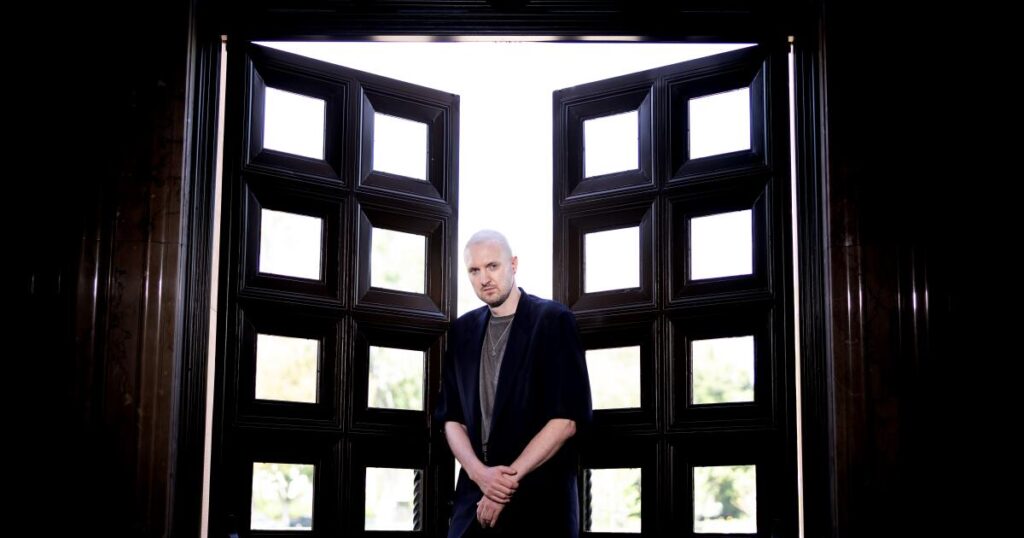
“Part of your labor as a director is helping to navigate that problem set, which is getting worse and worse,” said Adams, a tall Nordic-looking man in his late 30s with a phlegmatic demeanor that undersells his refreshing candor and charming vulnerability. “I sometimes joke that for me arriving off-Broadway was like arriving at a party as the police were showing up.”
Seated in a studio space that had all the warmth of a school detention hall, Adams admitted that, when he moved to New York, he didn’t know much “about the professional side of the world.” Recalling his early days in the city, he said his budget for food and personal care items, like shampoo, was $30 a week. He worked temp jobs and lived off dollar pizza while taking internships that might pay him in metro cards and free opening night food.
“My expectation was that artists were starving,” he said. “We were supposed to live uncomfortable lives. And I was sort of monastic about it.”
Has his recent success transformed his life? “I still live cheaply,” he said. “I have roommates.” But he acknowledged that “over time you develop less tolerance for squalor.”
His brush with Broadway decadence during the Tony Awards hoopla for “English” opened his eyes to the disparities of the scene. “I was such a foreigner, a guest in that community,” he said. “While others were getting dressed by Tom Ford, I was stressing out, thrifting for my ceremony outfit.”
Adams had been systematic about his directing path. He went to Kenyon College, where he said he “directed a ton,” and did the internships that “had a little bit of stipend or would house you in the summer.” After graduating, he spent a summer interning at Chicago’s Steppenwolf Theatre Company before moving to New York. Subsequent internships and fellowships led to assistant director opportunities, which he said he took “very seriously” while figuring out how to create his own work.
Back then, he said, directors tended to be placed on one of two tracks. “It was either classics or new work,” he recalled, “and I chose new work partly because I like the partnership with the playwright in the room.”
The challenge of bringing a new piece of writing to life on the stage appeals to both hemispheres of his brain, the analytic and the intuitive sides. “I love encountering a play for the first time and not being able to Google-Image-search how other people have solved it,” he said. “But it’s also about taking care of something really delicate and fragile.”
Playwright Erin Courtney, who first encountered Adams at Clubbed Thumb, is working with him, in conjunction with the National Asian American Theatre Company, on her new play “Begin, Again.” “Here is what I learned from the rehearsal room so far,” she wrote via email. “He assumes everything about the play is working before he starts. He comes to the room with an open mind and a wildly observant ear. As we worked, he quietly asked questions about certain formal choices I had made. I found myself very open to his dramaturgical approach — respectful, quiet, caring for pacing, tempo, curious and open. His care for the actors, for the writer and for the play itself is palpable. His aesthetic is micro and macro all at once.”
Adams had an itinerant upbringing, spending a formative part of his early years in Europe before moving to Ohio, where he attended high school and college. “Before we moved back to America, I grew up in France, England and Scotland, moving around once every year or two,” he said. “And in this spotty education that we had, bouncing between languages and countries, the constant for me was reading, drawing and visiting museums. We didn’t have a lot, but you could take your music cassettes and drawing utensils with you. That’s about it. I have five siblings, and we made a lot of our own play at home.”
His mother is an American citizen who was born in Denmark. And his father is a research scientist from Cincinnati. ”He was doing his postdocs in various European universities, but these are very short-term projects, so when he was unemployed he would get kicked out of the country,” Adams said. “Eventually, we ran out of money, and there was illness in the family. We were just defeated and had to come back to the States.”
The culture shock was intense. “We were dirt poor, had big Scottish accents at the time, a family of six siblings, and then coming to very conventional suburban schools,” he said, the memory eliciting a wild-card smile. He said that his background is unusual but perhaps not all that uncommon for an artist. Being an outsider is ideal preparation for entering new playwriting worlds.
“There are a lot of directors who come from military families,” he said. “Anne Bogart writes about this beautifully. There’s something about being an observer of life as a survival mechanism that translates really well to the art of directing, where you’re constantly trying to take the measure of your environment, to adapt and survive.”
Suburban ennui also has its uses. “I didn’t drive,” he explained. “I wasn’t drinking. I wasn’t doing drugs. I was bicycling around the streets, no cellphone, bored out of my mind, looking for trouble. I found some trouble, but also this imagination, this inner life, develops.”
After high school, Adams considered going to art school. Sculpture, installation art, photography, and drawing with ink and charcoal all appealed to him. He doesn’t necessarily think he was “anointed” for any of these paths, but his love and appreciation for the visual arts propelled him.
“I also was writing fiction at the time,” he continued. “And it wasn’t until I fell into Intro to Theater in college that I realized I didn’t have to choose. Directing plays is literary and visual. You get to work with materials, and the plastics of the theater fascinated me. The history of theater fascinated me too. It’s also a bit of algebra, and I was a little mathy, so the puzzle of working on a play intrigued me.”
But theater wasn’t just a way for him to integrate his artistic interests. It was also a source of community.
“I got into theater because of the social obligations,” he said. “I was a bit of a loner, and I was quite serious about my other artistic interests, photography and sculpture. I would spend hours and hours in the darkroom in college just by myself, inhaling chemicals. To force my hand at social interaction, I signed up to direct a play. And I discovered I liked that structure.”
The plays he’s drawn to don’t follow prescribed patterns but they wear their unconventionality with a difference. While not in any way rabble-rousing, they wage subtler revolutions.
“English” insists on viewing its Iranian characters through a humane, rather than geopolitical, lens. “Primary Trust” doesn’t ignore the role of race in the story of its profoundly alienated protagonist, but the focus is on repairing the breach between Kenneth, the central character, and the community in which he was orphaned. And “Cold War Choir Practice,” a play set in 1987 that brings together roller disco, Reaganomics, Cold War espionage, the threat of nuclear Armageddon, a capitalist cult and Black ideological power struggles, never loses sight of the forlorn 10-year-old girl trying to make sense of her anxious life in Syracuse, N.Y.
Theatrically playful, these works are suffused with a longing for human connection. Adams was reluctant to categorize his sensibility, but he acknowledged that he gravitated toward plays “that have some invitation for design innovation while being centered on human beings.”
“Something that Eboni [Booth] and I talk about all the time, even when I was directing her as an actor, before she started writing plays, is our appreciation for the fact that life is very hard, and that, in my experience, we’re simultaneously dealing with these various strata of challenges,” he said. “One is societal. There are so many structural hardships that everyone is trying to navigate every day. There are the interpersonal hardships. And then, equally important, is this vast interior world, where a lot of us spend most of our time. And these internal obstacles are as vivid and real as external obstacles.”
This holistic perspective is spectacularly evident in Booth’s “Primary Trust,” a play that has both the aerial view of Thornton Wilder’s “Our Town” and what Adams describes as the “evocative and efficient” intimacy of “the very best short story writing, where you’re immersed in a feeling of a place and a time that’s distinctive on every page.”
“I spent a lot of time in advance thinking about how to convey that atmosphere on the stage,” he said. “And it began with my decision to put as much of the town as possible on stage. It’s sort of the reverse of ‘Our Town.’ Rather than show you nothing, you show Kenneth as much as possible in his whole environment. And we played with scale and the feeling of being inside a very familiar community yet feeling foreign to that community.”
As for “English,” he didn’t anticipate having to make any drastic changes to address the current war with Iran. The play, set in Karaj in 2008, takes place at a specific political moment.
“Iranian and Iranian Americans who saw it,” Adams said, “understood immediately that moment, because it takes place over the months leading up to the Green Movement, which was a fraught time when they hoped there would be a fair election. So we’re subtextually charting that journey.”
He added that the characters’ relationship to their headscarves would be different if it were set today. “There’s a nuance to what people are protesting, hard-earned protests that have come at great cost,” he said. “I think Americans more than ever are aware that there is a separation between a country’s people and its leaders, that we are not always represented by our government. This has been tragically true of Iran.”
When I saw “English”at the Old Globe in a different production than the Atlantic Theatre Company-Roundabout Theatre Company co-production directed by Adams that transferred to Broadway, I wondered if Toossi might be skirting some of the play’s difficult politics out of fear of imposing an American perspective.
“I think one of Sanaz’s rules for herself is feeling free from the obligation to educate,” Adams said. “That she gets to be an artist who’s focused on character and interiority and writing hyper-specifically about the context in which the characters live, but not needing to decode that for her audience. Feelings of romance and wit and subversiveness are as important to her as the political background of her story. So it’s all in balance.”
In terms of the authenticity of the Iranian experience, he said that there’s a feeling of protectiveness from the Iranian American cast members “around their mothers, their sisters, these Iranian women who only are considered in America vis-à-vis the tragedies of the country and are never considered as stylish, witty, romantic people outside of that context. I think creating space for that is as political as talking about current events.”
So does Adams have the Pulitzer touch? It certainly seems that way to me.
“Maybe they have the Knud touch,” he joked before taking a moment to reflect on this rare accomplishment.
“I remember being an undergrad looking for more plays and Wikipedia-ing the Pulitzers for a reading list,” he said. “The thing that thrills me is that Eboni and Sanaz get to be on that list forever.”
The post Red-hot director Knud Adams brings his Pulitzer touch to L.A. with ‘English’ and ‘Primary Trust’ appeared first on Los Angeles Times.