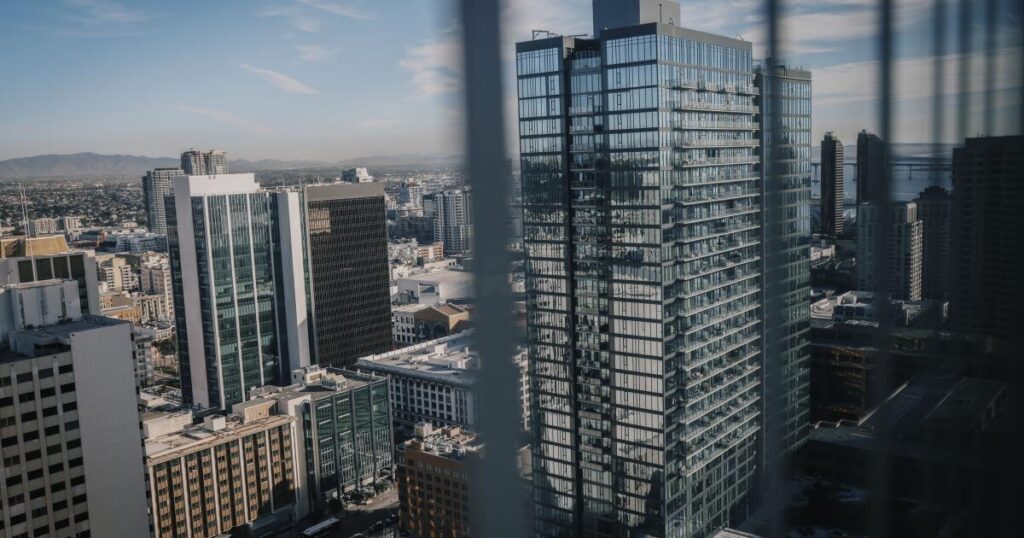
San Diego is one of the nation’s hottest housing markets, with average home prices hovering around $1 million and rents for a one-bedroom apartment topping $2,000 a month.
Yet city officials estimate that more than 5,000 properties sit empty most of the year, which some advocates argue worsens the city’s housing shortage and affordability crisis.
So California’s second-largest city is set to take dramatic action.
In a few weeks, San Diego voters will decide whether to become the latest California municipality to tax vacant homes — a revenue bid that officials insist could raise millions and return some empty residences to the housing market.
San Diego’s independent budget analysis estimates that the tax, if it’s passed by voters in June, would apply to about 5,000 empty homes and could raise up to $24 million in its first year of implementation, depending on the extent of exemptions. That money can be used by officials to fund new affordable housing projects, and proponents hope the financial blow could discourage some owners from keeping their units empty.
Affordability “is a problem across the state and it’s something that I think we have to be more assertive about,” said City Councilmember Sean Elo-Rivera, who proposed the legislation for the tax. “Empty home taxes are one of the ways to do that.”
Even if the tax affects only about 1% of the city’s housing stock, Elo-Rivera said, he’d consider it passing a win.
“Homes shouldn’t be empty during a housing affordability crisis, when everyday people are struggling to afford to live in communities they work in,” he said. “As council members, we celebrate projects that come on line with 50 homes, 100 homes. … Every home that we add to the city’s housing stock is literally a door for someone to walk through and live in.”
San Diego is the biggest of several California cities to try taxing empty houses, and it could serve as a key test case.
Oakland and Berkeley collect taxes on vacant homes after having passed laws in recent years; a similar tax passed in San Francisco was struck down in court, though it’s now under appeal.
As these taxes on empty homes — or so-called vacation homes — have gained popularity, many property owners have pushed back, arguing the government has no right to tell them what to do with their properties. Some say it’s unfair to be taxed for not wanting to rent or occupy a home full time.
Others worry it will dissuade local real estate investment, or point out that properties can be vacant for a variety of reasons, including during renovations or transitions.
“Beyond its legal deficiencies, the proposed vacancy tax sends a troubling signal to housing providers at a time when San Diego urgently needs investment in new housing and the preservation of existing supply,” Melanie Woods, the vice president of the California Apartment Assn., wrote in a letter to the City Council.
Housing experts mostly agree that the measure, if passed, could provide some positive outcomes for San Diego, but several said its success hangs on the ease of its implementation, the extent of exemptions and potential legal challenges.
“This is a policy, essentially, to bring luxury housing back onto the market,” said Shane Phillips, a housing initiative project manager with UCLA’s Luskin School of Public Affairs. “It does help, but most of the homes that are used as vacation or second homes are not affordable.”
Still, if the process encourages even a few owners to open up their units for tenants or sale, he said, it can have an “indirect benefit” on the housing market.
Phillips and other experts pointed to Vancouver as an example of a successful vacant homes tax. The city has collected almost 200 million Canadian dollars ($144 million) since its tax was enacted in 2017, and the number of vacant homes has fallen by about 1,500, according to city data. However, the homes that were brought back into the market represent only a small share of the overall housing landscape: The city’s vacancy rate has fallen from about 1% in 2017 to less than 0.5%, according to the city’s most recent data.
It’s “one tool that cities have been exploring, but how effective these taxes are, I think, will remain to be seen, especially in the U.S. context,” said Sarah Karlinsky, director of research and policy at UC Berkeley Terner Center for Housing Innovation. “It’s not a substitute for adding new housing supply.”
Phillips also pointed out that Vancouver’s tax is “much more aggressive than anything proposed in any California jurisdiction,” noting that the state doesn’t allow new, ad valorem-based taxes, so cities in California are limited to flat-rate taxes, instead of a percentage of a home’s value.
Several California cities have levied taxes on empty homes and lots, with varied success.
Oakland was the first to implement one in 2019, when it began placing a $3,000 or $6,000 yearly tax on unoccupied residences as well as undeveloped lots. Since the measure’s inception, the city has collected more than $35 million, but data show that despite the negative incentive, a relatively steady number of parcels — an average of about 1,600 — have been charged the tax during its first five years.
Berkeley enacted a similar measure in 2024, which was expected to bring in up to $4 million in its first year, according to nonprofit news site Berkeleyside.
But the same year, a legal challenge to San Francisco’s version of the tax halted the city’s implementation of the law. Opponents argued the city’s 2022 empty home tax amounted to unconstitutional taking, and it remains in legal limbo.
Los Angeles City Council members initiated an analysisof such a tax in 2020, but nothing came of it. City lawmakers proposed lengthy exemptions, which led to meager revenue estimations.
But the renewed interest in San Diego could help usher in another wave of local measures targeting empty homes — especially in progressive cities in Southern California where there hasn’t yet been much movement on the idea.
Phillips said he could see L.A. building off San Diego’s momentum should the proposed law pass, but he hopes it would be considered only in conjunction with other, bigger-picture solutions and investments.
The empty home tax “could bring some units back onto the market and it could raise some money,” Phillips said. “It’s still helpful, but we are talking very small stakes compared to the scale of the crisis and the need.”
In San Diego, voters will consider the measure their City Council approved this month — a watered-down version of Elo-Rivera’s initial proposal that was fiercely opposed by Airbnb and other short-term rental companies. The original legislation would have taxed both vacant residences and short-term rentals, but the measure was amended to apply only to vacant residences.
The current language would apply an $8,000 tax to vacant residences, which are defined as a residence unoccupied for more than 182 days a year. In its second year, the tax would increase to $10,000, according to the measure. Corporations that own vacant homes would also be charged an additional $4,000.
The proposal provides for some exceptions, such as residences unoccupied because of military service, disasters or an owner’s death.
It’s not yet clear how voters see the measure, but Elo-Rivera said he’s hopeful it will pass given the extensive support he’s seen from the community, including from housing advocates, and how similar measures have gained support from politicians on both sides of the aisle. He pointed to a measure signed into lawlast year by Montana’s Republican governor that enacted a tax on second homes and short-term rentals.
“There’s this pretty broad ideological spectrum that has identified this is a problem and one that is worth addressing,” Elo-Rivera said.
Still, it’s not an automatic yes. In South Lake Tahoe, officials put forward a measure that would have taxed second homes, but voters in 2024 overwhelmingly rejected it. And many in San Diego’s real estate industry have opposed the proposal.
But Elo-Rivera hopes people see the measure as a step toward progress.
“San Diego’s housing situation is at a crisis level in terms of affordability and accessibility for working families,” he said. “This idea that there’d be homes sitting empty during that sort of situation, I think folks intuitively understand that’s not right. … And this is something to do about it.”
The post Owners keep thousands of San Diego homes vacant despite high rents. They could soon be taxed appeared first on Los Angeles Times.