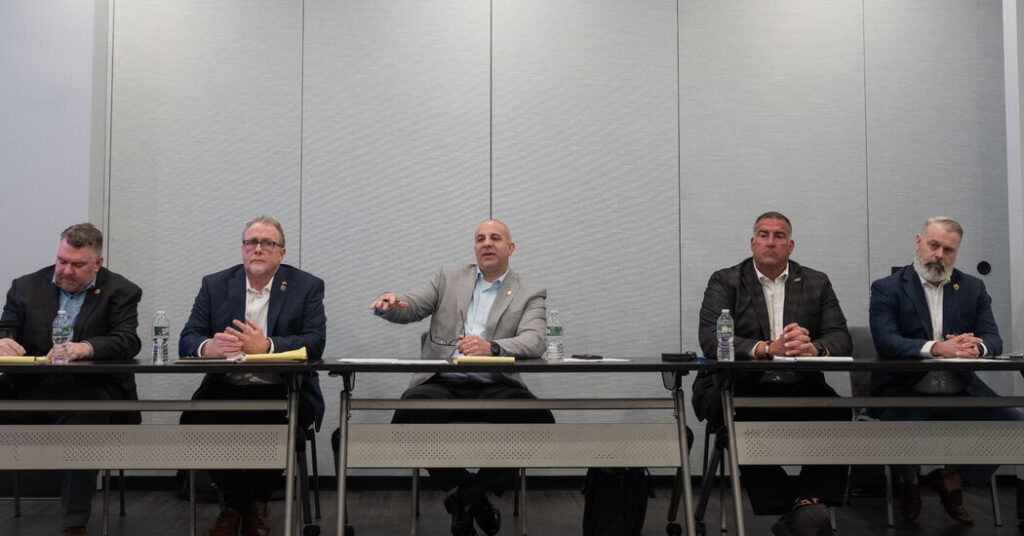
Long Island Rail Road workers are prepared to go on strike as early as May 16 if they can’t agree on a new contract with transit officials, labor leaders said on Wednesday — a move that would be a major blow to America’s busiest passenger rail service.
“We’re talking about a complete and total shutdown,” said Kevin Sexton, a vice president of the Brotherhood of Locomotive Engineers and Trainmen, one of the unions ready to strike. He added, “The clock is ticking.”
Five unions representing more than 3,500 workers have threatened for months to walk off the job unless they receive bigger raises than other divisions of the Metropolitan Transportation Authority, the state agency that runs the railroad.
The unions, which represent engineers, machinists, signalmen and other jobs critical to the rail operation, are seeking a retroactive 9.5 percent wage increase covering the last three years — the same offered to many other New York transit and civil servant unions. But they also want an additional 5 percent raise starting in 2026.
The M.T.A. has argued that such a divergence in pay would upset the typical pattern for wage increases established with other groups, and would not be feasible unless the unions compromised on other aspects of the contract.
The unions had asked for two federal boards to review the case, but their recommendations did not lead to the resolution of the dispute. The unions were granted the right to strike as early as 12:01 a.m. on Saturday, May 16.
The federal government could still prevent a work stoppage, but Congress did not intervene in a similar dispute last year, when NJ Transit workers went on strike.
A strike on the Long Island Rail Road, which carries more than 270,000 passengers a day between Long Island and New York City, would be a nightmare for commuters, many of whom have few other ways to get to work. And the disruptions would take place in the middle of an election year for Gov. Kathy Hochul, a Democrat, who is set to face Bruce Blakeman, a Republican with close ties to Long Island as the Nassau County executive.
The strike would be the first to take place on the Long Island Rail Road since 1994, when a two-day suspension sent riders scrambling for alternatives.
The railroad’s work force is already among the highest paid in the nation, with cash compensation for members of the five holdout unions averaging over $136,000 in 2024, according to M.T.A. figures. The holdout unions have not received a raise since 2022, and said they were seeking only to keep up with the high cost of living in the New York City area, one of the most expensive places in the country.
Janno Lieber, the chief executive and chair of the M.T.A., called the idea of a strike “insane” at a board meeting last month. He said he was open to negotiating about salaries, but only if the union was willing to give up some rules that could greatly increase the costs of certain kinds of work.
For instance, if an engineer drives a diesel train at the start of a shift, but is asked to switch to an electric train in the same day, the M.T.A. is required to compensate that worker with two days’ pay. And if, on the same day, the engineer is asked to switch from driving passengers to driving a train back to a yard for maintenance or storage, that worker is entitled to a third day of pay.
These so-called penalty payments added almost 15 percent to the average engineer’s compensation in 2024, the M.T.A. said.
But the holdout unions, which represent about half of the railroad’s work force, were emboldened by the support of two federally appointed boards that were called to weigh in on the negotiations. Both boards argued that the unions should be paid more in 2026 than what the M.T.A. had offered. Union leaders said they were unwilling to make concessions on work rules in the new contract.
The recommendations are not binding, and Mr. Lieber has suggested that the boards, whose members were appointed by President Trump, were politically motivated to side with the unions.
Ms. Hochul’s office declined to comment, deferring instead to what the M.T.A. has said.
Mr. Blakeman said in a statement that, as county executive, he had helped negotiate labor contracts and would do the same as governor.
Unlike several other divisions of the M.T.A., which are generally prevented from striking because they are governed by different rules, the Long Island Rail Road is covered by a more permissive 1926 federal law called the Railway Labor Act.
Work stoppages are still very rare under the law, but in an unusual move, the federal agency that oversees these labor disputes, the National Mediation Board, released the five unions in August from ongoing mediation, clearing the path for a potential strike.
The M.T.A. has said it would run free bus service at a limited number of busy stations during a strike, especially for commuters who cannot work remotely, but that there was no alternative that could effectively handle the volume of riders who relied on the railroad.
But Mr. Lieber, the M.T.A. chair, has shown no signs of retreat, arguing at a recent board meeting that a strike would be “flushing money down the toilet,” because workers would squander much of the salary increase they are seeking after three unpaid days on the picket line.
Even if the contract dispute is settled soon, the long delay in reaching a deal means that the unions will begin negotiating another contract, for 2027 and beyond, within the year.
Jeff Klein, the general chairman of the International Brotherhood of Electrical Workers, one of the holdout unions, said in an interview that the M.T.A. was underestimating their resolve.
“To sit there and infer that somehow the organizations are just looking to blow off steam and this would just be a three-day stoppage, I think is a serious miscalculation,” he said.
“Our memberships are prepared to do what’s necessary, if it comes to it.”
Stefanos Chen is a Times reporter covering New York City’s transit system.
The post Long Island Rail Road Strike Looms, as M.T.A. and Unions Reach Impasse appeared first on New York Times.