Officials at the Federal Reserve broadly backed a wait-and-see approach as they held interest rates steady amid acute uncertainty about the economic impact from the conflict with Iran, minutes from March’s meeting showed.
The record of the latest gathering, released on Wednesday, affirmed that the Fed felt confident about holding rates steady for the foreseeable future, extending a pause in cuts that began in January. More officials also expressed greater openness to consider raising rates to fully tame inflation.
Most officials concluded it was too early to know what the economic fallout from the Middle East conflict would be. As such, they “judged it prudent to continue to monitor the situation and assess the implications for the appropriate stance of monetary policy.”
The minutes also showed that policymakers were acutely attuned to the risk that a prolonged crisis could lead to more intense price pressures that, if sustained, could affect underlying measures of inflation. They worried that expectations about future inflation could then become unmoored, especially given that the Fed had missed its 2 percent inflation target for roughly five years.
“Partly as a result of these factors, the vast majority of participants noted that progress toward the Committee’s 2 percent objective could be slower than previously expected and judged that the risk of inflation running persistently above the Committee’s objective had increased,” the minutes said.
While many officials still saw a path to cut rates if inflation eventually retreated as expected this year, a couple of policymakers conceded that they had pushed back the most likely timing of a reduction. Some attendees said there was a “strong case” for the Fed to signal more directly that there was a possibility it could raise rates “if inflation were to remain at above-target levels.”
Officials gathered for their March meeting just weeks after the conflict in the Middle East began. Supply disruptions related to the war had pushed energy prices sharply higher by that point, with Brent crude, the international oil benchmark, topping $118 a barrel the week of the meeting. That had filtered into higher gasoline prices and shipping fees. Fertilizer costs had also surged higher, reflecting strains caused by the war on the natural gas market.
Some of those gains reversed sharply on Wednesday after U.S. and Iranian officials announced a temporary cease-fire late Tuesday. But prices still broadly remain higher than before the conflict began. Brent crude, for example, dropped 14 percent, to $94 a barrel. In late February, it traded around $70.
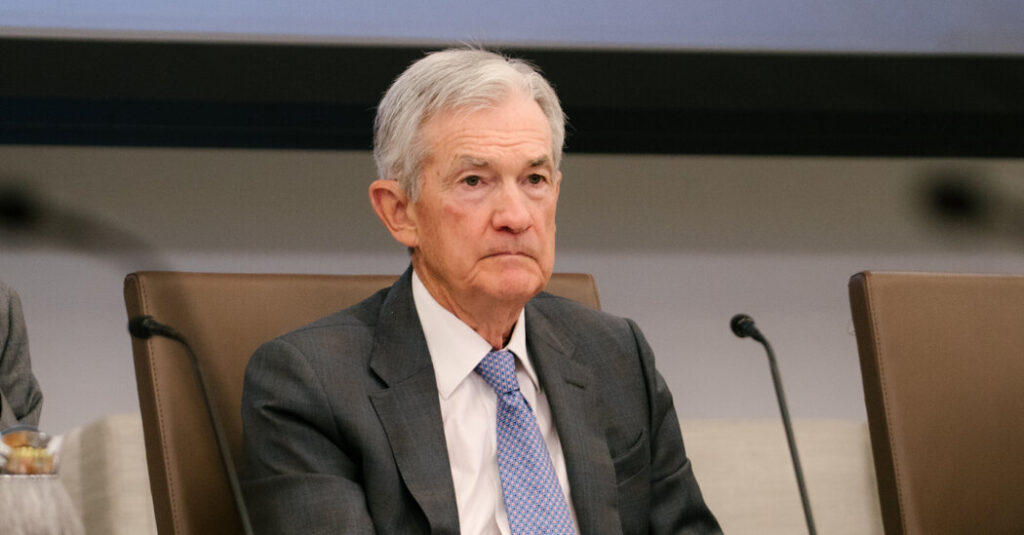
Jerome H. Powell, the Fed chair, opted last month against making any declarative statements about either the economic impact of the war or the policy implications in light of the rapidly changing geopolitical backdrop. Instead, he was blunt about officials’ lack of clarity.
“The thing I really want to emphasize is that nobody knows,” he told reporters after the rate decision, which was supported by all but one policymaker.
Mr. Powell also sought to downplay how much to read into the latest economic projections published by the Fed alongside the rate decision, noting that several policymakers remarked that if there were ever a meeting to skip releasing quarterly economic projections “this would be a good one, because we just don’t know.”
Those projections showed that most of the Fed’s 19 officials still saw a path to lower rates this year despite expecting a bumpier and more prolonged return to 2 percent inflation.
Seven officials penciled in a quarter-point cut by the end of 2026, while five others expected a reduction of half a percentage point or more. Seven policymakers projected no policy adjustments at all. By the end of the year, most officials expect both overall inflation and a “core” measure, which strips out volatile food and energy items, to decline to only 2.7 percent, a higher level than projected three months ago.
On Thursday, data released by the Bureau of Economic Analysis is expected to show that in February, the Fed’s preferred gauge — the Personal Consumption Expenditures price index — rose 0.4 percent and maintained a 2.8 percent annual clip. Core inflation is projected to have steadied at 3 percent following another 0.4 percent increase.
A cease-fire, if it holds, would significantly reduce the risk that the war currently poses to both inflation and the labor market. But it would not eliminate the problems confronting the Fed altogether. Long before the conflict broke out, the central bank was dealing with stubbornly high inflation and a stalling out of progress toward its 2 percent goal. The minutes indicated that they were marginally less confident about the pace in which the impact from President Trump’s tariffs would start to fade, noting that the situation had become more uncertain since the January meeting.
The Fed is also contending with a labor market that still remains relatively fragile as companies scale back on hiring. The minutes showed mounting concern about a protracted war denting hiring even further while also forcing consumers to pull back on spending, a combination that could justify rate cuts.
Colby Smith covers the Federal Reserve and the U.S. economy for The Times.
The post Fed Minutes Show Officials in No Rush to Cut as Iran War Scrambled Outlook appeared first on New York Times.