On a Broadway stage dressed up to look like a shimmering nightspot, a D.J. with a high-top fade (Ken Ard) enters with his crate of records. He sorts through the box, and holds up three album sleeves. First, he brushes off Diana Ross’s 1980 disco classic, “Diana,” which contains the gay anthem “I’m Coming Out”; then he pulls out “Renaissance,” Beyoncé’s 2022 tribute to queer Black club culture. Finally, with the night’s aesthetic lineage established, he holds up a familiar black square with two lambent, yellow eyes. Jellicle cats come out tonight … you think, right as the synths kick in and the audience goes to pieces.
For the 40 or so minutes before it comes fully into itself, “Cats: The Jellicle Ball” is merely wonderful. The theme is: Youth. The category is: Fabulous. The directors Zhailon Levingston and Bill Rauch, along with the dramaturg Josephine Kearns and the choreographer Omari Wiles, have revived and reappraised (not to say rescued) Andrew Lloyd Webber’s 1981 musical, “Cats,” by shifting it out of the wasteland of London’s alleyways and into New York’s queer ballroom scene.
Even in its unadapted state, Lloyd Webber’s “Cats” seems like a hopped-up late-night dream. How strange that he musicalized T.S. Eliot’s “Old Possum’s Book of Practical Cats,” which consists of feline character sketches written for children; how odd that Lloyd Webber (with the director Trevor Nunn) devised a mystery-play plot about cats in aerobic-wear competing to be sent “up, up, up, up” to a cat heaven called the Heaviside Layer. How disorientingly bizarre that the original “Cats” played on Broadway for 18 years, and then, more than a decade later, was made into a frightening and terrible film. (I speak as a once devoted fan. Forty years ago, I had the T-shirt; I still have the pin.)
This exhilarating Broadway production opened Tuesday at the Broadhurst Theater after its 2024 premiere at the Perelman Performing Arts Center in Lower Manhattan, where Levingston and Rauch first recast the mega-musical’s Jellicle Ball as a ballroom competition, an event that includes both “RuPaul’s Drag Race”-style walk-offs and a series of vogueing dance battles. The new approach infuses the kitsch of the original with queer communitarianism sincerity and a spirit of ecstatic trans liberation. Sense emerges out of nonsense. A fanciful person might call this result a 10th life.
In the revisioning (the text itself is largely unchanged), Lloyd Webber’s “cats” aren’t literally cats anymore. The “curious cat” Rum Tum Tugger (the scene-stealer Sydney James Harcourt) is an abs-baring pretty-boy contestant. Magical Mister Mistoffelees (the balletic Robert “Silk” Mason) executes a few sleight-of-hand tricks in the middle of their enchanting pirouettes. Everyone flirts; everyone goes hard; everyone shines.
The performers also materialize mischievously throughout the theater: our D.J. sets up in one of the boxes near the stage, and wherever audience members are seated at café tables, they’re warned that their drinks may be snaffled by the cast. Categories blur deliciously: Stars of the voguing scene, like Leiomy from the TV series “Pose,” mingle with Broadway troupers, and the combined cast’s excitement pings around the room like the light ricocheting off a disco ball. (The set designer Rachel Hauck provides the literal disco ball, while Adam Honoré provides the light.)
The emphasis here is certainly on a body’s capacity for self-fashioning beauty. The choreographers Wiles and Arturo Lyons offer infinite combinations made from voguing’s primary components: duckwalking (bouncing in a deep crouch), arms (often hyperextended behind the head or flung forward), and the death-defying dips, which throw the body to the floor, with one leg left floating in the air. Much of ballroom movement emerges from the limber sway of the back, so even the most athletically precise pose incorporates a bit of hip-cocked sultriness. There’s precious little unison movement, though; each dancer is a soloist.
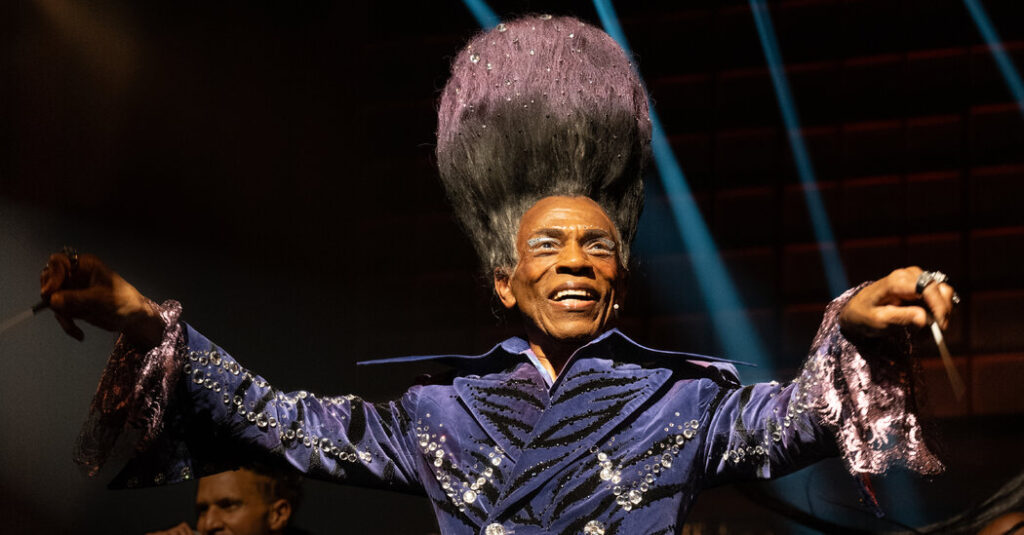
But then, just a few songs from the end of the first act, André De Shields arrives as the Jellicles’ god-king, Old Deuteronomy. The wig designer Nikiya Mathis gives De Shields a lion’s rippling mane, and the costume designer Qween Jean dresses him in variously purple splendor: a lavender taffeta gown, eggplant flares, a suit in deep plum. His gorgeous performance is really a collaboration with Qween Jean’s increasingly sumptuous clothes. (According to an interview in WWD, she designed 500 looks for the show; we’re witnessing her masterpiece.)
De Shields, now 80, first appeared on Broadway in 1973; only a couple of years later he was the Wiz in “The Wiz.” (He’s such a titan that when he takes a step, the sound designer Kai Harada plays thundering booms that make the theater shake.) De Shields speaks and sings in the high, twanging voice of total command, cutting through other sounds like a hunting horn. He summons the Jellicles into a unit, a tribe, a force. In his performance, we also see how ballroom vocabulary lends itself to any kind of grace — De Shields, who is often tenderly assisted by another performer when he’s on the stairs, dances entire, transfixing numbers just by flourishing his rings.
And, as he moves, the production ascends into its higher nature — up, up, up, up — as a pageant honoring its three elders: De Shields, of course, but also the bejeweled Junior LaBeija, a ballroom figure made famous in the 1990 documentary “Paris Is Burning,” who plays an actor lost in reverie, and “Tempress” Chasity Moore, who plays the washed-up beauty queen Grizabella. The young(er) company turns to them and, for all their many showy spotlight moments, maintains this touching attitude of solicitous affection.
The original “Cats” might have been a bit fluffy in the “meaning” department, but “Cats: The Jellicle Ball” is thinking about legacy, and the structures of care that emerge from intergenerational performance. In the second half, a mid-act slide show celebrates major figures from the ballroom demimonde, most of them long gone. The largely Black and Latino scene organizes itself through houses (e.g., the House of Xtravaganza, the Royal House of LaBeija), which operate as chosen families. This show wants us to notice that ballroom already functions as its own Heaviside Layer: It’s paradise, refuge, home.
I fell for this show downtown, and I love it still, even though Hauck’s catwalk-in-a-club structure fits less comfortably into the Broadhurst than it did into the long, narrow Off Broadway space. And uptown, Eliot’s lyrics seem even harder to hear, which gives everything an additional sheen of surreality. There is a cat, for instance, who dances with a MetroCard, and if you don’t understand the stanza about the “railway train,” you are … look, sometimes a cat has a MetroCard.
If you’re lucky enough to have a knowledgeable and prepared audience around you, the atmosphere at the ball crackles — literally. Those sitting close, at the set’s little bar tables, egg on the performers; theatergoers snap huge fans, which creates a kind of thundering paper applause. I too felt like clapping for hour after hour.
Because what we do hear is spectacular. The text contains relevant echoes, so many that they seem to go beyond coincidence: “Jellicle cats are black and white!” the not-cats sing, looking at one another meaningfully, or they land, a little heavily, on the phrase “come out tonight.” Eliot’s poems insist that cats keep a secret, true name (“there’s the name that the family use daily,” which is a useful fiction for the straight world), and the Jellicles wander across a city that sometimes strokes them, sometimes starves and abuses them. In its most pointed lyrical moments, the show insists on the right of these self-possessed, slinky creatures to be seen and admired but also, when they wish it, to be left alone.
The most complex characterization is left to Grizabella, who both wishes for the spotlight but also shies away from it. “I can smile at the old days / I was beautiful then,” Moore sings, in her extraordinary rendition of “Memory” — a song that starts as sentimental gloop and ends, somehow, with staggering power. It was the only moment when I thought that the original lyrics didn’t quite coincide with the world of this show. Who, in the name of Deuteronomy, was beautiful then? They’re all so beautiful now.
Cats: The Jellicle Ball At the Broadhurst Theater, Manhattan; catsthejellicleball.com. Running time: 2 hours 25 minutes.
Helen Shaw is the chief theater critic for The Times.
The post ‘Cats: The Jellicle Ball’ Review: Fanciful and Fabulous appeared first on New York Times.