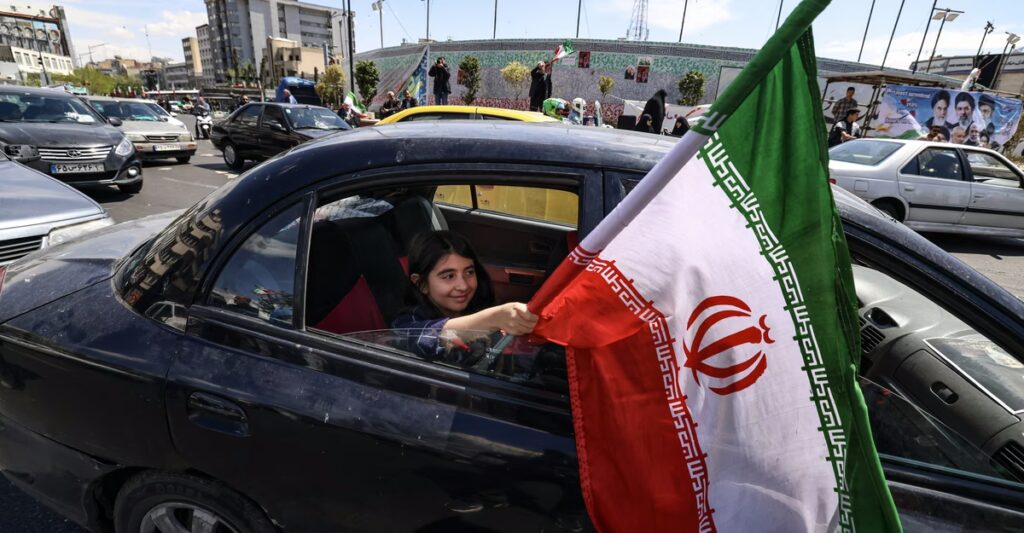
Last night, Iran, the United States, and Israel agreed to a two-week cease-fire. The central element appears to be a 10-point proposal by Iran that President Trump called “a workable basis on which to negotiate.” The New York Times published the points, which include removing all sanctions on Iran, ceding control of the Strait of Hormuz to Iran, and allowing Iran to charge tolls whose proceeds would be split with Oman.
If these are indeed the conditions under which the war is concluded, the U.S. emerges from the conflict in worse strategic shape than it started, and Iran emerges in better condition in the long run. Although the U.S. demonstrated tactical and operational excellence throughout the conflict, it was not sufficient to provide a real victory.
The Trump administration’s stated aims shifted throughout the conflict. Early on, it hinted that regime change was desired. Later, this goal was dropped in favor of destroying Iran’s missile capabilities and production, dismantling its navy, preventing it from obtaining nuclear weapons, and stopping it from funding, arming, and directing terror groups. Functionally, the United States failed to achieve any of these.
There was regime change, but only in a nominal sense. The U.S. and Israel killed a great many Iranian leaders. However, these were replaced by other Islamic hard-liners, including Supreme Leader Ali Khamenei’s son. Trump even admitted as much when he said that most of the “moderates” the U.S. had planned to negotiate with were dead. The result is an even more entrenched Iranian regime.
[Read: A new geopolitical reality is here]
Iran also continued to launch ballistic missiles and Shahed drones steadily through the final weeks of the war. It retained as much as half of its missile-launch capability. Iran also demonstrated the ability to rapidly reconstitute these capabilities after U.S. strikes. These facts suggest that whatever damage the U.S. did, it can be rebuilt relatively quickly.
The Iranian navy was largely destroyed in the first 10 days of the war, but this success proved to be meaningless. The Strait of Hormuz remained effectively closed until the cease-fire, despite the absence of any Iranian navy. Instead, Iran relied on a combination of drones, small craft, and the threat of mines to create a situation where insurers deemed it too unsafe to attempt a transit.
As for the nuclear program, Iran retains control of the fissile material it started the war with. It has far more enriched uranium than it did when the U.S. ended the Obama-era Iran deal, the Joint Comprehensive Plan of Action. Iran’s ability to enrich further has been significantly degraded but can be restored. Before the war, the elder Khamenei may have forbidden the production of nuclear weapons via a 2003 fatwa, and U.S. intelligence also assessed that Iran did not have an active nuclear-weapons program. Now Iranian leadership may be convinced that the only way to deter future U.S. attacks is to take a lesson from North Korea and build nuclear weapons.
The United States’ final declared goal was to stop Iran from funding terror in the future. This is far easier said than done, especially if sanctions on Iran are lifted entirely. Without sanctions, much of the world’s ability to monitor and restrict Iranian transactions goes away, and moving money and goods through more normal channels becomes easier.
But the U.S. not only failed to reach its military goals in anything but a technical sense; it also may have put itself in a weaker position for future conflicts. It has spent a prodigious number of its advanced precision munitions, such as Patriot, THAAD, Tomahawk, and JASSM-ER, and they will take years to replace. These missile systems are essential to defense and deterrence in the Pacific as China attempts to achieve the capacity to take Taiwan by force.
Just as worrisome, the U.S. has lost credibility as a regional check against Iranian aggression. Iran demonstrated that it could shut down the strait, and the U.S. could not be counted on to reopen it. Iran was also able to hit crucial infrastructure targets throughout the region, including Qatar’s gas fields, which could take years to repair.
Meanwhile, U.S. allies (particularly NATO) have been taken aback by Trump’s erratic behavior during the conflict. On Easter Sunday, Trump posted on Truth Social, “Open the Fuckin’ Strait, you crazy bastards, or you’ll be living in Hell – JUST WATCH! Praise be to Allah.” He followed it up two days later with, “A whole civilization will die tonight, never to be brought back again. I don’t want that to happen, but it probably will.” His words were swiftly criticized by the chief of the United Nations and the pope.
[Read: The forgotten war that Iran already won]
If the United States is on worse footing in many respects than before the war, Iran may be on better footing.
Iran has survived this war battered but sounding triumphant, and it has good reason to be. It has weathered the best punch the U.S. could throw, while keeping the strait closed all the way to a cease-fire. Its oil infrastructure remains intact, and it has demonstrated the capacity for mutually assured economic destruction with neighboring nations. The regime’s hold on power remains, and appears to be getting stronger and harsher. Iran actually increased oil production and revenue during the conflict. It is still in possession of near-weapons-grade uranium.
All of these facts support Iranian claims of victory even before considering the terms of the cease-fire, which lift the sanctions that crippled its economy. It also grants Iran hegemony over the strait in perpetuity, creating a steady flow of income and de facto control over the most important waterway on Earth. Iran had neither of these things at the outset of the conflict.
As recently as January, the Iranian regime was dealing with internal unrest over the economy severe enough to threaten its survival. Khamenei responded with a crackdown that killed thousands. Now, between control of the strait, additional oil revenue, and removal of sanctions, the Iranian economy may begin to recover. This could reduce internal unrest. If the United States had waited, some observers believe, the regime might have eventually collapsed on its own. Instead, it has been fortified.
The post America Looks Like a Paper Tiger appeared first on The Atlantic.