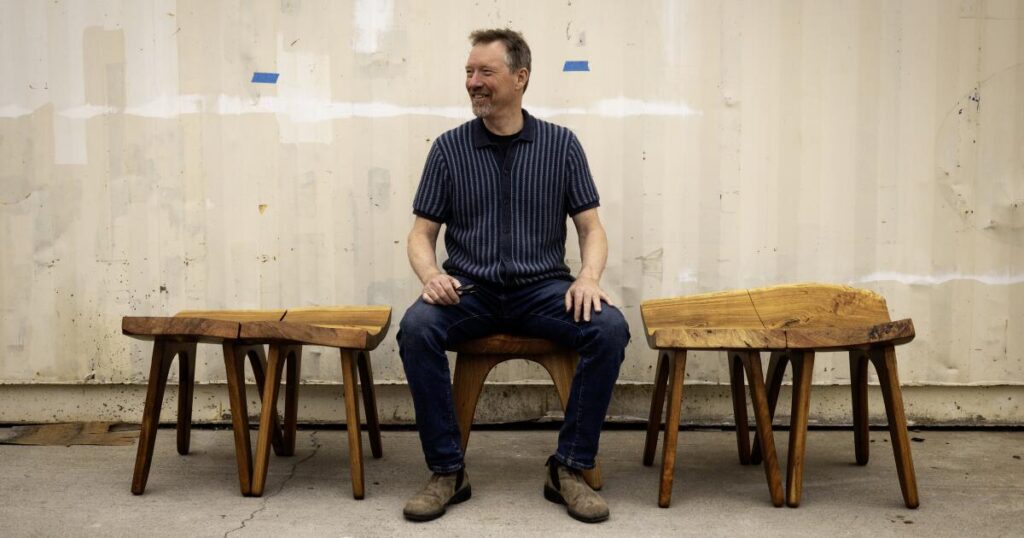
After a devastating windstorm destroyed more than 1,200 Pasadena trees in 2011, architect Chris Peck spent the next six years gathering fallen trees, milling the trunks into slabs, and storing and drying them in his garage and his friends’ garages while he figured out how to use the wood.
At first, he was happy to keep the fallen trees from being cut into stumps, turned into mulch or sent to landfills, even if that meant just selling the wood as lumber.
At the time, Peck was serving on Pasadena’s urban forestry commission, and, as he puts it, there were “trees everywhere,” including a 30-inch oak on San Rafael Avenue that he would later turn into his family’s dining room table.
“Working as an architect and engineer in Los Angeles, I’ve often seen trees taken down and wondered why that wood was not utilized as lumber,” Peck says. “The idea of utilizing the urban forest for lumber started as a business idea in relation to the Urban Ecology Project, a business dedicated to utilizing urban resources.”
When he collaborated with woodworker Ladislav Czernek to design a dining table from the 100-year-old white oak on San Rafael, the project inspired Peck to do more than just sell lumber. Peck decided to focus on designing and making handcrafted furniture that could last another hundred years.
After letting the lumber dry for several years, Peck started Keita Design in 2017, a sustainable furniture company that uses hardwoods from Pasadena, South Pasadena and Altadena, along with Aleppo pines from Bel-Air and Sherman Oaks, to create unique pieces inspired by the wood.
What began as a business idea after the windstorm became something more personal for Peck: creating art and giving new life to fallen trees.
“The beauty and uniqueness of that first dining table really confirmed this new direction for us,” he says. “Working with raw wood inspired us to try designs that are different and that respond to the material itself.”
In the beginning, Peck says it was easy to find trees and hire a mobile sawmill to cut them into planks. “We were full of energy,” he says. “We drove around, hired millers, rented trucks and moved lumber to different storage spots until we ran out of space. My wife put up with wood in the garage, driveway, backyard and even the living room, with only a meltdown or two.”
In 2023, after designing an Aleppo pine conference table for Wesleyan University’s engineering department, a coastal live oak dining table for his neighbor and a 13-foot oak table shaped like Michigan for a client, Peck brought together a small team of young woodworkers. The group includes his niece, artist Hannah Peck, 27; woodworker and designer Jessie Blackman, 27; Ethan Casselbery, 28, who has experience in sculpture fabrication and metalwork joinery; and Jordan Kennedy, 36.
Their first project together was a series of nesting tables made from a coast live oak that had fallen on Grand Avenue in South Pasadena. “We chose two pieces of wood, and it turned out they almost nested,” Blackman says. “Hannah was the mastermind who figured out four nesting possibilities.”
“We used tracing paper and pieced it together,” Hannah says.
Their pieces stand out for their simplicity, such as a pair of nesting coffee tables made from a single oak branch. “They were sisters,” Hannah says about the twin tables. “They were next to each other in the tree, so we decided to flip one over to mirror the other.” (Prices for Keita pieces start around $5,000 and can go up to $33,000 for a custom dining room table.)
Keita Design started with a mindset similar to Angel City Lumber, which sells processed wood from local trees and recently started a nonprofit that recovers fire-damaged trees from Altadena and returns them to the community as usable lumber.
“We want to save trees that have to come down, especially after natural disasters,” Hannah says. “But we also care about the design and working with those trees, even using pieces that are warped instead of throwing them away.”
Their pieces include an undulating bench set made from a eucalyptus tree that fell near Johnson Lake in Pasadena, the Luna dining table made from re-sawn oak slabs for a butterfly effect and a five-legged coffee table crafted from the branch of a rescued fallen oak in South Pasadena. You can see these pieces at My Zero Waste Store in Pasadena.
All of these pieces have dramatic warps, waves, marbling and imperfections that make them unique and add to their beauty and history. Some of the coastal live oak slabs even have bugholes and signs of powderpost beetles. “That’s part of the reason why we use epoxy,” Chris says.
Adds Jordan, “One of my first tasks here was going through and filling all the bug holes.”
Because some of the slabs are so wavy, Blackman had to get creative when shaping the wood. “I had to put the table upside down and use a chisel and grinder to remove as much material as I could. It took us three tries to get the table right.” She also uses a floating router jib for most of their joinery since the machine can’t rest on the wood’s uneven surface.
When they designed a table using a plank with a natural gap, they left the gap in the center, which helped them get the right width and refine its shape. Their tables evolve, Blackman says, as they “consider the profile and the joinery so we can highlight the wood grain and keep live-edge features. We let the wood guide us.”
“I think of their furniture as useful art,” client Diane Rhodes Bergman said in an email about her dining room table, which was made from a large live oak that fell in Pasadena during the 2011 windstorm. “It’s functional, practical, durable, but the beauty of the wood and design is what makes you pause and appreciate it. The tree was hundreds of years old — what did it witness? What did it survive? Who rested in its shade? The design captures the majesty and beauty of its origin. Their furniture goes beyond beautiful and unique; it is designed with a deep respect of the wood and the tree from which it came.”
They often keep the underside of each slab as it is instead of flattening the bottoms.
“A lot of the furniture we make looks alive,” says Jordan. “We keep the bottoms of the tables true to what the tree looked like before.”
“We spend so much time and thought on the legs and the finishing, and no one ever sees them,” Hannah says.
“Our tables are perfect for children and dogs, or anyone else crawling around on the floor,” Blackman says, laughing.
During a recent visit, their Lincoln Heights studio at Big Art Labs was filled with towering slabs of pine, oak and eucalyptus, including the last three tons of wood they picked up from a Sun Valley concrete and rebar company.
Gathered around a large work table, the group talked about their latest project: using offcuts and scrap material from larger tables to make a set of patchwork design tables.
“Chris is the most eco-conscious person I’ve ever met,” Blackman says. “He’ll see offcuts in bins and ask, ‘Why is this in the trash? This is going in a table.’ We have a lot of hardwood scraps from our larger tables, and we’re going to use all these cool little pieces.”
Although the young crew at Keita didn’t have much experience in fine furniture-making when they started the shop, Hannah says the Big Art Labs community where they work has supported them throughout their journey.
“There was definitely a learning curve,” says Hannah, who works full-time in the shop with Blackman. “But the Big Art community is full of makers and woodworkers, and everyone was kind and helpful when we were starting out. Jon Meador taught us some rules of thumb for grain movement, and another shopmate has a CNC [Computer Numerical Control] machine that’s been helpful to us. Now, we’re more experienced, more organized and have more people in the shop.”
These days, the group is making furniture for a show at electric vehicle brand Rivian’s space in Venice on April 19 and at Gallery 945 in Chinatown from May 1 to 31. They’re also working on a new line of pine tables with metal bases, which they hope will help them increase production since these are less time-consuming to make.
As they use up the rest of their hardwoods, they plan to keep working with fallen trees, whether through Angel City Lumber or other sources.
Although Blackman says that balancing “labor and sustainable values” can be challenging, they are committed to preserving the life of L.A.’s magnificent urban tree canopy.
“It would be much easier and faster to make a solid wood table, but we really care about the trees,” Blackman says. “We want to use every piece. We don’t want anything to go in the trash. And in the end, we end up with this gorgeous stuff.”
The post After an L.A. windstorm, he used fallen trees to make furniture with a story behind it appeared first on Los Angeles Times.