“You’re doin’ fine, Oklahoma!” — Richard Rodgers and Oscar Hammerstein (1943)
No, you’re not. The waving wheat might sure smell sweet when the wind comes right behind the rain, but there is an unpleasantly pungent aroma surrounding the rent-seeking you allow. Would that Oklahoma’s legislators took the U.S. Constitution as seriously as they take caskets.
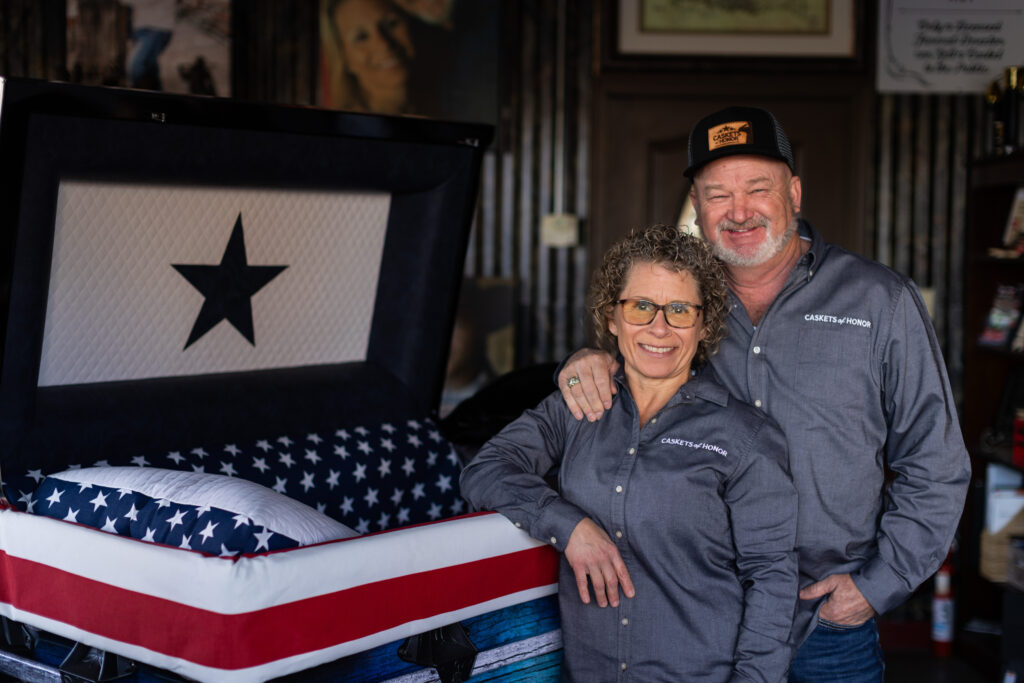
In the town of Calvin, the married couple Candi Mentink and Todd Collard conceived an entrepreneurial idea that their state’s law says is forbidden. They sell inexpensive caskets wrapped in vinyl graphic designs depicting hunting, fishing, religious motifs, sports teams’ logos, perhaps even the likeness of famous Oklahomans. Imagine whiling away eternity in a Mickey Mantle casket. Heavenly.
Thanks to the internet, they can sell caskets to people in Orlando or Ottawa or Oslo or Okinawa. But not Oklahoma, as they learned when the law, in its majesty, pounced on their company’s booth at the state fair. There, they learned that the law forbids selling caskets in the state without a license, which would require: Two years of “mortuary science” classes. Passing two tests on directing funerals. A one-year apprenticeship under a funeral director. And spending hundreds of thousands of dollars to convert their workshop into a full-service funeral home with an embalming room and viewing area for human remains.
The couple paid a fine and toiled futilely for years to get the protectionist law repealed. The faction that got it passed — the funeral directors cartel — remained as muscular as the legislature was obedient.
Cartels exist to limit competition by restricting entry into an economic activity. This is rent-seeking: bending government power to disadvantage rivals.
Mentink and Collard are represented against the state by the Institute for Justice’s libertarian litigators, who must be weary of casket nonsense. In 2002, IJ persuaded the U.S. Court of Appeals for the 6th Circuit to strike down a Tennessee law that prohibited anyone without a license from selling caskets. The court said: “Protecting a discrete interest group from economic competition is not a legitimate government purpose.”
In 2004, however, IJ lost a similar case when a 10th Circuit judge, who should find another line of work (funeral director?), wrote laconically of Oklahoma’s protectionist casket law: “While baseball may be the national pastime of the citizenry, dishing out special economic benefits to certain in-state industries remains the favored pastime of state and local governments.”
In 2007, monks at a Covington, Louisiana, monastery decided to support their good works by making and selling wooden caskets. Before they sold even one, the Louisiana Funeral Directors Association demanded enforcement of an existing law similar to Oklahoma’s. The association complained, in the mincing language people use when trying not to be understood, that any sale would place funeral homes in “an unfavorable position with families.” Meaning, customers would be peeved at funeral homes that refuse to handle inexpensive caskets not bought from funeral directors.
In 2013, IJ got the U.S. Circuit Court of Appeals for the 5th Circuit to side with the monks. The court said: “The great deference due state economic regulation does not demand judicial blindness to the history of a challenged rule or the context of its adoption nor does it require courts to accept nonsensical explanations for regulations.”
No protectionist laws like Oklahoma’s would survive judicial scrutiny if the U.S. Supreme Court had not rendered a preposterous 1873 decision in a case from near Covington. Some New Orleans butchers said a state law conferring a monopoly on a single slaughterhouse violated their right to earn a living. In 1868, the 14th Amendment established that no state shall abridge any American’s “privileges or immunities.” The amendment’s foremost author (Ohio Rep. John Bingham) said this language was to protect, inter alia, “the liberty … to work in an honest calling.” But in the slaughterhouse case, Supreme Court vitiated the privileges or immunities clause, holding that it refers merely to a few obscure federal rights (e.g., “to use the navigable water of the United States”).
And in the 1930s, the court declared that economic liberty is inferior to “fundamental” rights. Hence the pernicious judicial “restraint” of deferring to any government abridgments of economic liberty for which a court can imagine a “rational basis,” even when the abridgment is patent rent-seeking.
In Oklahoma, you can be buried in a cardboard box, or a shroud, or nothing. But not in a casket unless the purchase of it enriches the state’s funeral cartel. Continuing judicial deference to Oklahoma’s casket racket would be dereliction of the judicial duty to take seriously incontestable facts, including undeniable and unsavory legislative motivations.
The post A casket cartel tries to bury the competition appeared first on Washington Post.