While yoga can be a welcoming and inclusive practice, the poses aren’t always accessible for everyone. If you have limited mobility or balance issues, you may not be able to move easily from a standing to a seated position on the ground, or you may need a little extra support to hold the poses. In those cases, chair yoga can be a more approachable alternative.
You can come to chair yoga “at any age, from any background in physical activity — and that includes having no background in physical activity,” said Lesley Ward, research fellow at Northumbria University, who has studied chair yoga and teaches yoga.
You can do the poses from a seated position or while standing and holding the chair for balance. “You can make it whatever you want it to be,” said Justin Smith, an assistant professor of physical therapy at Wichita State University and a geriatric specialist.
And getting an assist from a chair doesn’t take away from yoga’s many benefits. Anna Guest-Jelley, a yoga instructor in Oregon and founder of Curvy Yoga, an online yoga studio, said: “You can still have increased flexibility, strength and mobility. You can connect with your breath. You can feel more present in your body.”
Staying in a seated position can also help you focus on your breathing and on performing poses properly, Dr. Ward said, which can be ideal for people who are new to the practice or returning to it after a break.
But even regular practitioners can gain something from chair-based poses. “You feel the mechanics of a pose in a different way in a chair,” Ms. Guest-Jelley said. You can then bring that new awareness of your body and breath to your practice without the chair, she said.
This routine, designed by Ms. Guest-Jelley, includes both seated and standing poses using a chair. Choose a sturdy chair, preferably with a back but no arm rests, Dr. Smith said. If you’re in a wheelchair, be sure to lock the wheels. Sit so that you are balanced on the seat with your feet planted on the ground. If your feet don’t reach the floor, rest your feet on a folded blanket or blocks, Ms. Guest-Jelley said.
Overview
Time: 10 minutes
Intensity: Low
What you’ll need
-
A chair
-
Blocks or a blanket
Mountain Pose
Sit in the chair. You should feel centered and stable, with your knees bent at 90 degrees and your feet planted on the ground, approximately hip-width apart. Stack your head and torso over your pelvis, and draw your shoulder blades down your back, gently lifting your chest. Let your arms hang alongside your body, palms facing forward. Engage your body, rooting your feet into the ground and extend through your fingertips. Hold for five to 10 breaths.
Upward Salute
From mountain pose, reach both arms overhead. Depending on your mobility, your arms can be parallel to your ears, or your arms can make a V-shape. Keep your head level and chin slightly lifted. Hold for five to seven breaths.
Side Bend
Sit in the chair evenly and with your feet flat on the floor. Reach your left arm overhead on an inhalation. Lengthen the side of your body by extending through your fingertips while keeping your hips grounded in the chair. On an exhalation, bend as far to the right as feels comfortable. As you bend, reach your right arm toward the ground. Hold for five to seven breaths. Come back to center and let both arms rest alongside your body for a breath or two. Then, switch sides.
Cat-Cow
Sit in the chair with your feet planted firmly on the ground. Your arms can rest alongside your body. If you want more support, hold the side of your chair. On an inhalation, arch your back and lift your chest. Keep your belly soft. On an exhalation, round your spine and bring your belly inward, allowing your chest to curl in and your head and chin to drop. Alternate between the two poses five times, moving slowly with your breath.
Wide-Legged Forward Bend
Sit up tall toward the front of your chair, but not so far forward that you feel unstable. Walk your feet out to a wide stance, as far as is comfortable. Your feet should be firmly planted on the floor with your toes slightly turned out. Rest your forearms on your thighs and lean forward, letting your head drop and chest come between your legs. Stay here, or bring your hands down to the floor or to blocks. Hold for five to seven breaths.
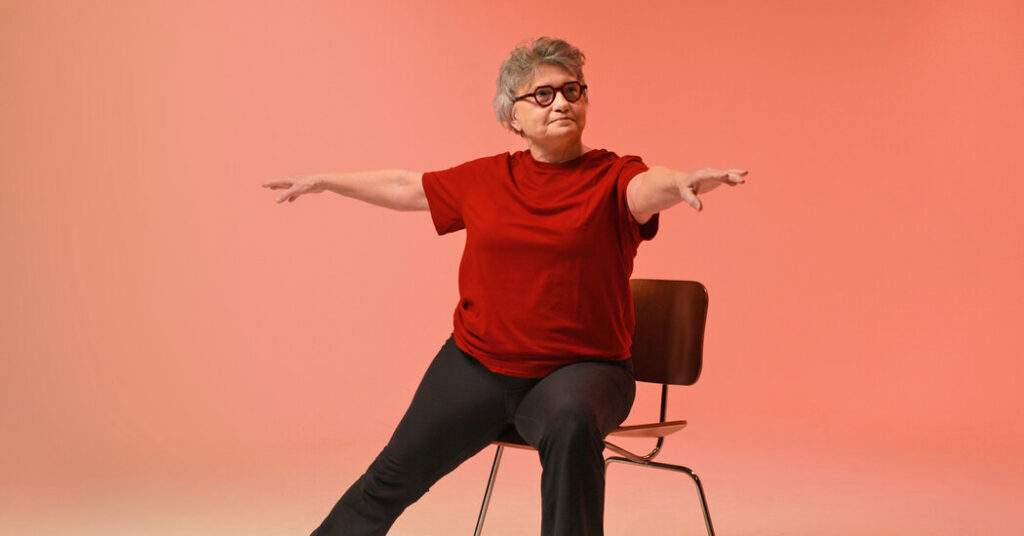
Warrior II
Link this pose with the next two poses to create a sequence that flows from one pose to the next. Complete the sequence on one side before switching sides.
Sit toward the front of your chair and walk your feet wide, opening up your hips. Keep your left knee bent and point your toes to the left. Extend your right leg to the side, toes pointing forward. Root down through both feet and sit up tall. Raise your arms out to the side, and gaze over your left arm. Reach through your fingers and hold for three to five breaths.
If you have less mobility in your hips, you can take a shorter stance. Or modify the pose by keeping your right leg bent and your knee pointing forward. Open your left knee out to the side, letting your left leg rest over the left side of the chair. Your legs should form a 90-degree angle. Raise your arms out to the side and gaze over your left arm.
Side Angle
From Warrior II, place your left forearm on your left thigh. Actively press your forearm into your thigh to help keep your chest lifted. Lift your right hand up toward the ceiling. Stay here or reach your right hand over to the left, arm by your ear. Hold for three to five breaths. Return to Warrior II.
Reverse Warrior
From Warrior II, flip the palm of your left hand to face the ceiling. Reach your left hand up and over, moving into a side bend. Your right hand can rest on your right thigh. Hold for three to five breaths. Return to Warrior II before dropping your arms and returning to a neutral seat.
Christine Yu is a freelance journalist and the author of “Up to Speed: The Groundbreaking Science of Women Athletes.”
On-set trainer: Anna Maltby
The post 10-Minute Chair Yoga for Beginners appeared first on New York Times.