The latest
President Trump issued dire threats against Iran’s energy and civilian infrastructure on Tuesday, ahead of the deadline he had set for Iran to reopen the Strait of Hormuz, a key shipping route. Here’s what else to know:
-
Oil prices: Oil prices initially climbed on Tuesday after Trump rejected a cease-fire proposal. As Rebecca Elliot put it, the oil market is behaving in unusual ways: “The sooner you need the oil, the more expensive it is.”
-
Iranian oil hub hit: The United States launched a series of more than 90 strikes on Kharg Island, Iran’s oil export hub, early on Tuesday. A U.S. official said that the United States was not yet striking Iranian oil infrastructure on the island.
-
Tolls: Most of the countries in the world have agreed to an international treaty, known as the Law of the Sea, that bans interfering with ships passing through the Strait of Hormuz. But neither the U.S. nor Iran has ratified it. And now, both are saying they want to impose tolls on ships passing through the strait, which would be illegal under the Law of the Sea.
Electric vehicles
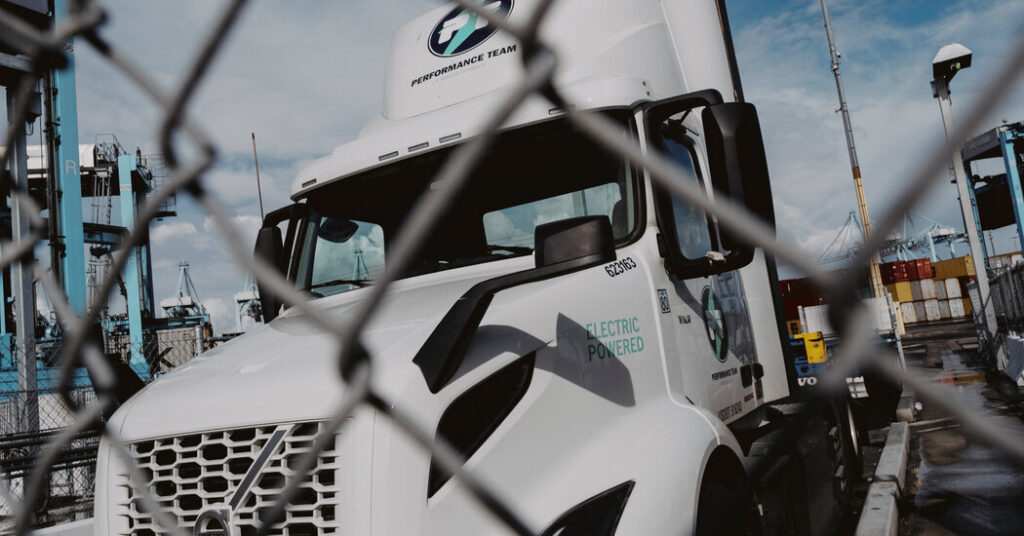
Why electric trucks haven’t taken off in the U.S.
As the Iran war continues, average diesel prices shot up to $5.64 on Tuesday. They’re now up more than 50 percent in the last year.
That has put a big strain on the trucking industry. One logistics company owner told my colleague Emmett Lindner that his profits dried up even after he began imposing a fuel surcharge. Food distributors have raised shipping prices in response to rising costs, too.
And last month, after years of delays, Tesla announced it would begin mass-producing electric semi trucks later this year.
So is now the moment for electric big rigs to take off?
In recent weeks, the math of commercial truck ownership has shifted incrementally toward electric options. But there’s a long way to go: Nearly half a million commercial trucks were sold in the U.S. in 2024, but fewer than 2,000 were electric.
We’ve written about the significant climate and health benefits of ditching diesel. Medium- and heavy-duty trucks are responsible for about 7 percent of U.S. greenhouse gas emissions, and large diesel trucks emit about 10 times as much of PM2.5, the deadliest particulate matter, as gas-powered cars. This pollution can cost lives: The Clean Air Task Force, an environmental group, estimates that diesel emissions can lead to more than 8,000 deaths per year.
Unlike casual drivers, trucking companies carefully track the cost of every mile a vehicle drives, a metric called the total cost of ownership. They consider the sticker price, but also the cost of the fuel it uses over the course of its lifetime and maintenance expenses.
Early reports suggest that Tesla’s electric semi truck is selling for about $100,000 less than other electric trucks on the market. The sticker price is still around twice that of a diesel-powered truck, which can generally cost between $100,000 and $200,000.
These changes could nudge electric trucks closer to a total cost of ownership that rivals diesel vehicles. For some routes, electric trucks are already the cheaper option.
Why the U.S. lags on electric trucks
Electric trucks are expensive. They can run two or three times the cost of diesel-powered vehicles. They’re also harder to electrify than cars, in large part because of their size — it takes a lot of energy to pull tens of thousands of pounds of cargo.
(Batteries are also very heavy. Electric trucks can be 2,000 pounds heavier than their diesel counterparts, a factor that has raised concerns among transportation engineers who worry that roads can’t handle their weight.)
Despite the challenges, other countries have left the U.S. trucking industry behind. “There’s a huge amount in China and a lot in Europe, but there’s almost nothing in the U.S.,” said Daniel Sperling, emeritus professor at the University of California, Davis who researches sustainable transportation.
In China, which has the highest electric truck sales in the world, about 76,000 vehicles were sold in 2024, making up about 4.4 percent of total sales, according to the International Energy Agency. In Europe, just over 2 percent of trucks sold that year were electric.
In the U.S., the dismantling of electric vehicle tax incentives by the Trump administration and Republicans in Congress has hampered growth. Even more important, Sperling said, was the rollback of a California regulation that would have required half of all new trucks sold to be electric by 2035.
Charging is another challenge. It’s not practical for long-haul trucks to spend hours recharging in the middle of a route, and new models will rely on specialized fast chargers that aren’t yet widely available, said Rick Mihelic, director of emerging technologies for the North American Council for Freight Efficiency.
“It’s evolving slowly,” Mihelic said, “but we’re just in the very early stages of this marketplace taking off.”
Could Tesla change things?
In theory, the arrival of mass-produced semi trucks from Tesla could address a lot of these problems. The vehicles are said to be cheaper than the competition. The company says they can travel 500 miles per charge and recharge up to 60 percent of their range in 30 minutes.
The fast-charging capabilities are useful only if there’s a network of chargers that can deliver power quickly. Tesla truck drivers will need access to megawatt charging systems, or M.C.S., a new technology that delivers six to 10 times as much power as an electric vehicle charger.
Tesla has opened three of these fast semi truck chargers in California and Nevada, according to its website, and has plans to open dozens more. Other companies are working on megawatt chargers, too.
Tesla is not the only carmaker with eyes on the U.S. truck market. Windrose Technology has vowed to challenge Tesla and has begun selling trucks in the U.S. for $300,000, according to Forbes.
Even if Tesla and Windrose succeed in their goals of making and selling tens of thousands of trucks in the next couple of years, it will most likely be years before they make enough vehicles to put a big dent in the market, Mihelic said.
A bright spot for smaller trucks
There’s one corner of the commercial trucking market where the total cost of ownership already favors E.V.s: smaller delivery trucks and cargo vans that make shorter trips.
“In a lot of operations that are in the range of 200 miles a day or less, these trucks make perfect sense today,” Mihelic said.
At that range, which might cover trips between warehouses in a large metro area, vehicles can charge overnight. Amazon, which has purchased thousands of electric Rivian vehicles, is among the most visible examples of companies investing in electrifying deliveries, Sperling said. Amazon’s Rivian vehicles are recognizable by their round headlights. “Maybe they’re trying to be a little environmental, but mostly it’s economics,” he said.
According CALSTART, a nonprofit group, 60,000 zero-emissions trucks have been put on U.S. roads over the last five years, and about 52,000 of those vehicles are smaller cargo vans.
Pollution
The California lake billed as the ‘Saudi Arabia of lithium’
Beneath the Salton Sea in California, there is so much metal essential to rechargeable batteries that Gov. Gavin Newsom calls the vast lake “the Saudi Arabia of lithium.” An estimated $500 billion worth of lithium there could help power our smartphones, electric cars and electricity grids. And a so-called white gold rush could bring jobs, tax dollars and economic revitalization to one of the most impoverished places in the nation.
But not everyone is eagerly welcoming the lithium industry.
The Salton Sea is already an environmental disaster zone. It’s shrinking, and as it does, it spews plumes of pesticide-laden dust throughout Imperial County, home to 182,000 people. Extracting lithium requires a steady supply of fresh water, and locals worry the process will deplete the region’s scarce water resources. Some also fear that the industrial disruption of the lake will create even more air pollution. — Soumya Karlamangla
Climate law
Suspect in hacking of climate activists is extradited to New York
Amit Forlit, who has been charged by U.S. prosecutors with running a so-called hacking-for-hire operation that targeted environmental groups, has been extradited from Britain to stand trial in New York. He is accused of running a sprawling enterprise that operated around the world, including in Russia, India and the United Arab Emirates.
From at least 2012 to 2019, Forlit orchestrated “massive” crimes against corporations, organizations and individuals, according to a 2022 grand jury indictment unsealed on Friday. The schemes generated “tens of millions of dollars” in unlawful proceeds, the indictment said.
He is accused of working closely with Aviram Azari, who was convicted of crimes related to hacking in New York in 2023 and released from federal prison last year, and others.
Their clients included a lobbying firm in Washington that was working for “one of the world’s largest oil and gas corporations, with headquarters in Irving, Texas,” according to the indictment. A brief prepared by Forlit’s legal team as he fought extradition identified the lobbying firm as DCI Group and the company as Exxon Mobil, which at the time was based in Irving. — Karen Zraick
More climate news from around the web:
-
Five European Union countries are calling for a windfall tax on energy companies’ profits in response to the rising fuel prices caused by the Iran war, Reuters reports. The tax would “send a clear message that those who profit from the consequences of the war must do their part to ease the burden on the general public,” the finance ministers of Germany, Italy, Spain, Portugal and Austria wrote in a letter last week.
-
The Washington Post reports that a combination of record heat and less rain than expected in the U.S. “could have ripple effects through the nation’s food supply, with some products, like beef, already projected to see prices surge.”
-
The U.S. plastics industry was in the doldrums, The Wall Street Journal reports, but then the war in Iran began.
Read past editions of the newsletter here.
If you’re enjoying what you’re reading, please consider recommending it to others. They can sign up here.
Follow The New York Times on Instagram, Threads, Facebook and TikTok at @nytimes.
Reach us at [email protected]. We read every message, and reply to many!
Claire Brown covers climate change for The Times and writes for the Climate Forward newsletter.
The post Why Electric Trucks Haven’t Taken Off in the U.S. appeared first on New York Times.