Scott Ferson is the president of Liberty Square Group and the author of “How the Democrats Lost America: Making Sense of the 2024 Election and the Future of American Politics.”
After wandering through the political wilderness for years, the Polk County Democrats may have just stumbled onto the path back to civilization. Their opportunity came with a political crack-up. “I refuse to be a ‘battered wife’ hoping it all goes away and gets better,” Republican Rep. Marjorie Taylor Greene said of her relationship with Donald Trump and the GOP in November. She would resign her seat to prevent her “sweet district,” Georgia’s 14th, from enduring “a hurtful and hateful primary.” That was a slight to the president and a gift to local Democrats, who began gearing up for the special election triggered by her departure.
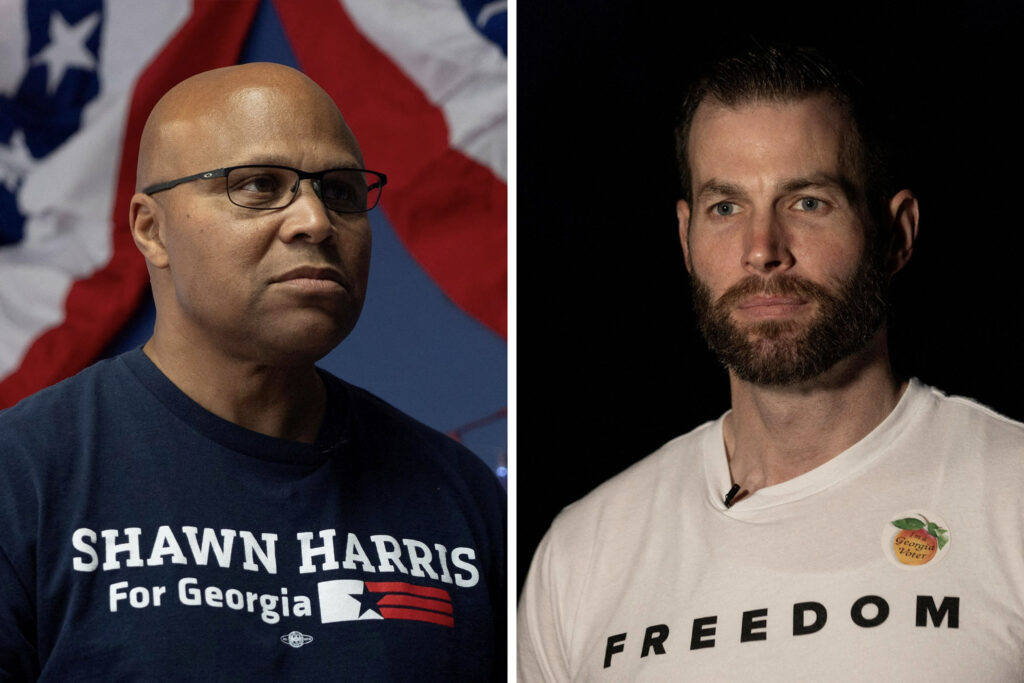
Seventeen candidates — 12 Republicans, three Democrats, an independent and a libertarian — faced off in that contest early last month. The top vote-getters, Democrat Shawn Harris (37.3 percent) and Republican Clayton Fuller (34.9 percent), now compete in a runoff Tuesday. It is perhaps the best shot the Democrats have had in the county, which two years ago Trump won by 60 percentage points. I wanted to know how they were faring, and so I packed a bag and rocked up to a committee gathering at JC’s Snack Shack in Aragon on March 18.
Lamar Wadsworth, the local party chair, has encouraged members to meet to discuss business and, evidently, keep up morale. At 11 a.m., the dozen or so activists took up the county’s affairs. They started on how to generate calls to their Republican state legislator to oppose a bill exempting officer body cameras from open records requests. “They can see my Ring camera, but we won’t be able to see their body cams?” asked one young mother, with her daughter in tow. They then turned to a smattering of other topics: fighting a proposed data center, discussing PFAS in the water and polling the table to see who drinks from their tap.
These are local issues, the blocking and tackling of government, and the conversation was good and healthy. Yet in hindsight there appears an obvious disconnect. Nationally, the Democrats hold No Kings rallies. Two weeks after my Georgia visit, cities across the United States saw millions of protesters animated by this principle. But can democracy as we traditionally think of it solve the problems discussed around the table at JC’s?
Some of the people I met in Georgia’s 14th wonder if a strong executive might have a better shot at resurrecting the American Dream. One voter, who owns an HVAC company with her husband, is happy with the president’s bold rollback of regulations. Another thinks regime change in Venezuela was an “America First” policy, securing a sure supply of oil. In domestic and foreign-policy some voters are okay with Congress being missing in action. Many I’ve spoken with around the country can’t name their representative in Washington.
What, then, might Democrats propose if not a king?
Kenneth Hamilton, the committee’s vice chair, reviewed the count of the first round. While Harris netted more overall votes in the district, he came in second in Polk. The silver lining, Hamilton added, was that more than 8,000 registered Democrats apparently didn’t show. He suggested they didn’t know there was an election. The job was to correct that mistake by Tuesday. Do voters need rides — and if so, who could help? Are there enough polls — and if not, who could help staff them?
Someone speculated if Harris would have enough money to compete. But that was evidently no problem. Significant funds have rolled into the district from blue states according to FEC filings. Through the special election Harris had raised and spent more than $4 million, mostly it seems to out-of-state vendorsfor services like ad purchasing, digital fundraising, email address acquisition, all common for modern campaigns.
Hamilton made his own pitch for cash, asking those around the table to pledge $2 a month to support the county party. A guest from deep-blue Massachusetts, I asked if they have cell numbers for those 8,000 Democrats who missed the preliminary. “Some,” I was told. The Harris campaign was conducting daily phone banking — but I suspect many of those calls originate with out-of-district activists. It’s easier to enlist Democrats in other blue districts than it is to recruit and cultivate those in red or purple ones like Polk. This lack of investment in the ground game means strangers are calling locals, leaving the county Democrats out of the strategy loop.
Harris is a dream candidate for Democrats, a cattle rancher and retired U.S. Army combat veteran. He’s battled-tested in another way too: He garnered just over 35 percent of the vote against Greene in 2024. Yet on the ground, it’s hard not to notice a break between the countrywide effort to flip the seat and the hardy few who meet monthly at JC’s.
Greene has energized liberals to campaign hard to replace her. But Harris, for all his charm, has a near impossible task, parroting national talking points while trying to connect with locals long abandoned by the Democratic Party. That’s not lost on townsfolk: Most of those I talked to are voting for the Republican, even if they supported a different candidate in the preliminary. This is a solid red district and no one, no matter how good, is favored to win with a D after his name.
A cynic might question if cash-driving national buzz is the more concrete goal than actually flipping the seat. Harris’s shaving a few points off a Fuller victory would be news, and more dollars would fly out of Democratic wallets to fuel party efforts to flip the House. The state party might pay for digital billboards that could read: “No wars. Low gas prices. Vote Democratic.” On my route here, gas had hit $3.89 a gallon. Today, the electorate may be angry enough at the pumps to send Republicans a message, but would that really mean Democrats are making inroads?
The national party will turn its attention away from Polk after April 7, but the locals will continue to gather at JC’s Snack Shack. Their predicament, it seems, is this: Their national leaders are stuck between a call for no kings and a 250-year-old democracy that was designed to slow things down, to check and balance calls for progress. As I’ve talked to all kinds of voters over the last eight years, it’s become clear that if you fear for democracy’s demise, democracy is working for you. But it isn’t for a lot of people out there.
If Shawn Harris pulls off a miracle and wins, it will be evidence of a Trump loss, not a Democratic win. Even a close loss shouldn’t qualify as a moral victory anyhow. It would instead a plea by voters for the left to reimagine its underlying, demographically blind principles. Rather than no kings, the Democrats might focus on how a democracy fit for this century is better than the version voters rejected in 2024. Kamala Harris said that “we’re not going back.” Voters I talk to want to know what Democrats are going forward.
The post Who will replace Marjorie Taylor Greene? In Georgia’s 14th, I saw clues. appeared first on Washington Post.