I’ve never been to space, but as a young child my ego was obliterated by the short film Powers of Ten. I was at summer camp, on a sticky-hot day that was suddenly interrupted by a thunderstorm. We were all herded into a room, the film projector was rolled out, and red-white-and-blue popsicles distributed. This was normally an occasion for Mighty Mouse or Tom and Jerry cartoons—a much more pleasurable situation for me than trying to catch a ball. On the screen that day, though, was a bell-bottomed couple picnicking in a park in Chicago, shot from above, accompanied by a voice-over explaining that every 10 seconds the camera would be moving outward from them by a factor of 10. Within a minute, Chicago, Illinois, the United States, and then our whole planet, shiny as a gumball, was in sight, and then it became smaller and smaller, subsumed within the solar system, which in turn was subsumed within the vastness of space, our sun “only one among the stars,” the voice explained.
This was, on some level, terrifying—the nine-minute film, distributed by IBM in 1977, even featured creepy organ music as we went farther and farther past the Milky Way, where “normal but quite unfamiliar stars and gas surround us.” I already felt small, but this was further indication that all humans were so minuscule as to be practically nothing. The film then reversed the trick and zoomed back toward that Chicago couple and into their bodies to show the equally breathtaking world of our insides, down to the molecular and atomic level. I suppose this could have been comforting, but it was not. I could deal with the thought that I contained multitudes, but to know that from a certain perspective I was truly less significant than a speck of dust—that was harder. How healthy, though, I now think, to have been nudged, melting popsicle in hand, toward this thought.
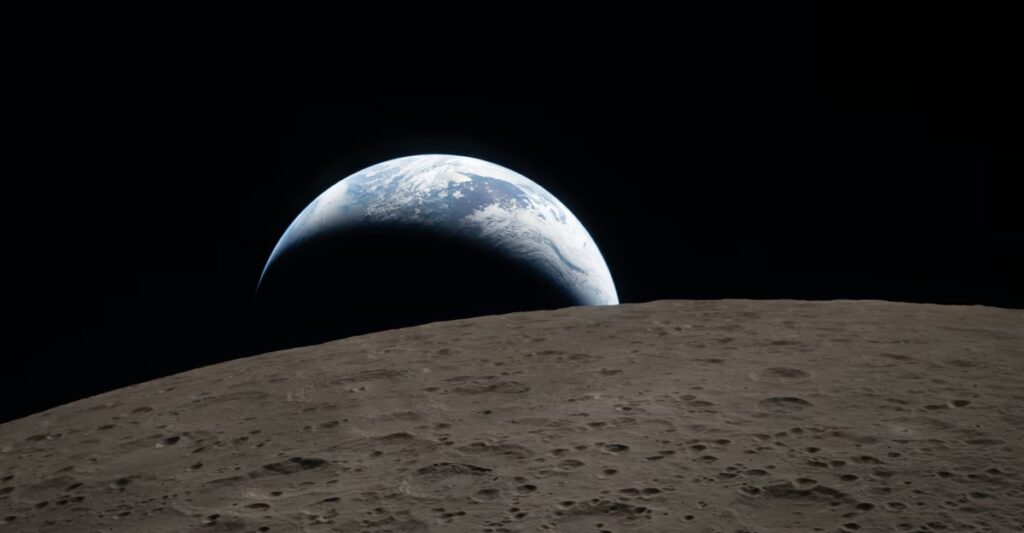
For those who have actually ventured into space, the effect of viewing our home planet from a distance has been studied and understood as a unique phenomenon called the “overview effect,” a term coined in the 1980s by the author Frank White. The view consistently produces a kind of euphoria, a sense of connection to other humans and an awareness of the fragility of the planet. Over the past week, as humans have followed the progress of the Artemis II mission, which is currently on its way back to Earth from its slingshot orbit around the moon, we’ve had a chance to witness this euphoria wash across the faces of the mission’s four astronauts in real time. “Trust us, you look amazing, you look beautiful,” mission pilot Victor Glover gushed. “And from up here, you also look like one thing. Homo sapiens is all of us. No matter where you’re from or what you look like, we’re all one people.”
In normal times, whatever those are, the sentiment shouldn’t feel so surprising, but given the other big news story of the moment, it could produce as much a whiplash effect as an overview effect. Turn the channel from the Artemis mission, and there is a screenshot of Donald Trump’s Truth Social message, threatening this morning that if Iran does not open up the Strait of Hormuz by his 8 p.m. eastern deadline, “a whole civilization will die tonight, never to be brought back again.” Trump seems to provoke cognitive dissonance every hour on the hour, but a professional-wrestling-style promo for what sounds a lot like genocide ranks high. What will happen? “We will find out tonight,” he wrote, “one of the most important moments in the long and complex history of the World.”
[Read: Moon joy: Photos from Artemis II]
This is an odd convergence of news events, to put it mildly: One of them pulls us out of our smallness and has us gravitating far above what look like the petty squabbles of humankind; the other slams us down into the Earth with the force of a ballistic missile, kicking up the dirt of civilizational battle, projecting the idea of survival of the strongest, domination through violence. And it all got me thinking: What would happen if we sent Trump into space?
I’m sure this could be easily arranged. Trump’s frenemy Elon Musk could surely organize such a trip. We already know Jeff Bezos would be able to customize a flattering spacesuit for the president. But the bigger question is whether this would actually change the way Trump thinks. What would the overview effect do for him?
Space exploration does not always point the way to transcendence and harmony. It can privilege the unexplored over the known, the future over the present. It can take that faraway perspective as an excuse to ignore the problems of our world. On the day the Apollo 11 mission took off in 1969, the civil-rights leader Ralph Abernathy led a protest at NASA, making this precise point: $12 a day to feed an astronaut. We could feed a starving child for $8. The billions spent to go to space seemed obscene given the poverty on Earth. My favorite articulation of this point was Gil Scott-Heron’s 1970 song “Whitey on the Moon.” To the thrum of bongos, Scott-Heron threw acid on the triumphalism of the space race. “A rat done bit my sister Nell / With whitey on the moon. Her face and arms began to swell / And whitey’s on the moon. I can’t pay no doctor bills / But whitey’s on the moon. Ten years from now I’ll be payin’ still / While whitey’s on the moon.” On his album, before he begins his incantation, Scott-Heron thanked the “whiteys on the moon” for inspiring him by displaying this extreme contrast. “I wanna give credit where credit is due,” he says.
I’m afraid that the billionaires now playing such an important part in America’s space program are more concerned about the moon than the people who can’t pay their doctor bills. And if Trump’s realization as he floated in zero gravity were that those everyday problems down there were not worth caring about, then the mission would be pointless. How does the rubble of Gaza or Tehran look from outer space? Well, you can’t see it, so maybe it’s okay to wipe it from your conscience. But if the view can diminish the damage we cause one another, it can also make the grandiose reasons we present for inflicting that damage suddenly seem absurd—specks of dust throwing dust at one another.
If I could suspend not just gravity but also disbelief and imagine what Trump could feel from up there—and assume that his extremely well-padded ego could still register a shock—I would hope, first, that he might experience a healthy dose of insignificance, just as I did back when I watched Powers of Ten. But even better, maybe he would realize that he shouldn’t be so flip about his fellow humans, that the ruination he seeks to cause is, from this superterrestrial height, everyone’s ruination—even his. From that distance, the civilization he blithely suggests he might obliterate is indistinguishable from the one that he thinks matters more. The destruction he’s describing when he posts about Iran and Iranians is actually self-destruction. I’m dreaming, I know, when I imagine that the president might then open his mouth wide in awe at the sublimity of the sight and say, as Glover did, “Homo sapiens is all of us.”
The post What the Astronauts See That Trump Cannot appeared first on The Atlantic.