Aerial drone attacks forcing a major Russian oil terminal to halt operations. Sea drones damaging tankers linked to Moscow. Strikes igniting refineries across western Russia.
As Moscow benefits from soaring oil prices and an easing of U.S. sanctions as a result of the war in Iran, Ukraine is trying to offset the windfall by escalating strikes on Russian oil assets. Experts describe a campaign unprecedented in scale, with Ukraine claiming responsibility for 10 attacks last month, though the true number is probably higher.
The most significant strikes have hit Russia’s Baltic ports of Ust-Luga and Primorsk, which handle roughly 40 percent of the country’s seaborne crude exports. Local authorities reported damage at both ports, and the number of tankers loading oil there has plummeted, according to an analysis of trading activity by Bloomberg.
Kyiv’s calculation is simple: every barrel of Russian oil that cannot be exported is money Moscow cannot spend on war. In a statement, Ukraine’s Defense Ministry described “coordinated precision strikes” aimed at depriving the Kremlin of “billions of dollars that are directly converted into missiles and ammunition.”
The reality is more complicated, energy analysts say, because Russia taxes oil extraction, not oil sales. That means striking ports and tankers hurts companies selling and shipping the oil, but could leave the government’s revenue nearly intact.
Cutting Russia’s oil exports also risks driving global prices higher by straining an oil market already squeezed by Iran’s blockade of the Strait of Hormuz. Russia’s tax rate on oil extraction is tied to market prices, so higher prices equal higher government revenue.
“It’s clearly a trade-off,” Damien Ernst, an energy expert and professor at the University of Liège in Belgium, said in an interview. “Strikes on Russian ports reduce exported volumes. But less volume leads to an increase in prices.”
Ukrainian officials argue that Russian Baltic Sea exports are a small fraction of global supply, so they have little effect on prices. Ukraine’s drone forces have said their goal is to cause enough damage to export infrastructure to force Russia to pump less oil, reducing state revenue.
“If they can sustain this string of attacks, it could be a game changer,” said Sergey Vakulenko, a senior fellow at the Carnegie Russia Eurasia Center in Berlin. “But that remains to be seen.”
In the short run, Russia can keep pumping and store the excess until its export systems recover, but it has limited storage capacity, said Mr. Vakulenko, a former top manager at Gazprom Neft, one of Russia’s largest oil producers. With significant, long-lasting export disruptions, he said, “at some point Russia would have to curtail its production.”
Ukraine’s latest strikes build on a strategy of hitting Russian oil assets that began at the start of 2024. Early attacks aimed to disrupt fuel supplies to Russian forces and to bring the war closer to home for ordinary Russians by causing gasoline shortages.
As the campaign expanded along with Ukraine’s growing fleet of long-range drones, the impact began to mount. By last September, the strikes had destroyed or damaged roughly 20 percent of Russia’s refining equipment.
At the same time, a series of setbacks battered Russia’s oil industry. Global prices fell, Washington imposed sanctions on the country’s two largest oil producers and pressed India to stop buying Russian crude, and Europe tightened its crackdown on the shadow fleet of tankers Russia uses to evade sanctions. As a result, Russia’s oil and gas revenues fell by nearly a quarter last year, opening a significant hole in the government’s budget.
In Kyiv, optimism grew that Russia’s economy might finally break down after years of surprising resilience. “There are lots positive results against the Russian economy,” Vladyslav Vlasiuk, President Volodymyr Zelensky’s top sanctions adviser, told Western diplomats in January during a presentation outlining Russia’s economic downturn.
Less than two months later, as the United States and Israel went to war against Iran, the picture suddenly brightened for Moscow — and worsened for Kyiv.
To ease the energy shock caused by the effective blockade of the Strait of Hormuz, the United States temporarily lifted sanctions on Russian oil already at sea by mid-March, allowing it to be shipped worldwide. Mr. Zelensky condemned the move, warning that it would help finance the Russian war effort. The Trump administration countered that it would not directly benefit the Russian budget because the oil at sea had already been taxed.
The United States has kept sanctions in place on Russian oil that had not left port by mid-March. European Union countries have also maintained their sanctions.
Still, disruptions to Persian Gulf oil supplies have boosted demand for Russian oil among countries that do not apply the Western sanction regime, including China and India. Combined with rising global oil prices, this means more money for the Russian government.
Mr. Vakulenko, of the Carnegie Center, estimated that if production levels hold steady, the Russian government could collect at least $12.8 billion in oil taxes in April — double March’s revenue.
As the Iran war drags on and the energy shock deepens, Washington may prolong its sanction relief, currently set to expire in mid-April, and broaden it to allow more Russian oil exports, said Janis Kluge, a Russia expert at the German Institute for International and Security Affairs.
At the same time, Ukraine is trying to clog every Russian export route.
The Ukrainian Army claimed major strikes on the Ust-Luga and Primorsk oil terminals on the Baltic Sea on four days in late March. Mr. Kluge said rerouting exports from the Baltic would be difficult because many alternative routes are either offline, like a big pipeline supplying Eastern Europe, or under threat from Ukrainian attacks, like ports on the Black Sea.
Attacks on oil tankers linked to Russia’s shadow fleet have recently been reported in the Black Sea. Ukraine has not claimed responsibility, but analysts believe Kyiv is behind the assaults, noting that its forces have increasingly used this type of attack.
“These strikes are disrupting Russia’s export system in a measurable way,” said Mr. Vlasiuk, the Ukrainian sanctions official. “We are seeing reduced tanker loadings, irregular port operations, and even ‘empty days’ at key ports of Primorsk and Ust-Luga — something highly unusual for these hubs. This is about degrading reliability and increasing costs.”
Mr. Vlasiuk said strikes in the last week of March had cost Russia more than $500 million in damage to oil storage facilities and reduced export revenues for Russian companies by $745 million. The figures could not be independently verified.
Another question is whether Ukraine’s Western allies will tolerate the strikes given the added pressure they place on global oil markets. Mr. Zelensky said that he had “received signals from some partners about reducing our responses against Russia’s oil and energy sector.” He said Kyiv would only do so if Moscow also stopped attacks on Ukraine’s energy infrastructure.
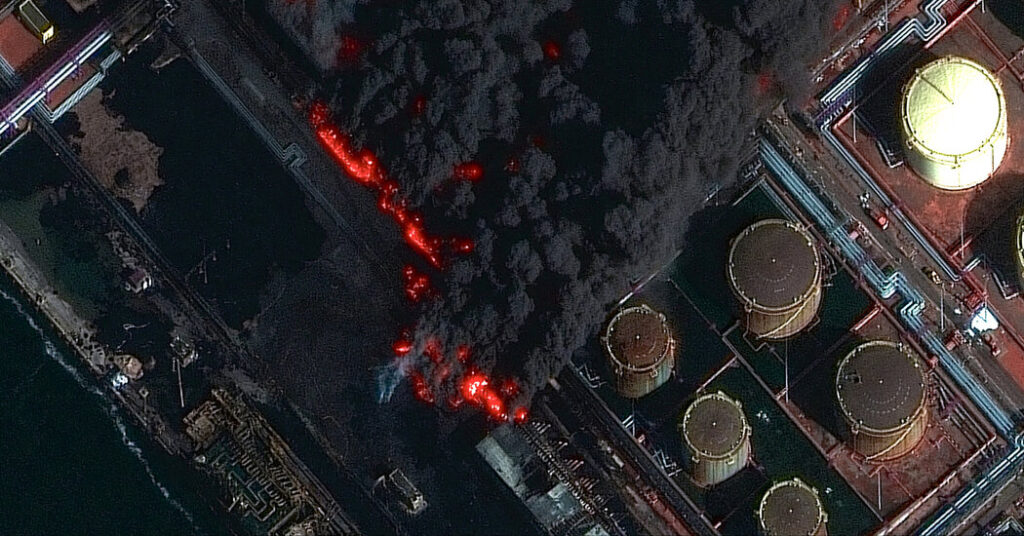
The destruction has continued unabated. On Friday, Ukraine said emergency power outages had been introduced following a “massive missile and drone attack” that hit the country’s energy grid. Three days later, a Russian Black Sea oil terminal was on fire following a Ukrainian night drone attack.
Ivan Nechepurenko, Dzvinka Pinchuk and Olha Konovalova contributed reporting.
Constant Méheut reports on the war in Ukraine, including battlefield developments, attacks on civilian centers and how the war is affecting its people.
The post Ukraine Ramps Up Attacks on Russian Oil, Aiming to Curb Iran War Windfall appeared first on New York Times.