WASHINGTON — In the days before the United States and Israel launched military strikes against Iran on February 28, 2026, a South Carolina woman’s account of being sexually abused by President Donald Trump when she was 13 years old was closing in on the front pages of America’s newspapers.
The FBI had interviewed her four times. The Post and Courier, a Charleston newspaper that had been digging into the Epstein files for months, had corroborated key details of her account. Congress was demanding documents the Justice Department had withheld.
And Pam Bondi, the recently fired attorney general who oversaw the release of those files, was under mounting pressure to explain why dozens of pages related to the woman’s accusations had quietly gone missing from the public record.
Then the bombs dropped on Tehran. Within days, Google searches for the Epstein files had plummeted.
“Bombing a country on the other side of the globe won’t make the Epstein files go away,” Republican Congressman Thomas Massie (R-KY), who co-authored the Epstein Files Transparency Act, wrote on X the day after the strikes began.
He wasn’t alone.
The Accuser’s Story
The woman, a South Carolina native whose name has not been publicly released, first contacted the FBI in 2019, days after Epstein was arrested. She told investigators that as a teenager she had responded to an ad for a babysitting job, only to be trafficked by Epstein, who abused her on Hilton Head Island — as many as twenty times — before transporting her to New York or New Jersey to be introduced to wealthy men.
One of those men, she told the FBI, was Donald Trump.
“She was introduced to someone with money, money, money. It was Donald Trump,” one FBI summary read.
According to the bureau’s own internal slideshow, she told investigators that Trump “subsequently forced her head down to his exposed penis which she subsequently bit. In response, Trump punched her in the head and kicked her out.” She was between 13 and 15 years old at the time.
The FBI took her seriously enough to interview her four times between August and October 2019, including her account in a 21-page internal slideshow on the Epstein investigation. Her interviews appeared in evidence logs for the prosecution of Epstein associate Ghislaine Maxwell.
And then, according to investigators and journalists who reviewed the files, three of those four interview summaries went missing from the Justice Department’s public database.
What the Post and Courier Found
The Post and Courier spent months investigating the woman’s account. While the newspaper could not independently verify her accusations against Trump, it corroborated a striking number of peripheral details she gave the FBI. These details gave weight to her overall credibility.
The newspaper verified her family background, her legal history, and her account of a third alleged abuser, a Hilton Head businessman named Jimmy Atkins. His Ohio college affiliation, physical description, age, and connections to the area all matched during the period she described.
The paper also revealed that the FBI’s official typed summaries diverged from the bureau’s own handwritten interview notes. Where the summaries presented her as uncertain about how she traveled with Epstein, the handwritten notes showed no ambiguity.
She said Epstein both drove and flew her to meet Trump. There was no “or.”
The Cover-Up Allegations
An NPR analysis discovered that serial numbers in the released documents skipped dozens of pages precisely at the section covering the Trump accuser’s FBI interviews. The DOJ claimed the missing pages were “duplicative,” but refused to release them for independent verification.
“We have a survivor that made serious allegations against the president,” Rep. Robert Garcia, the ranking Democrat on the House Oversight Committee, told CNN.
Senator Jeff Merkley, who wrote the Epstein Files Transparency Act, accused the administration of failing to follow the law, deleting references to powerful figures the act required to be included, and re-victimizing survivors by releasing unredacted personal information.
“They have absolutely failed to follow the act and release the information,” Merkley told KGW News.
Bondi was fired by Trump on April 2, two days before more suppressed handwritten notes became public. She’s still expected to testify before Congress on April 14 about the DOJ’s handling of the files. Senator Sheldon Whitehouse of Rhode Island demanded the DOJ preserve all related documents.
Trump’s Account of His Friendship With Epstein
Trump has claimed he had a falling-out with Epstein years before his arrest. “I was not a fan of Jeffrey Epstein,” Trump has said, without specifying a cause or date.
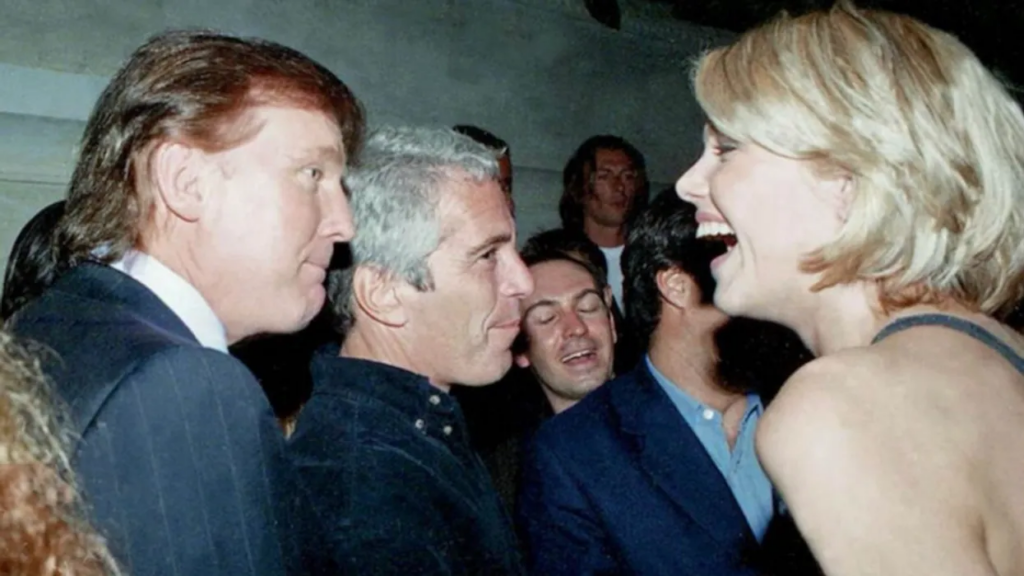
That account is complicated by the public record. The two men were photographed together repeatedly in the 1990s and early 2000s. In 2002, Trump told New York magazine: “I’ve known Jeff for fifteen years. Terrific guy. He’s a lot of fun to be with. It is even said that he likes beautiful women as much as I do, and many of them are on the younger side.”
A search of the Justice Department’s Epstein database returned more than 1,800 results for Trump’s name.
The White House has called the accuser’s allegations “completely baseless accusations, backed by zero credible evidence.” Press Secretary Karoline Leavitt called her a “sadly disturbed woman” and pointed to her criminal record.
The Distraction Theory
The circumstantial case that the Iran war served, at least in part, as a mechanism to suppress the Epstein story is made across the political spectrum.
House Democratic Leader Hakeem Jeffries was explicit the day after the strikes: “Just before this attack, there were reports that seemed to indicate that President Trump had some involvement with a 14-year-old girl. And what we do know is all of a sudden what is not in the news is the Epstein files. Is this a distraction of epic proportions?”
Shaiel Ben-Ephraim, a former Israeli diplomat and analyst with Atlas Global Strategies, told Al Jazeera the attacks had “very little strategic rationale.” “If you look at searches on Google for the Epstein files, they’ve plummeted since this started,” he said.
The Iran strikes launched on February 28 — just four days after NPR published its analysis revealing 53 pages of the accuser’s FBI interviews were missing from the public record, and as Congressional pressure for the full files was reaching a peak.
The Post and Courier’s corroboration of the accuser’s details followed weeks later, but the pattern was already established: each new revelation about the missing files was quickly buried by the next wave of war coverage.
“This war is also being pushed because Donald Trump is in the Epstein files,” Maine Democratic candidate Graham Platner told a crowd in Brewer. “They are terrified that we have noticed what they are doing.”
Whether Trump launched a war to bury a story about his past is unknowable. What is known: a teenage girl told the FBI what happened to her, the FBI took her seriously enough to interview her four times, the Justice Department withheld those interviews, and the war buried the story.
The accuser ended her cooperation with the FBI after receiving threatening phone calls. She received a settlement from Epstein’s estate through her attorney.
She has not spoken publicly.
The missing handwritten notes remain missing.
The post Trump launched Iran war as Epstein files accusations closed in appeared first on Raw Story.